Religious, Supernatural, Utilitarian, Political, and Erotic
The woman at the cemetery office handed me two maps. I had been carrying both in my pocket for six hours when I sat down exhausted on a staircase among the columns of names at the Fossar de la Pedrera and let the second map fall out of my pocket onto the stone steps. I had not opened it. I had assumed it was a generic visitor handout.
Before the second map fell out, I had spent two hours walking through Agrupacions 4 through 9 on the artistic route. I had begun, mid-walk, to sort the statuary into four categories in my head to manage the volume of what I was seeing. The cemetery contains more sculpture than most European art museums. Almost none of it is named in any guidebook.
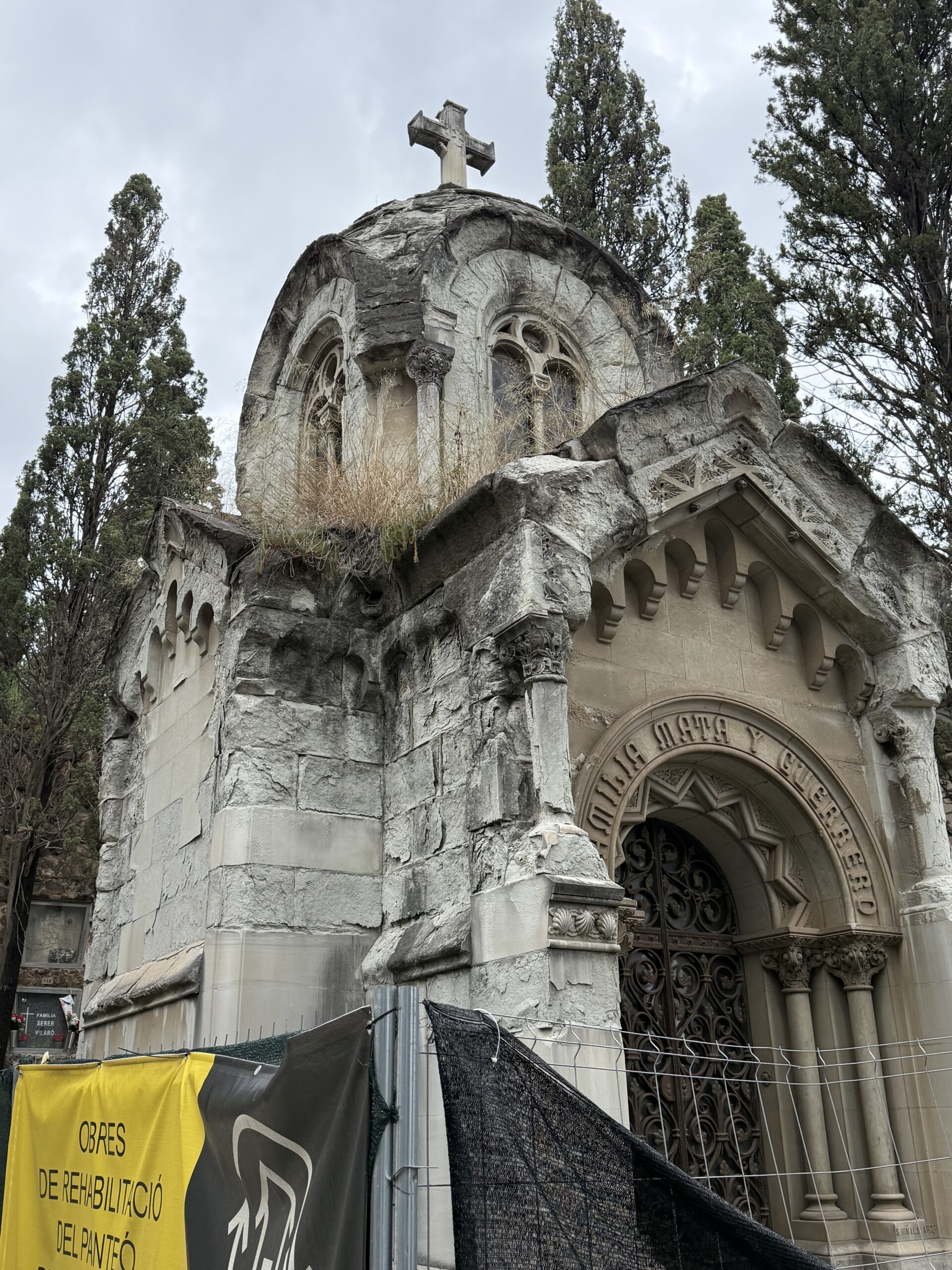
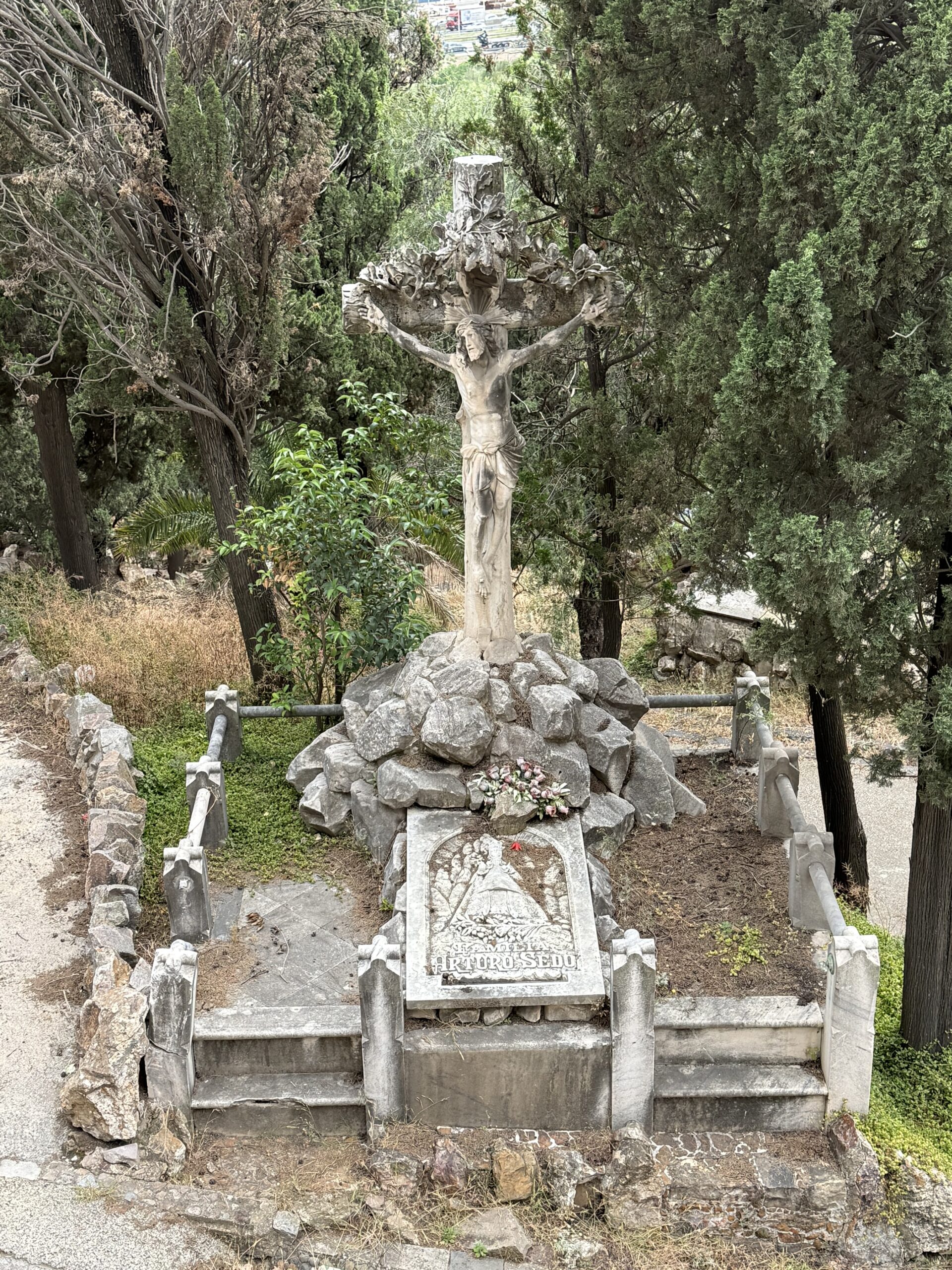
Religious. The crucifixions, the madonnas, the crosses. One crucifixion gripped me with its angst, a skeletal Christ. I photographed it. Most of the religious sculpture left me cold. I spent thirty years inside the iconography. Then I walked away from it. The symbolism has lost its grip on me, though I still respect artistic excellence.
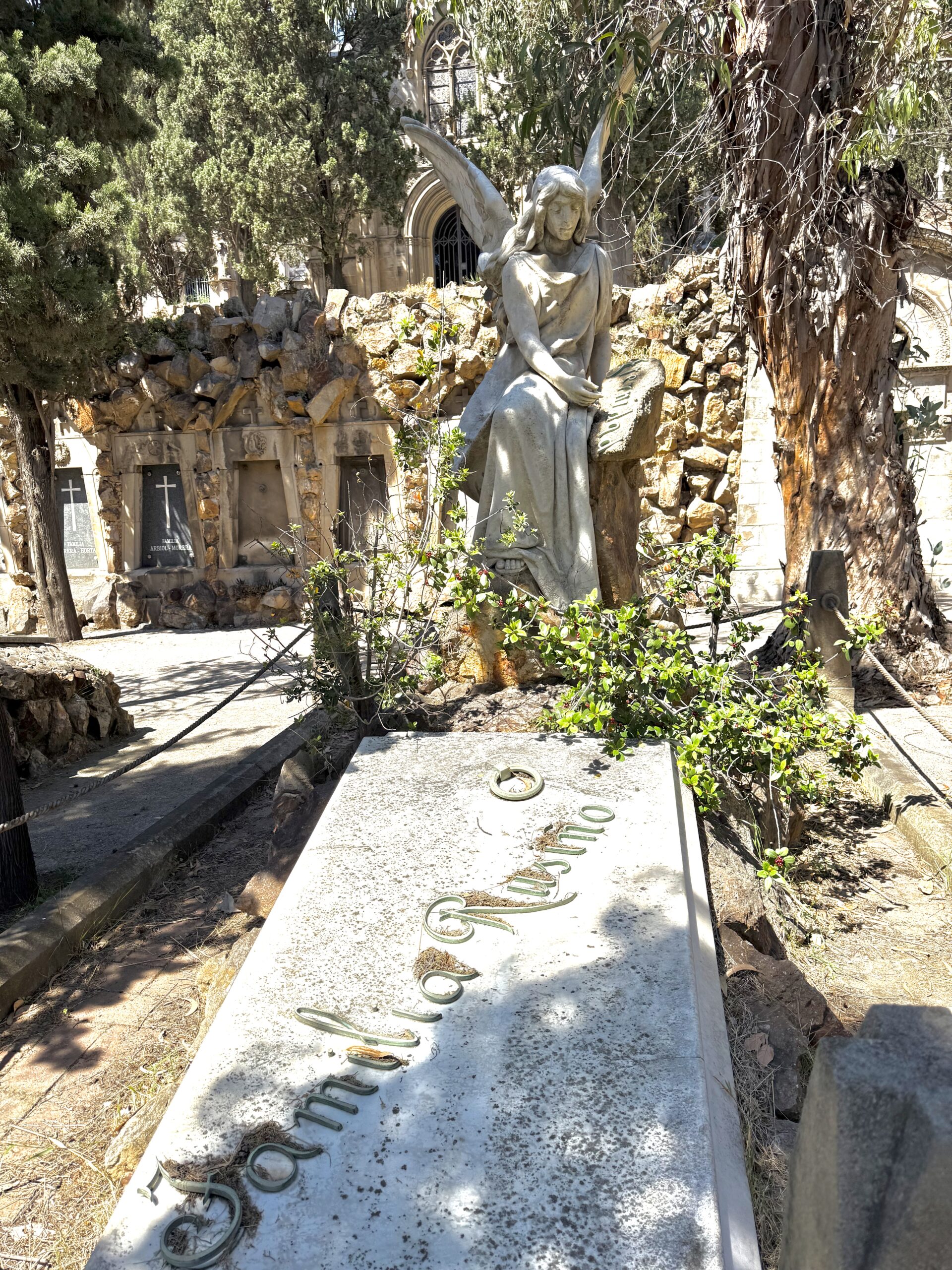
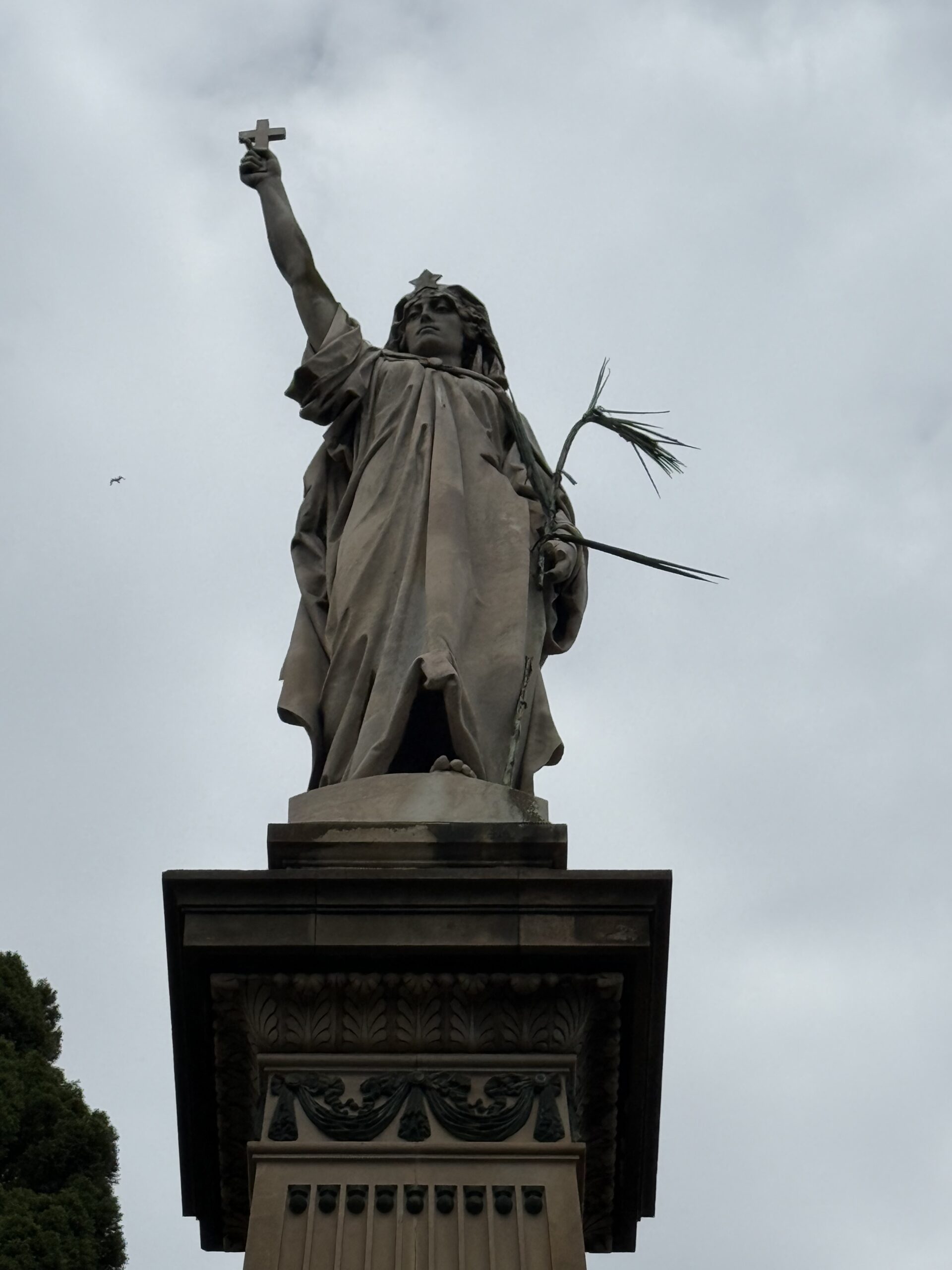
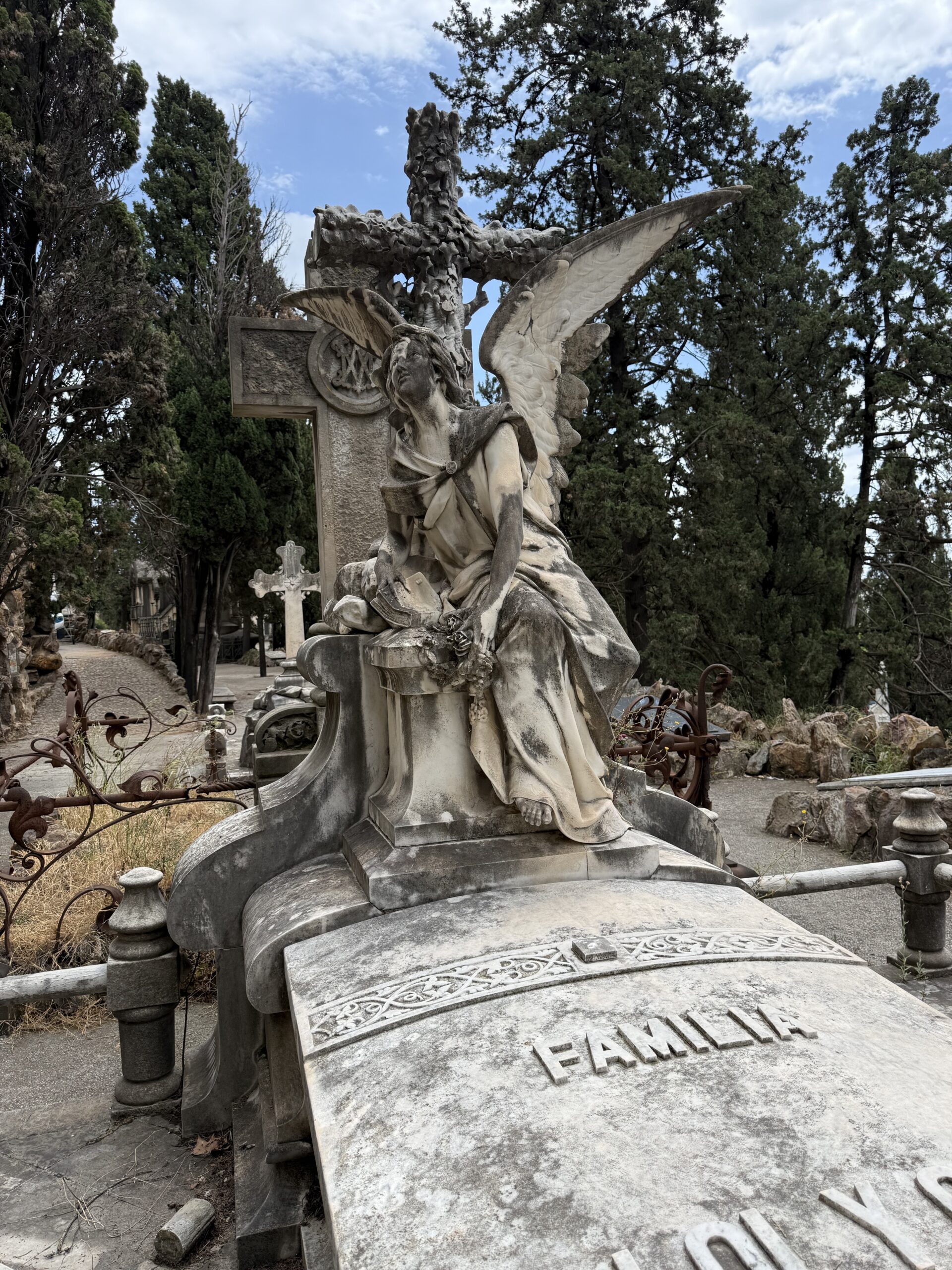
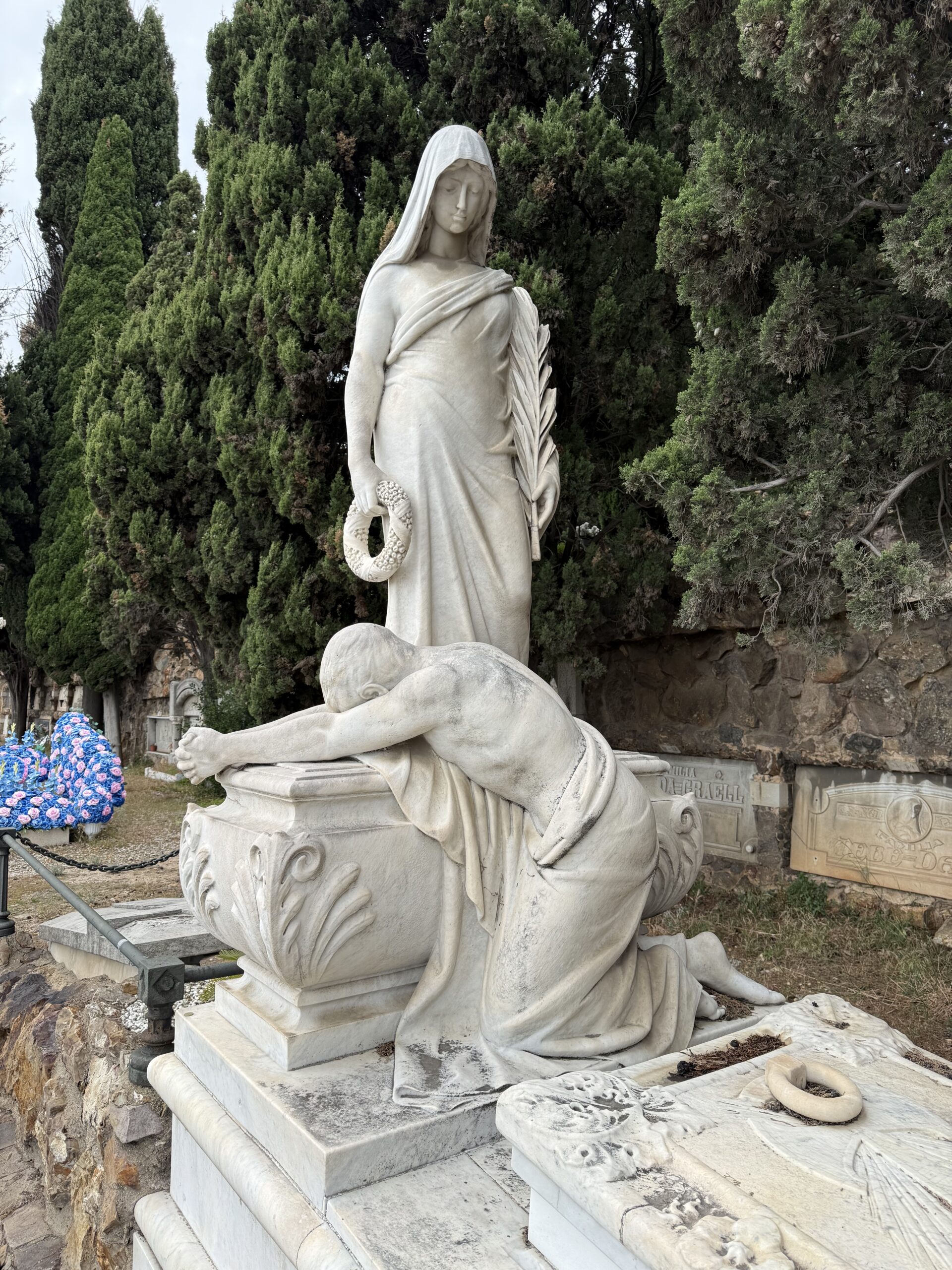
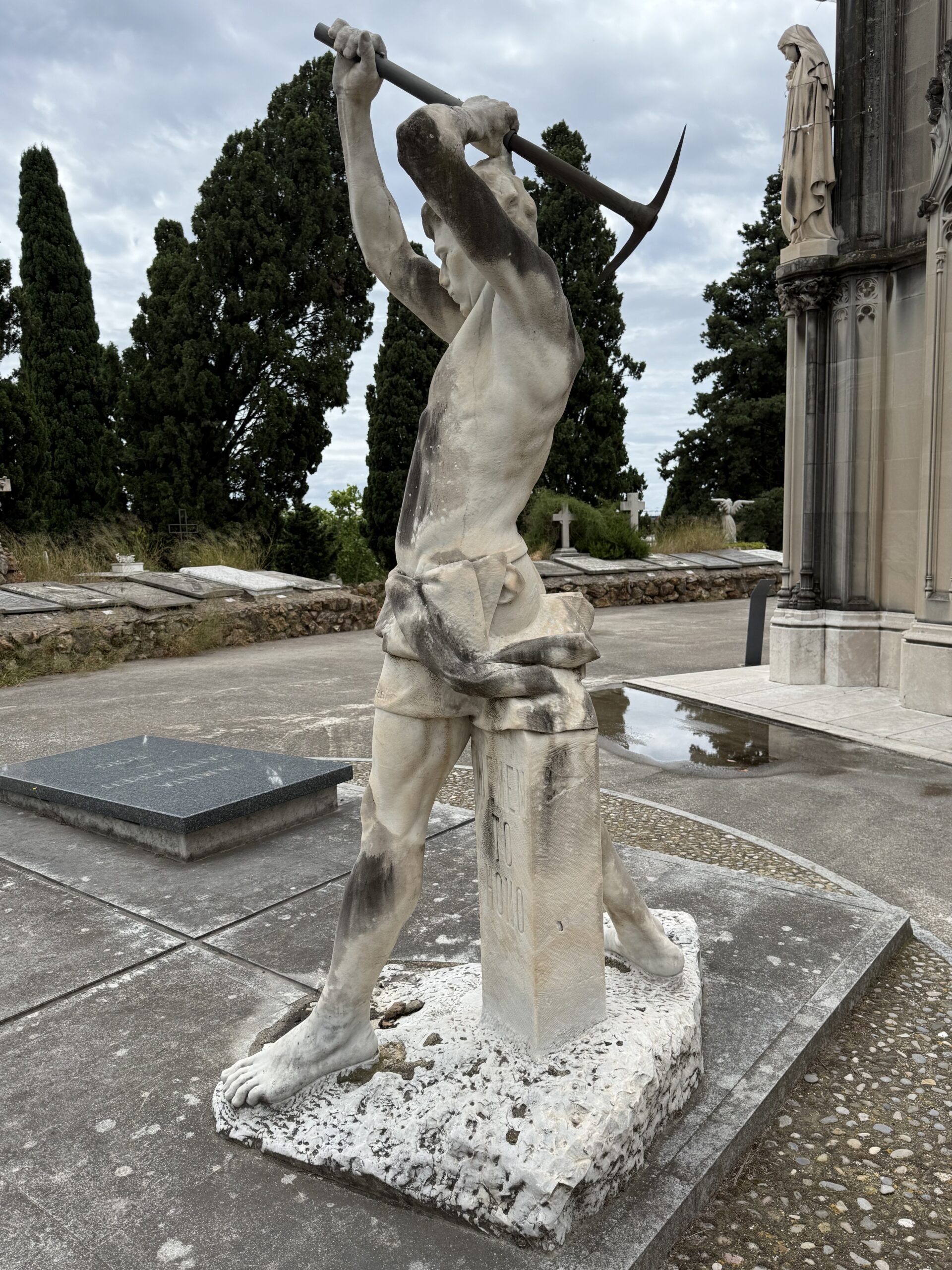
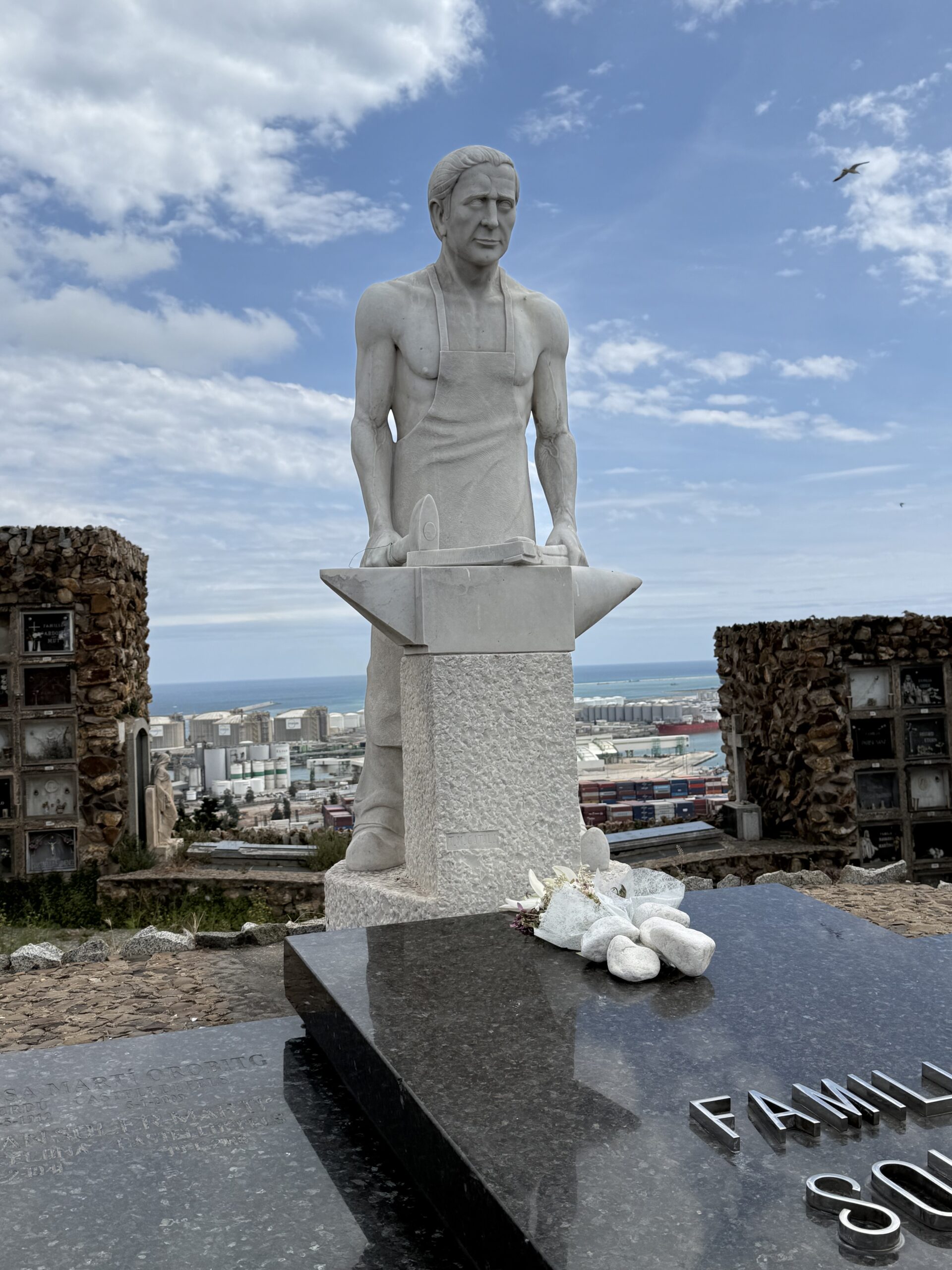
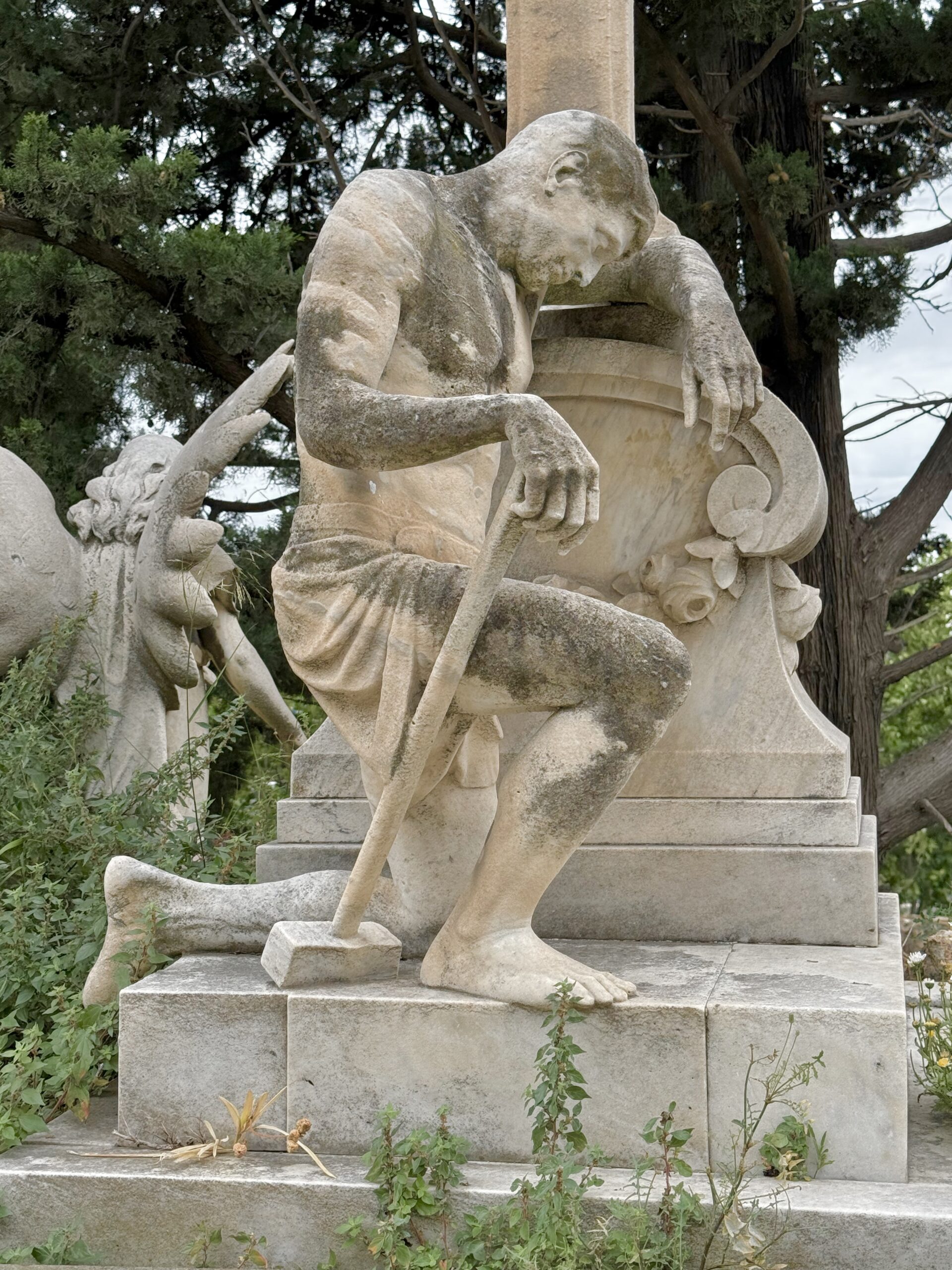
Utilitarian. I had not expected this category. Statues of workers: laborers, miners, sailors, women with babies, men with tools. I understood it as I walked. For many of these dead, their work was their life, and the family wanted the work memorialized along with the person. I don’t think American cemeteries do this. The Catalan bourgeoisie did. There is something honest about it. The deceased who wielded hammers are remembered striking the anvil.
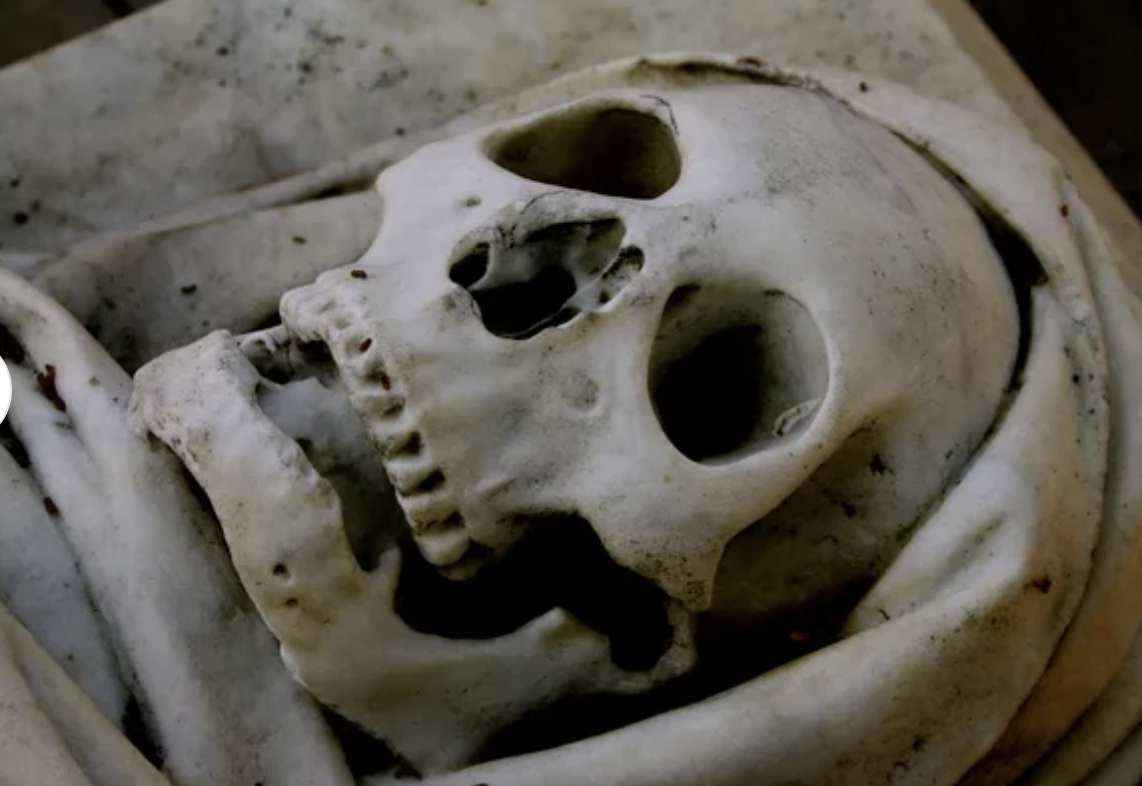
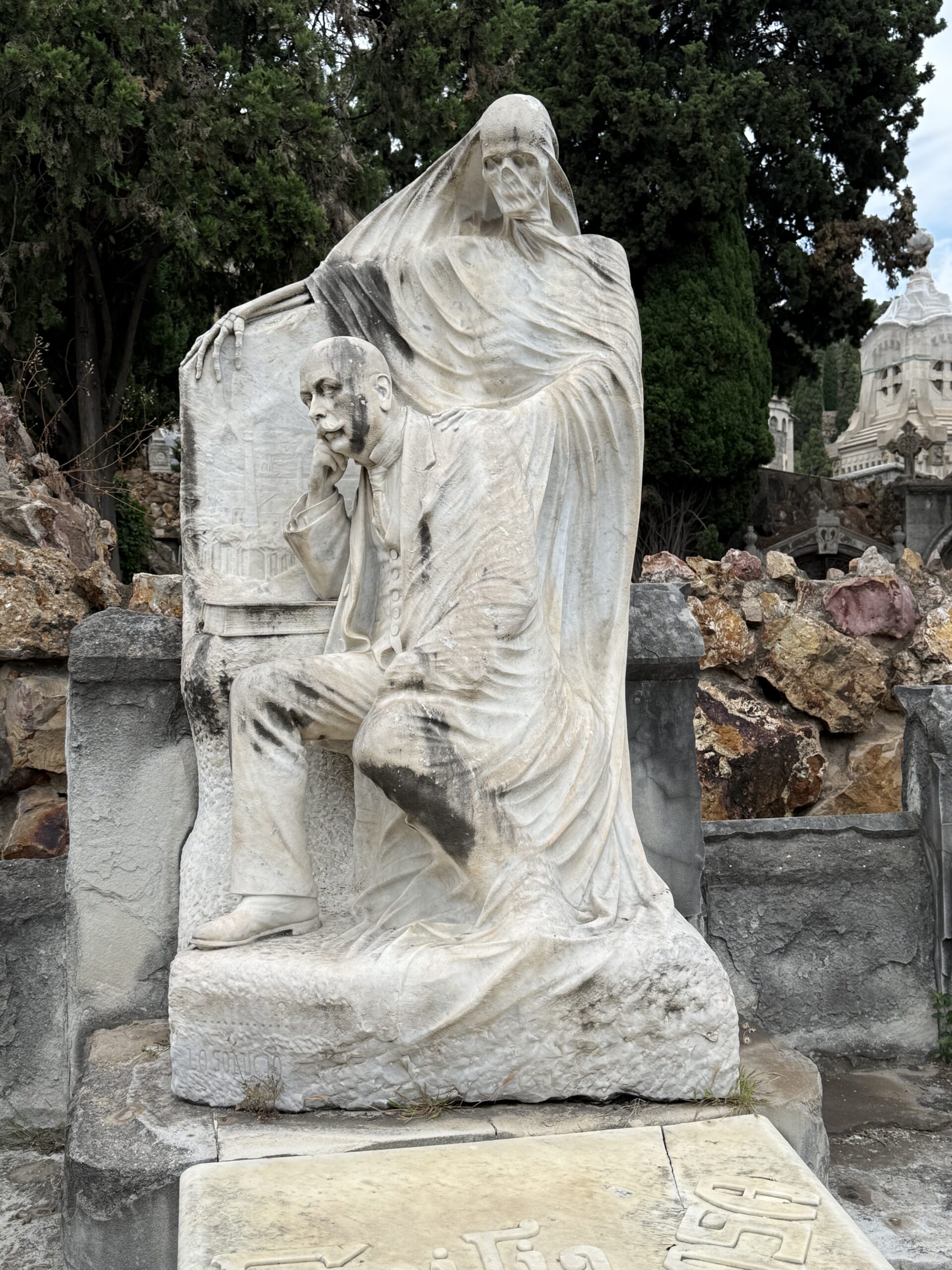
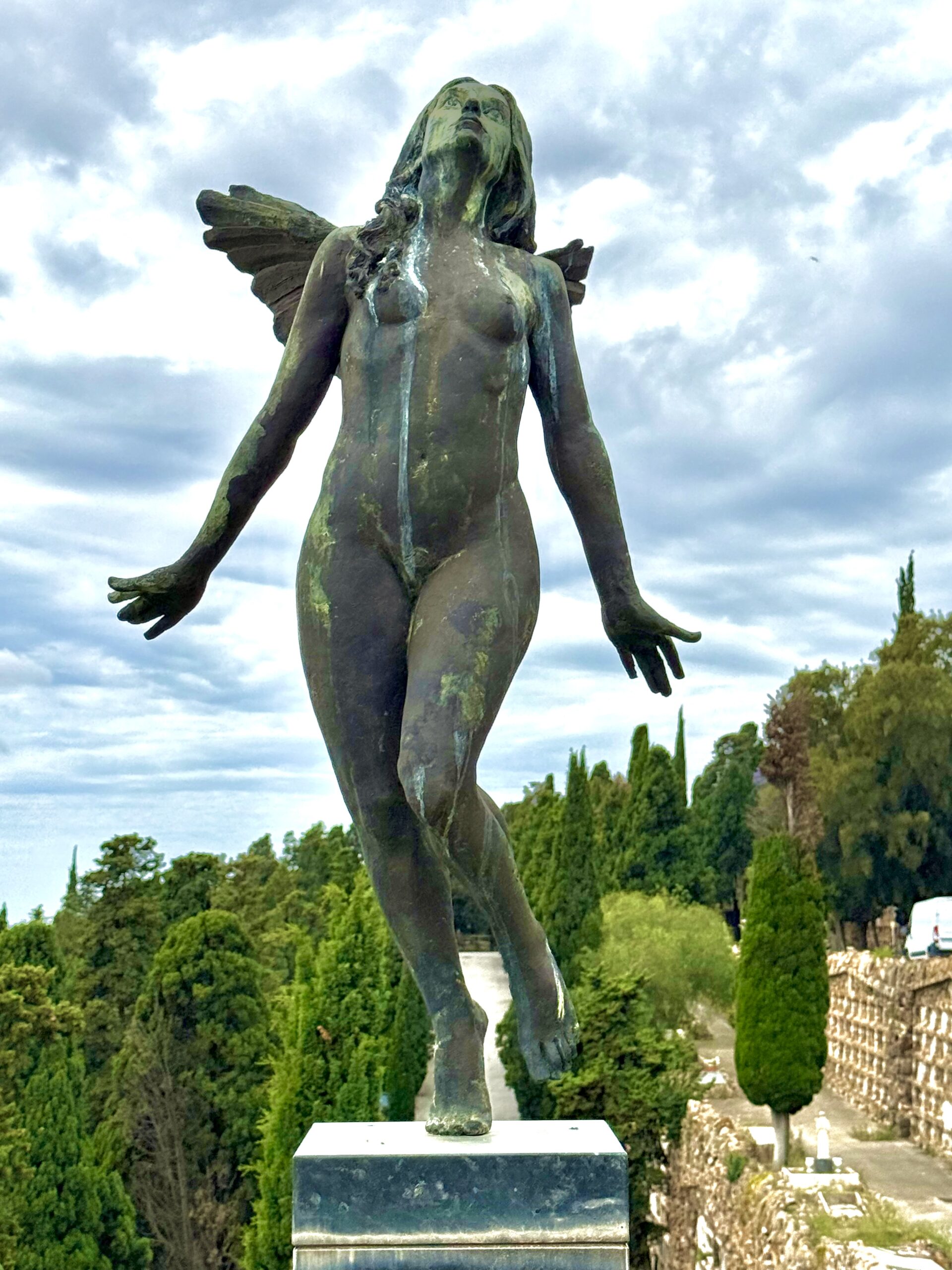
Supernatural. Skeletons, death angels, ghosts, the marble figures of the grim reaper holding hourglasses. Less common than the religious category but present and often the most psychologically alive of the four. Dr. Farreras’s skeleton on Agrupació 1 belongs here, the marble bones wrapped in a marble shroud.
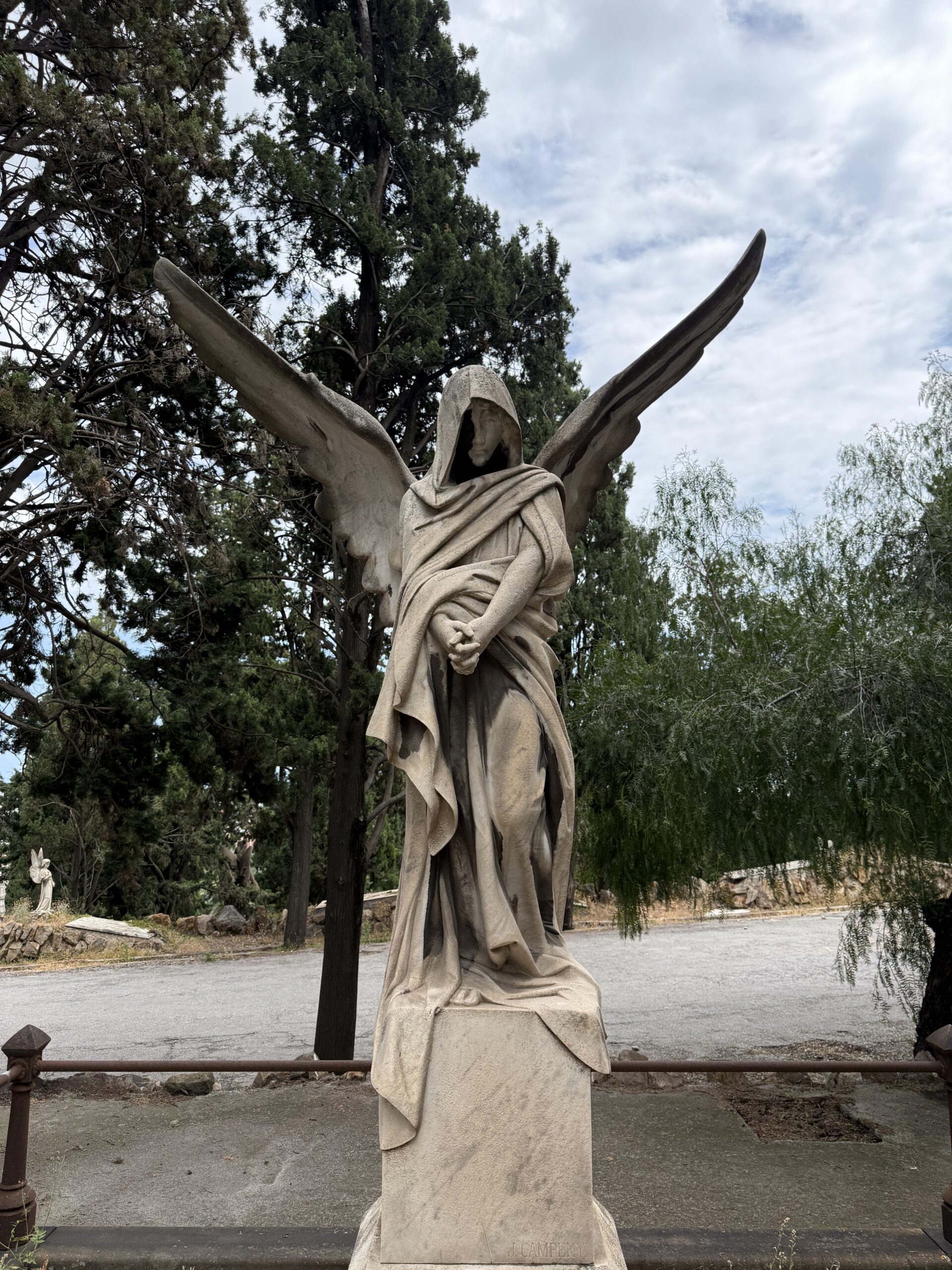
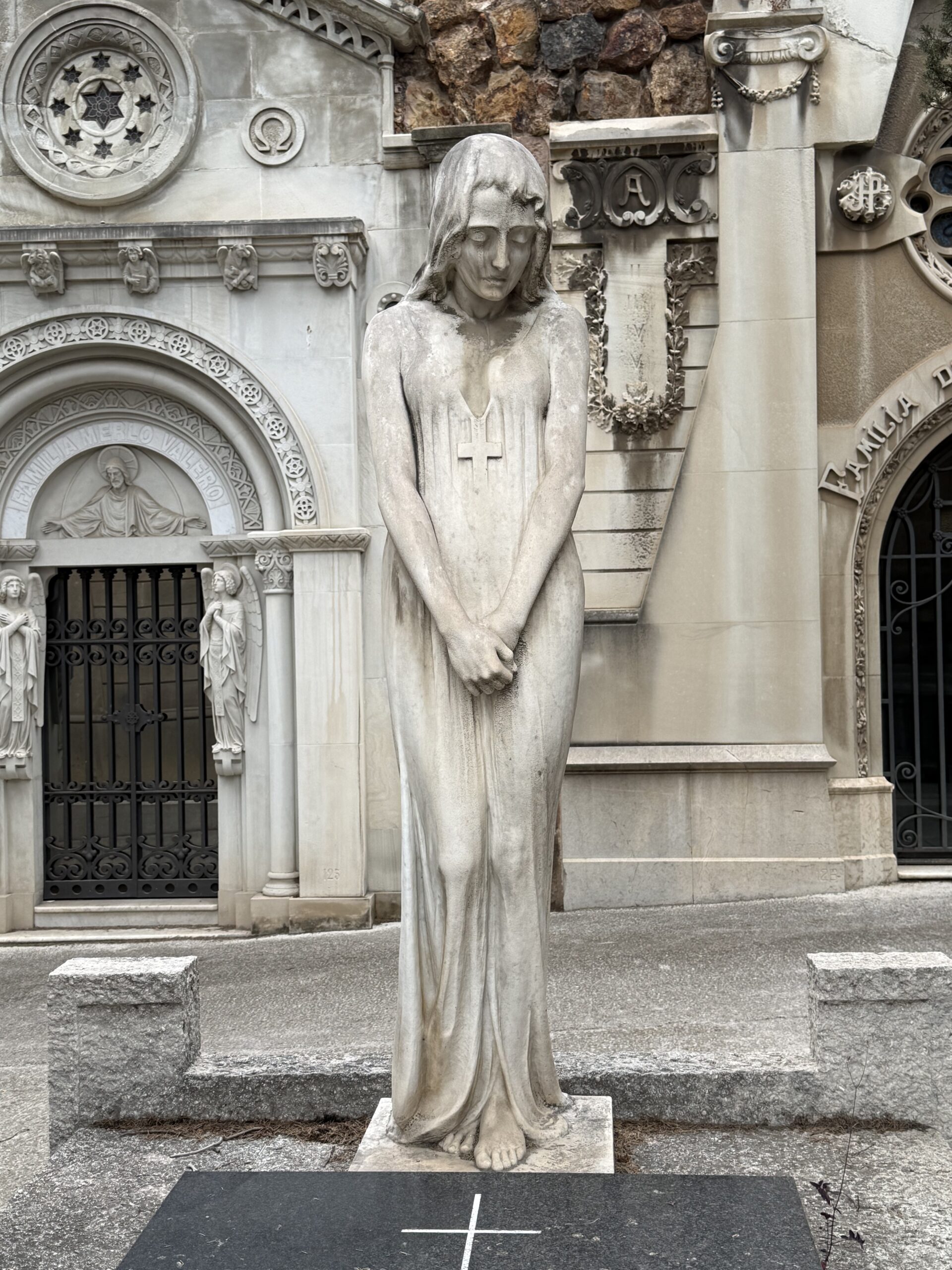
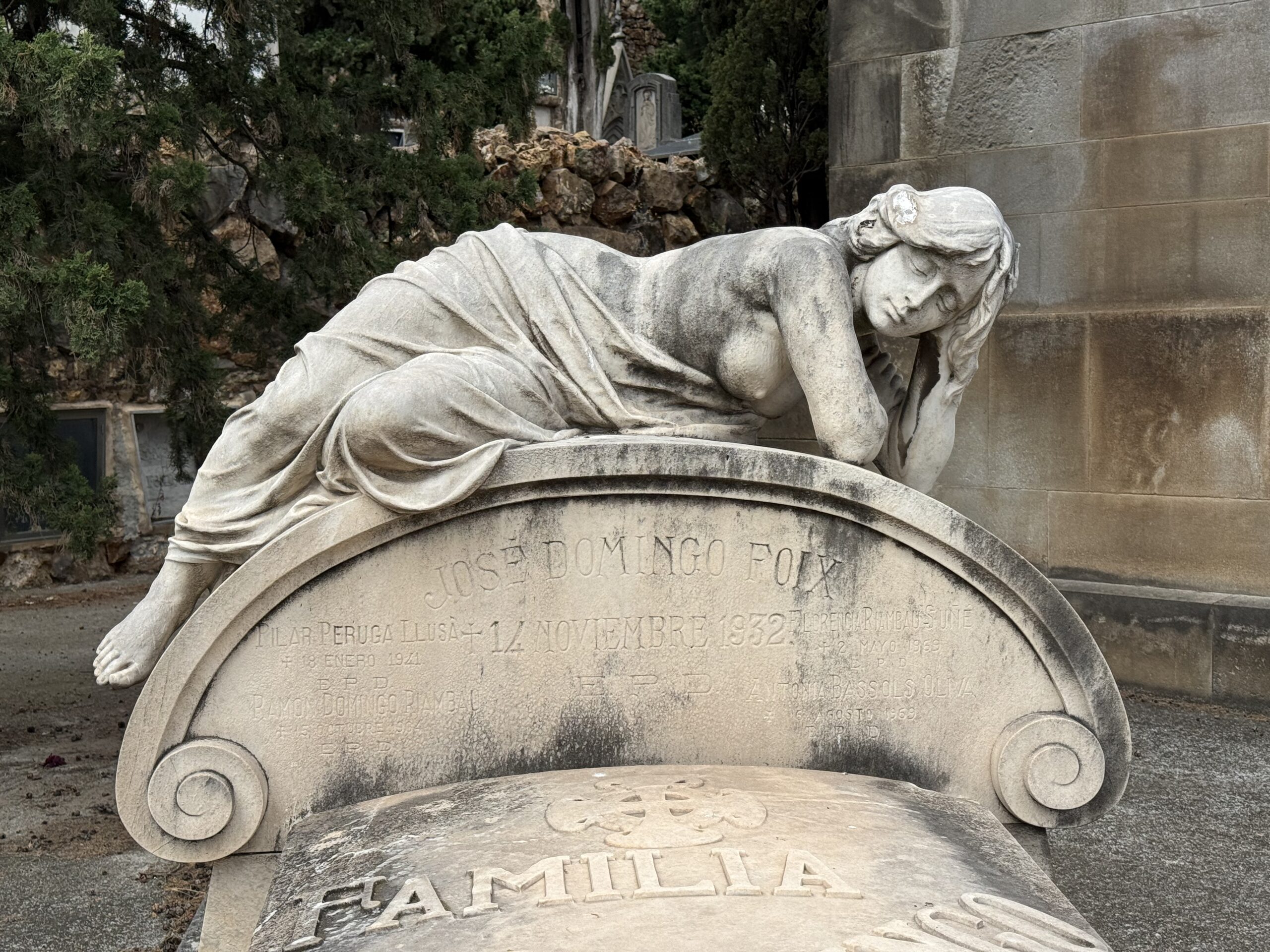
Erotic. My favorite, of course. The widow draped across her sarcophagus in a way that symbolizes more than grief. The nude laborer mid-strike. The shrouds that cling to nubile bodies. The mourning women whose marble breasts are deliberately uncovered (wives? lovers? daughters?) chosen by the deceased to grieve him for eternity in postures that do not pretend to be chaste. The Catalan modernistas who carved these figures knew what they were doing. The patrons who paid them knew too.
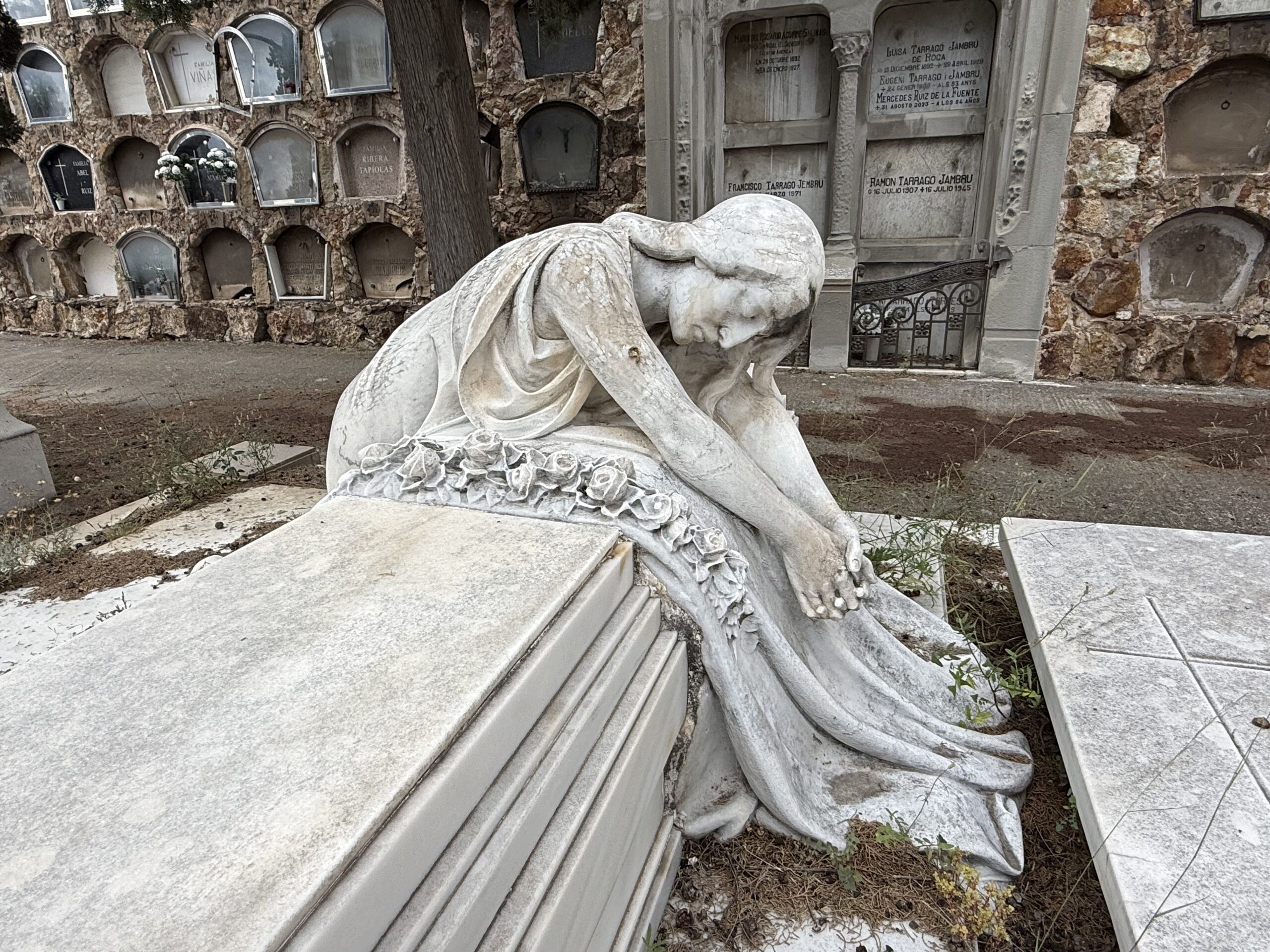
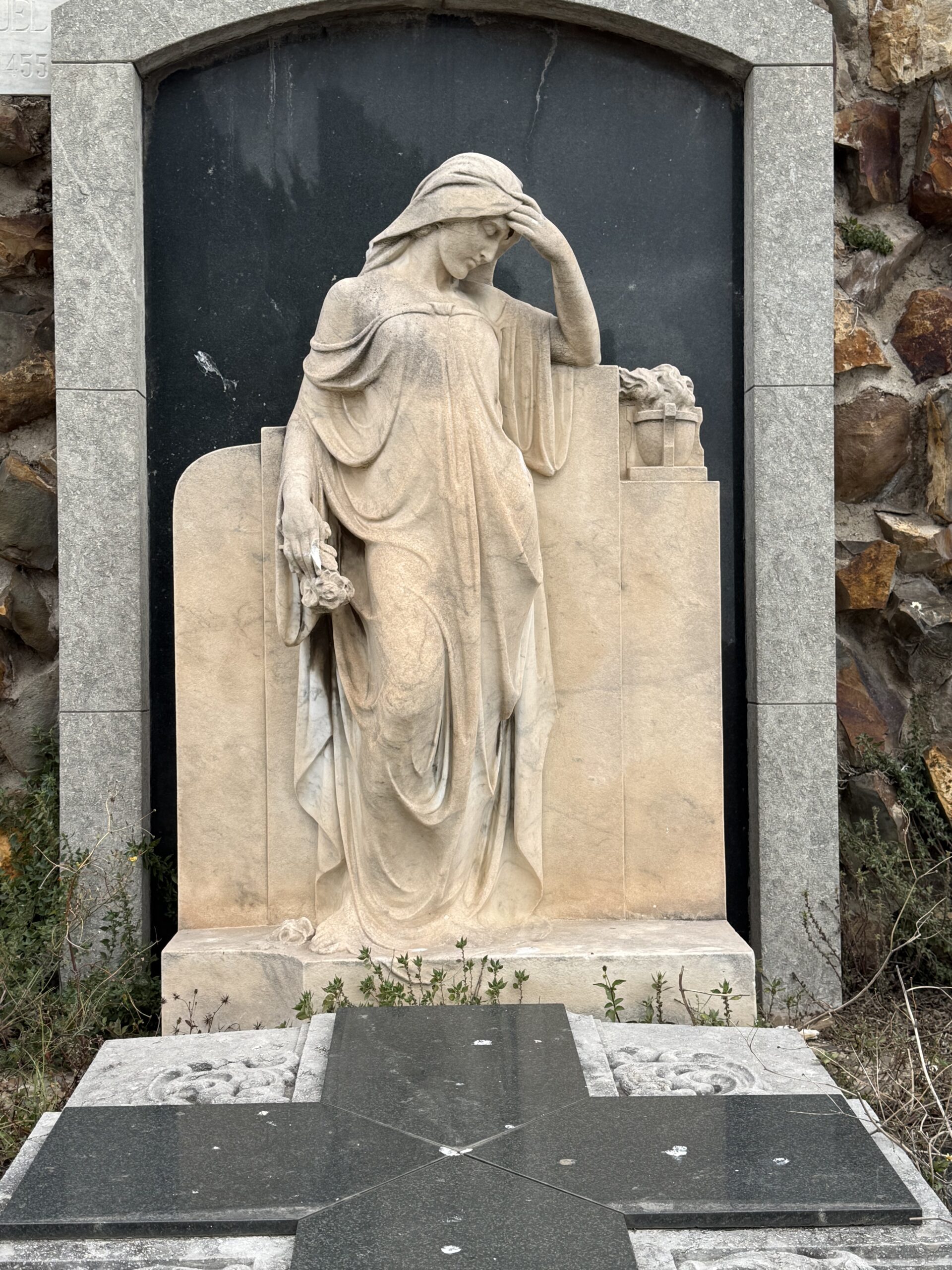
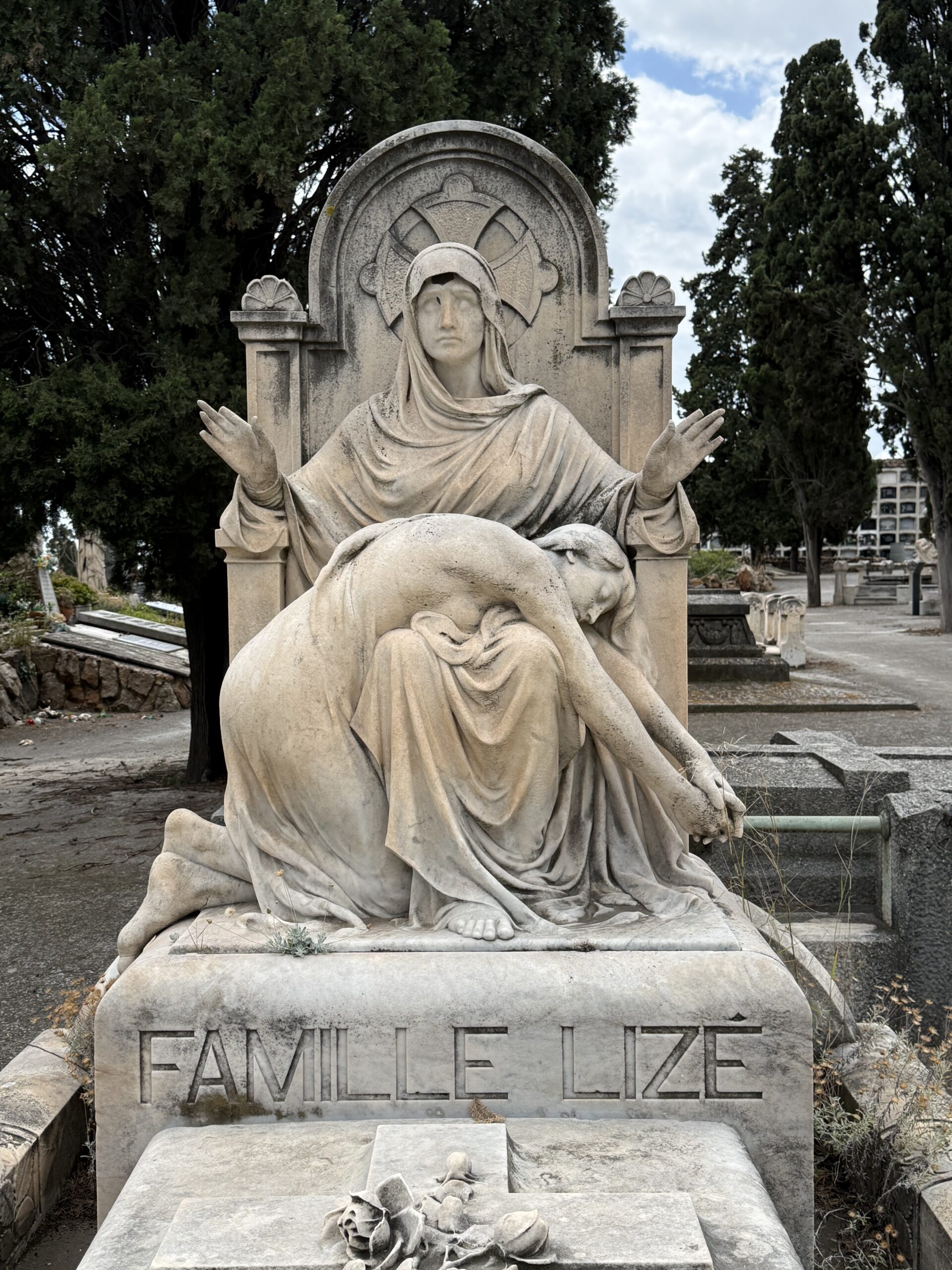
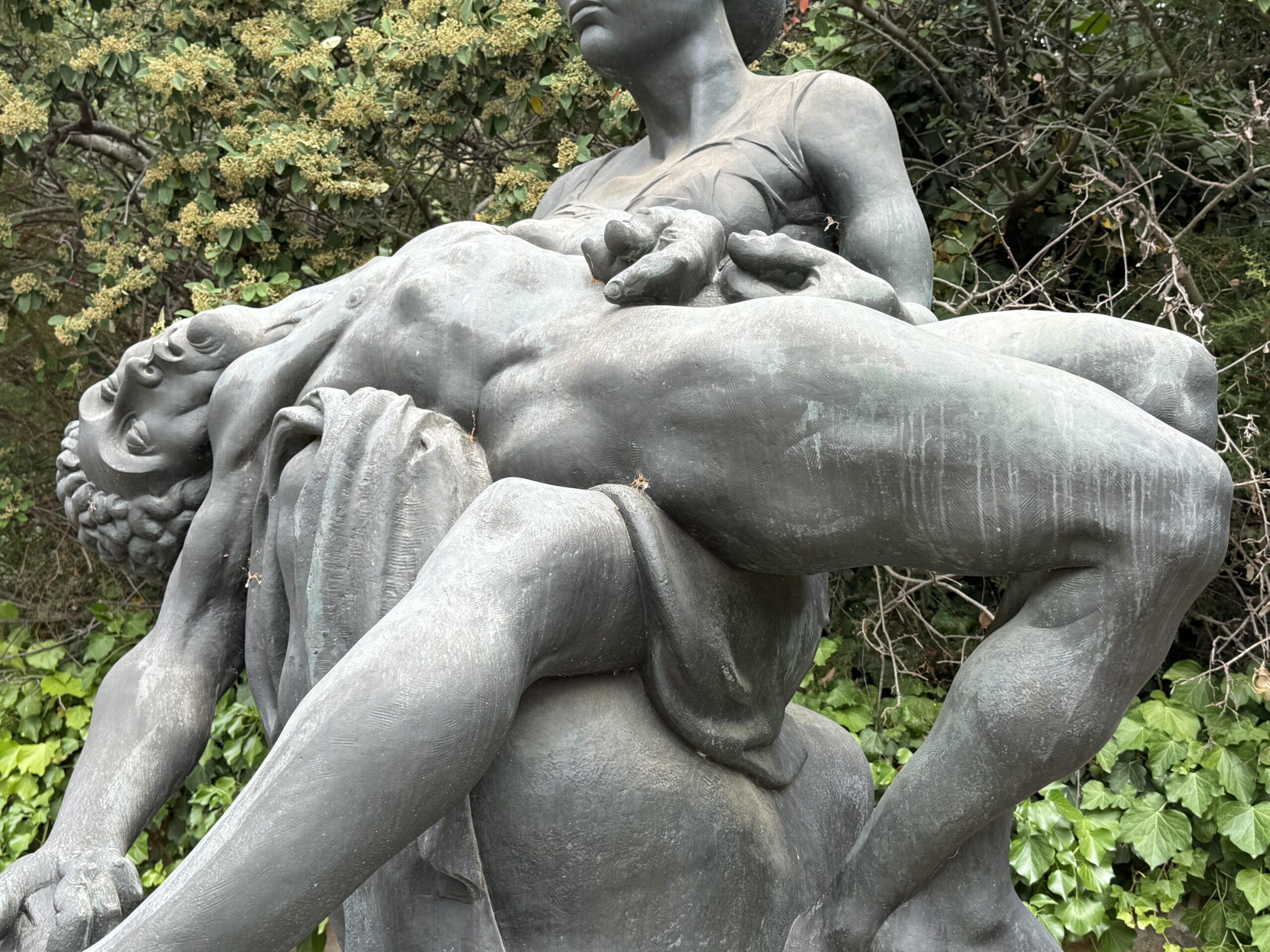
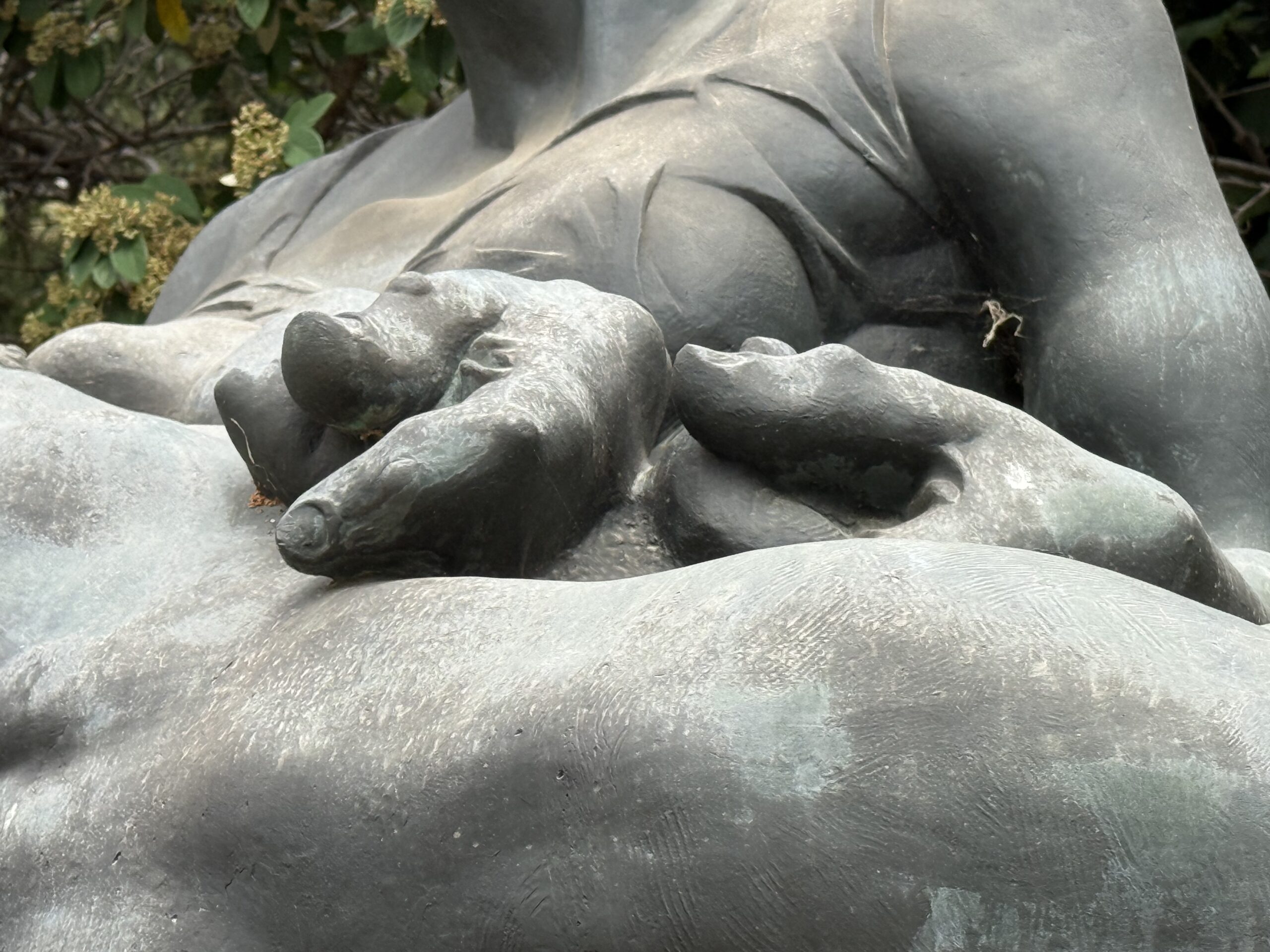
The most erotic sculpture in the entire cemetery is also the most political. I had not expected that.
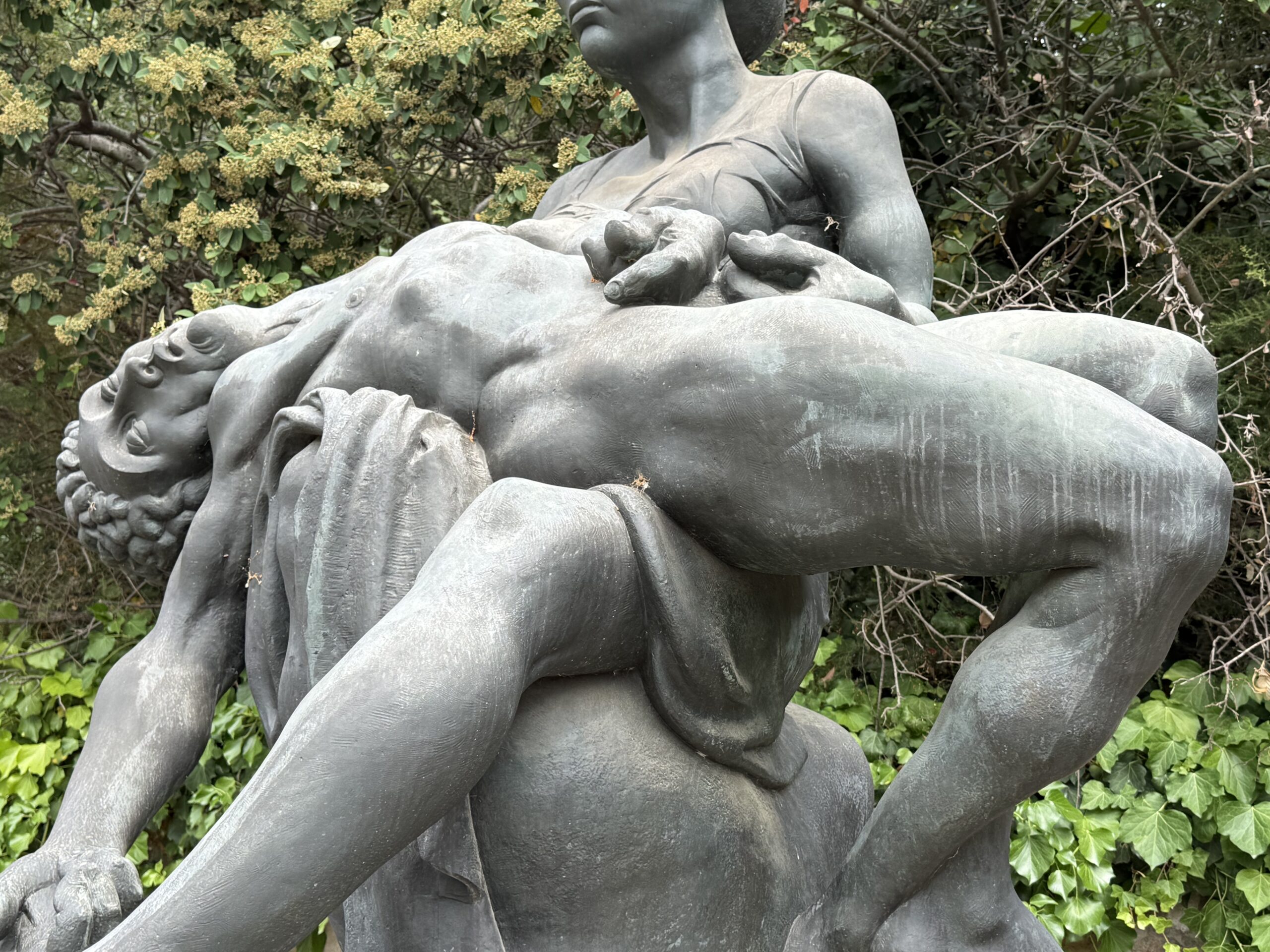
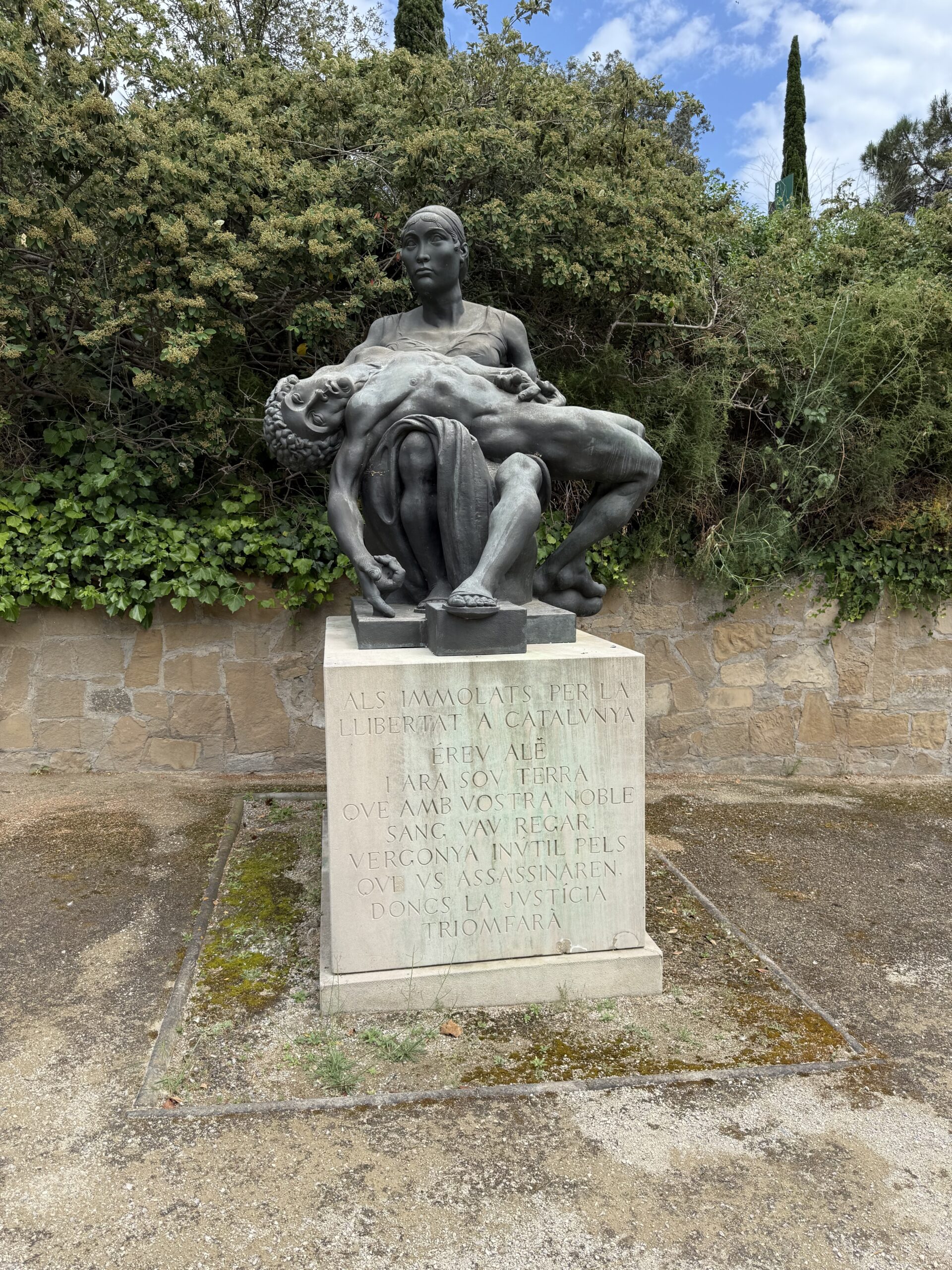
Ferran Ventura Rodríguez’s La Pietat sits at the entrance to the Fossar de la Pedrera in the upper western wing of the cemetery. The bronze is a replica of the stone original, which is installed at the Parliament of Catalonia. Both were made in 1984. The Fossar version was paid for by popular subscription — the Associació Pro-Memòria als Immolats per la Llibertat a Catalunya raised the money from Catalan citizens to commission a sculpture honoring the thousands of victims of Franco’s regime whose unmarked bodies lie in the quarry behind it.
I stood in front of her and observed for a long time.
She is enormous. She towers over my almost six-foot frame. A strong woman seated in a thin chemise that barely covers her shoulders, her bare foot on the front edge of the pedestal as if she is about to stand up and walk toward whoever did this to him. Across her lap she holds the body of a young man, nude, head thrown back, muscles ripple the sculpture. The Catholic Pietà tradition has always required Mary to grieve a draped son. Ventura spurned the drape. The son is exposed. The mother holds him fully.
And her hand. I noticed it on the second look. The left hand, above the knee that supports his pelvis from underneath, is positioned on his genitals. As I looked closer, I saw the pubic hair sculpted into the bronze with deliberate texture. There is no possibility this was accidental, given the scale of the sculpture and its intentionality. The hand is cupped. She is holding what is there. Although I cannot be sure, it looks as if his penis is in her hands.
I stood in front of the statue and tried to understand what I was seeing. The published art-historical commentary about the work (which I read later) describes it as a defiant secularization of the Pietà form, a mother whose grief has hardened into political testimony rather than dissolving into religious resignation. All of that is true. None of it addresses the hand and the eroticism.
What I sensed, standing there alone shivering in the cool wind off the harbor, is that she is holding the manhood that was taken away from him.
The regime did not just kill these thousands of men. The tyrannical rulers unmanned them. Took their future. Took the children they would have fathered. Took the capacity to be lovers, husbands, citizens of a free Catalonia. The bullet (or worse) was the last act of an unmanning that had begun in a courtroom or a cell. The mothers whose sons were slaughtered were holding men whose physical wholeness, including the parts mothers are not supposed to mention, had been annihilated by state violence.
Ventura sculpted what those mothers actually felt. They took everything. They took even what was not mine to hold. And I will hold it anyway, because there is no one else left to.
The inscription on the pedestal, carved in monumental Catalan with the V’s standing in for U’s in Roman fashion, says:
To those immolated for the liberty of Catalonia: You were breath, and now you are the earth that with your noble blood you watered. Useless shame for those who murdered you, for justice shall triumph.
The Catholic Spain that murdered them was the same Spain whose crucifixions and madonnas filled the marble pantheons I had walked past all afternoon. Ventura’s mother is not a Catholic mother. She is a Catalan mother who mourns what Catholic Spain did to her son, and she has stopped accepting Catholic comfort. The religious iconography has been stripped from her not because the sculptor is hostile to religion but because she is. The Pietà form survives the loss of its theology. The mother survives the loss of the god who failed her.
I stood there for a long time. I photographed her from every angle. The hand. The face. The bare foot. The dead son’s body. The pubic hair. The patina on the bronze where four decades of Catalan weather have worked on her without softening anything.
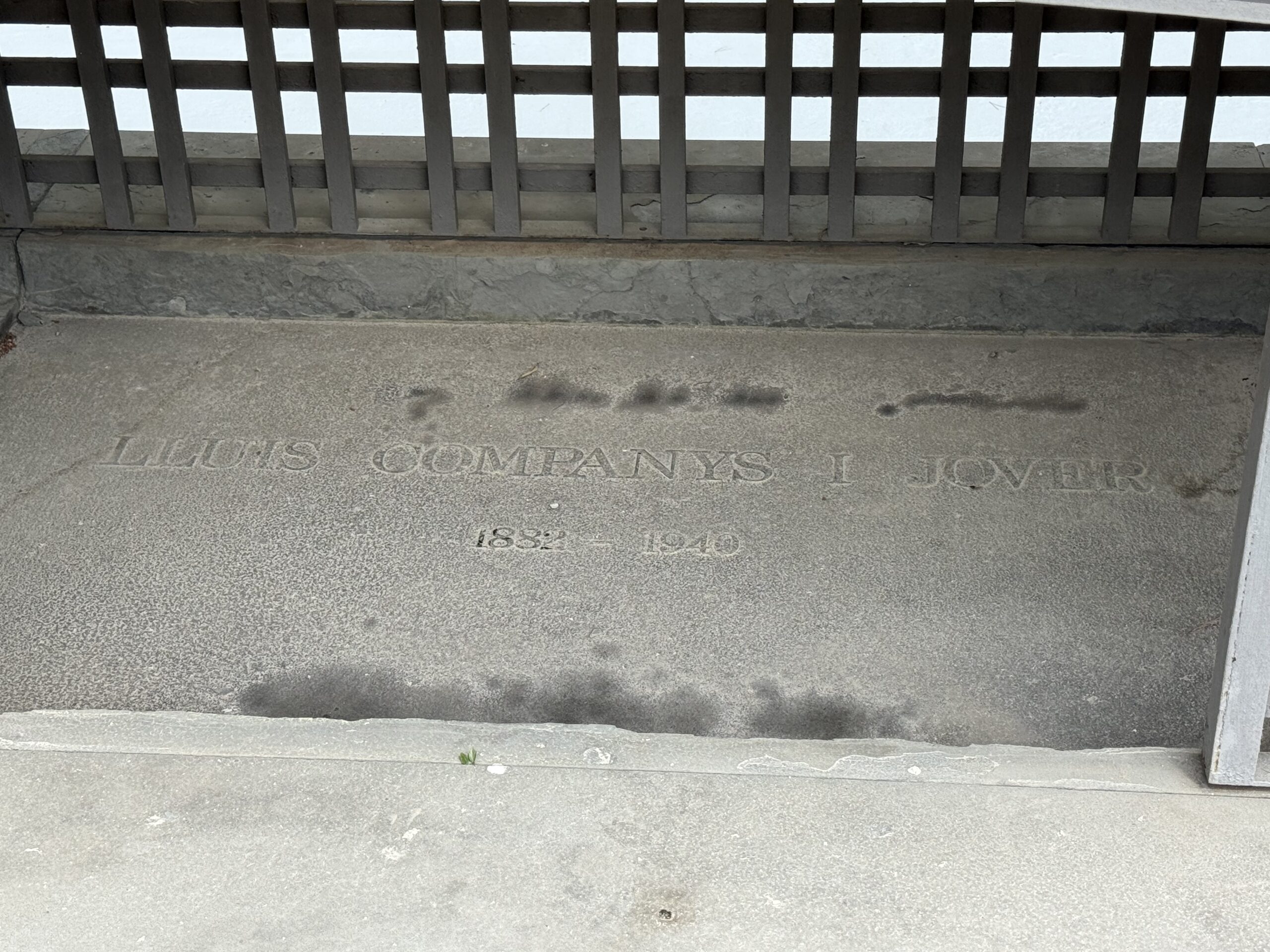
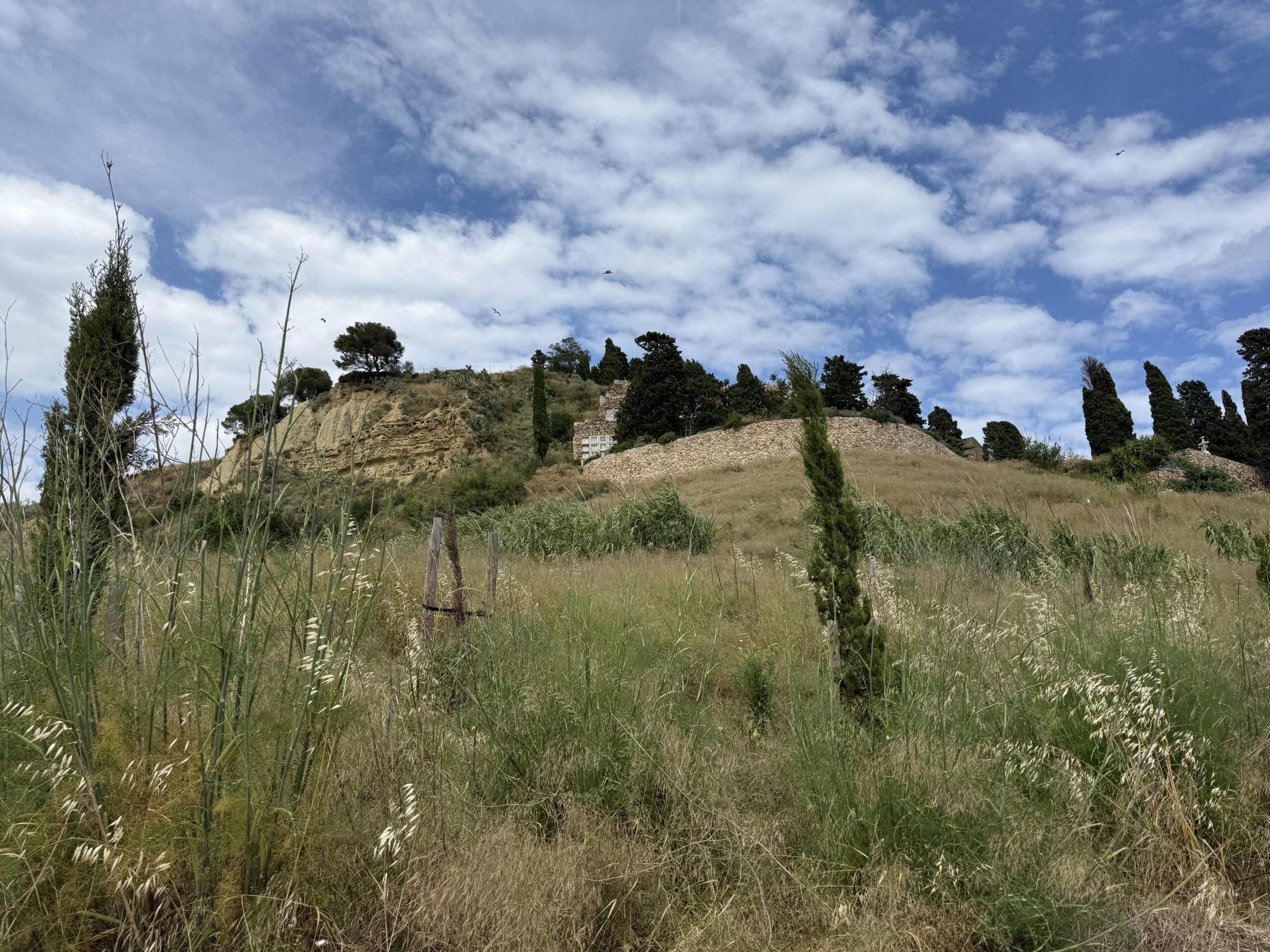
Behind her, the Fossar opens into the rock face. A stone amphitheater carved into the old quarry of Moragas, lined with columns engraved with the names of the four thousand victims, the Maccabi memorial to the Catalan Jews exterminated in the death camps, and more. President Lluís Companys’s mausoleum on the far right of the entrance. He was the only sitting European head of state to be executed by a fascist regime during the twentieth century, in 1940, at Montjuïc Castle on the hill above this quarry.
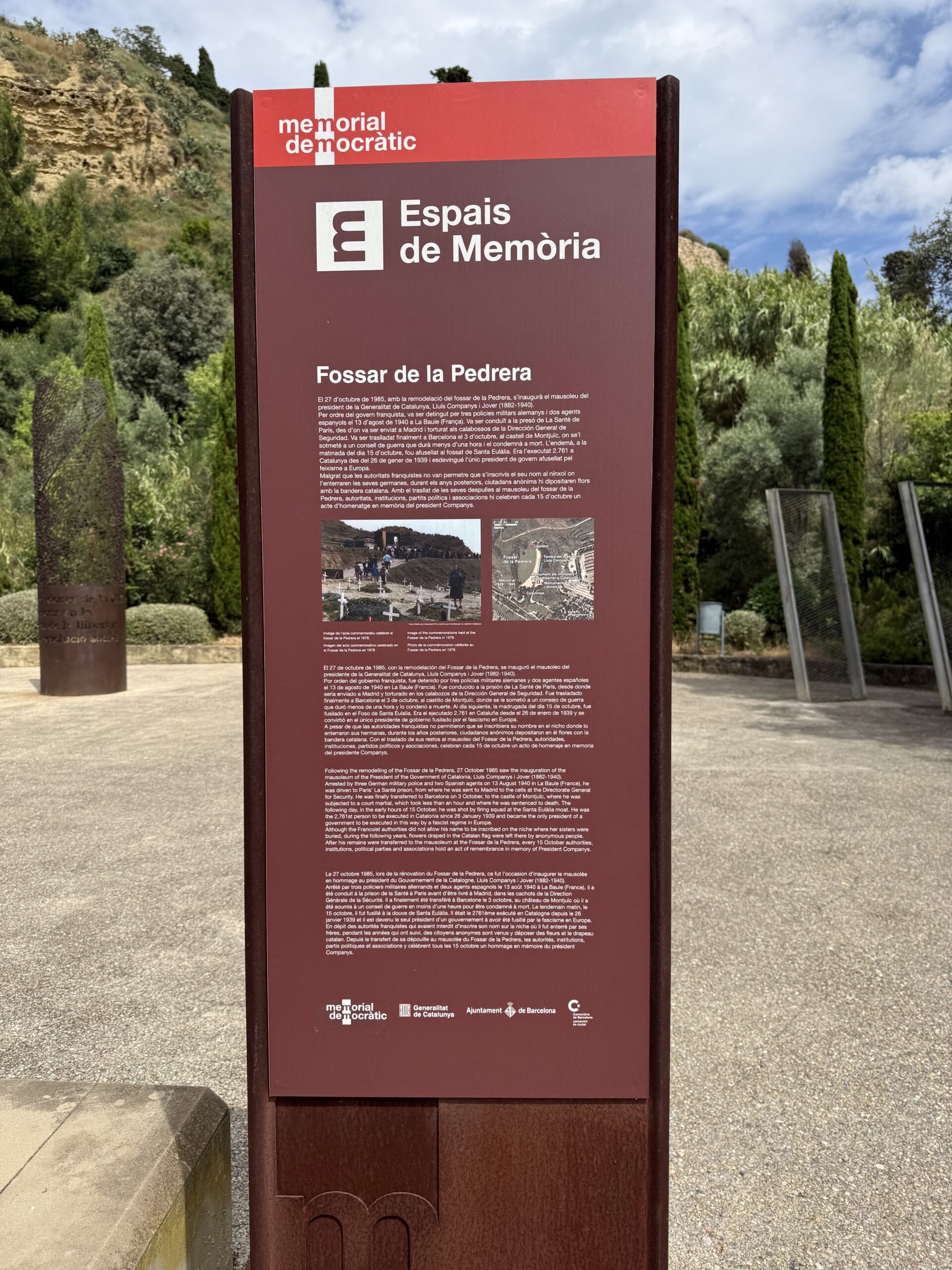
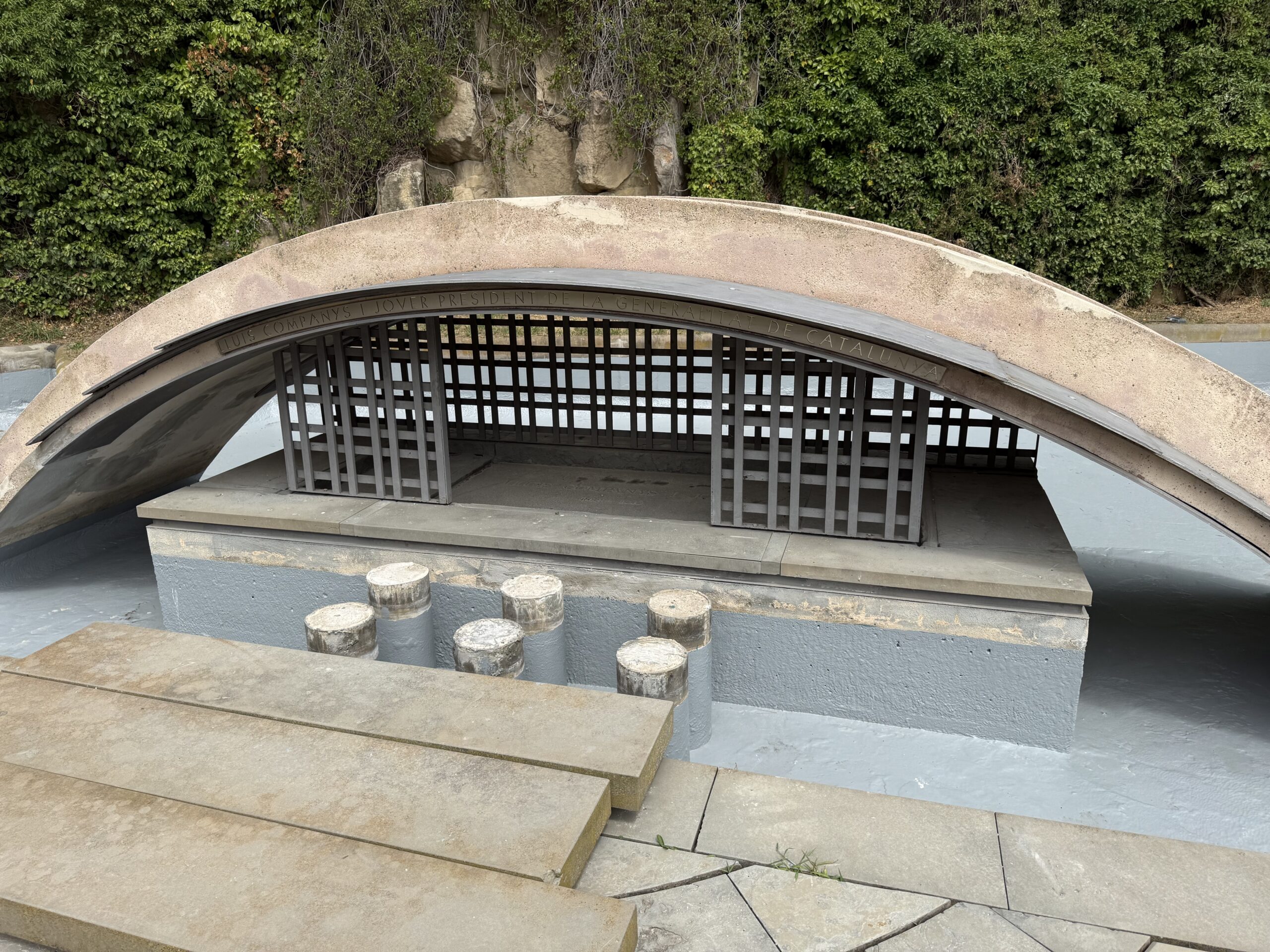
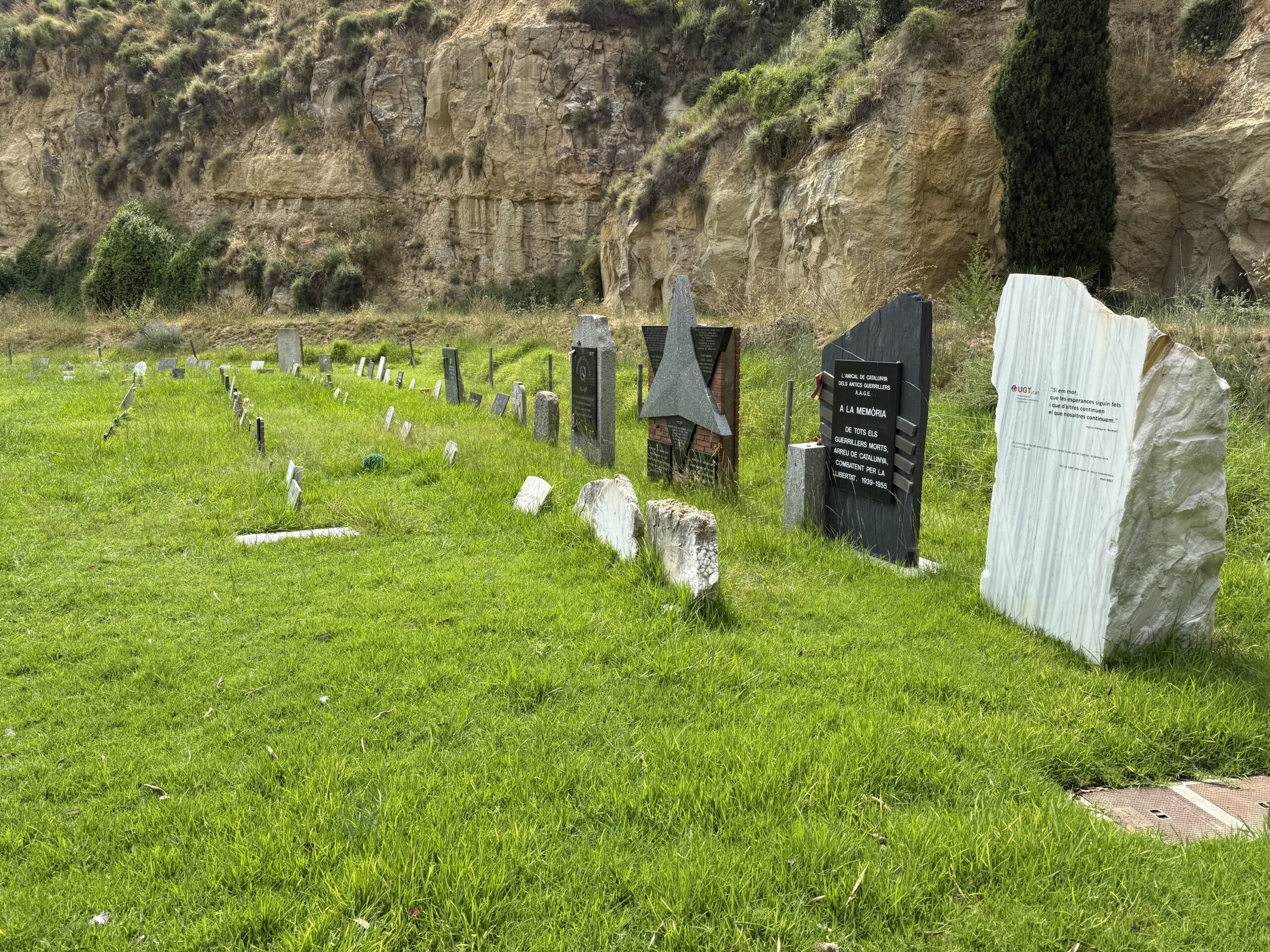
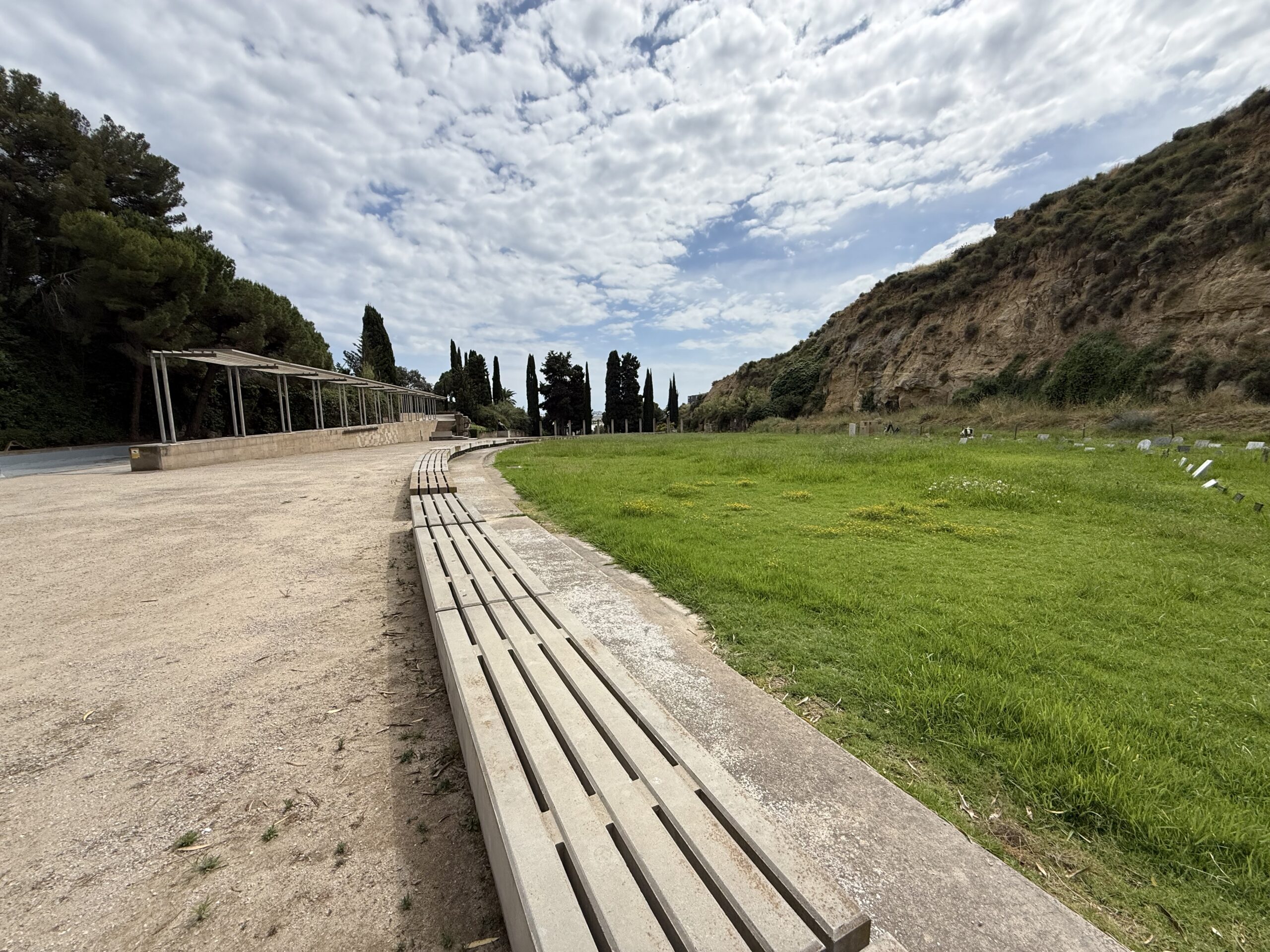
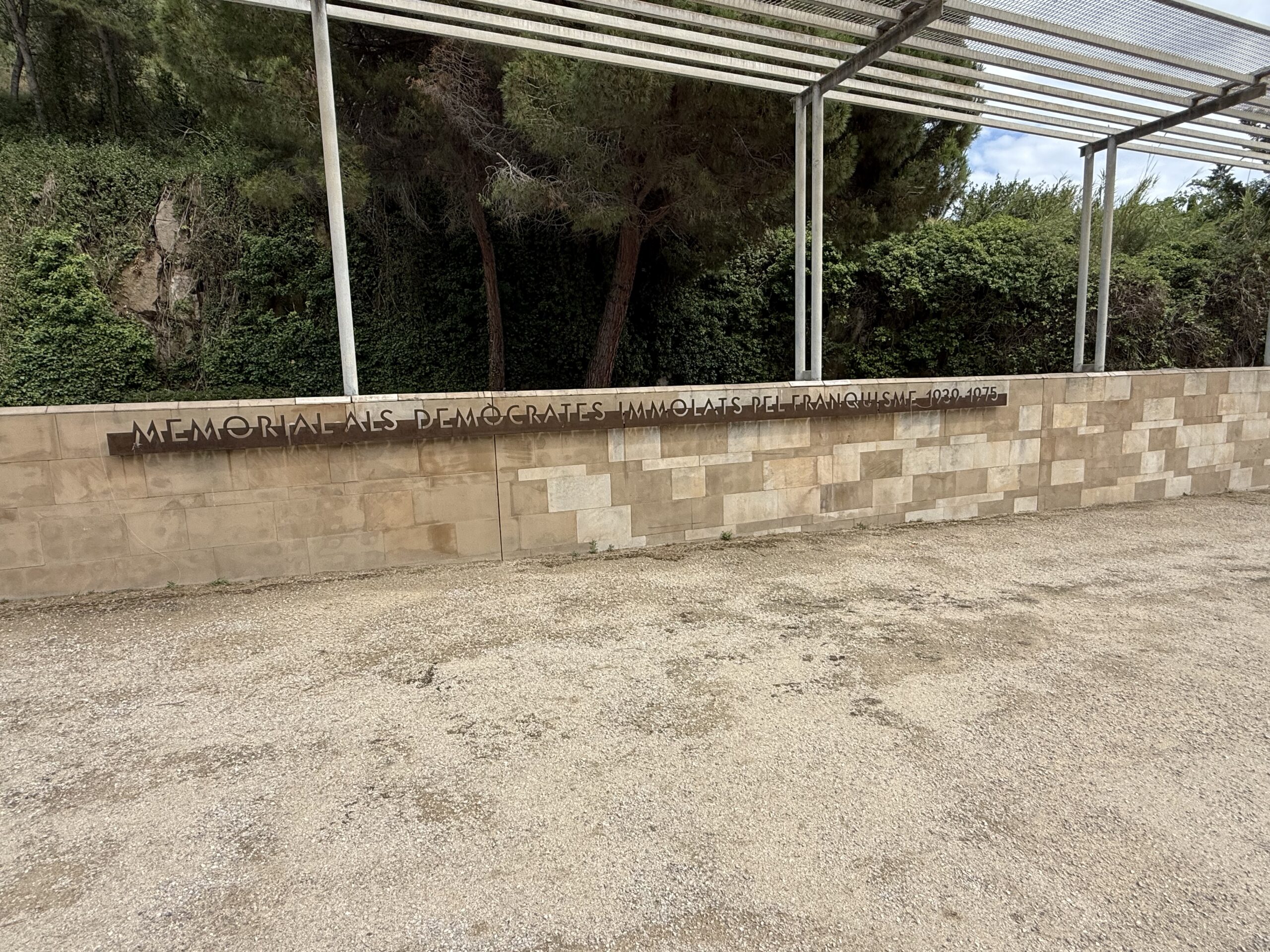
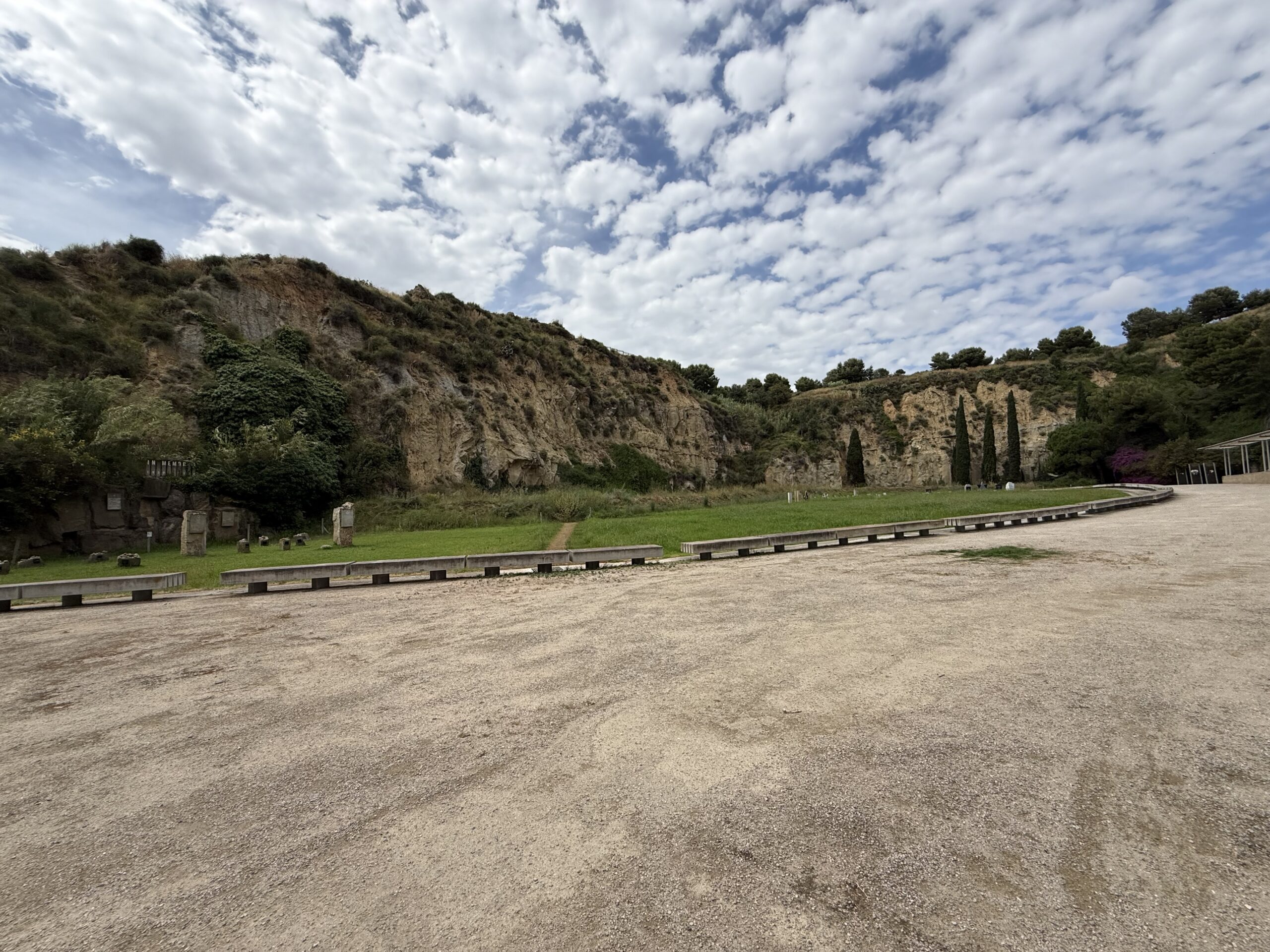
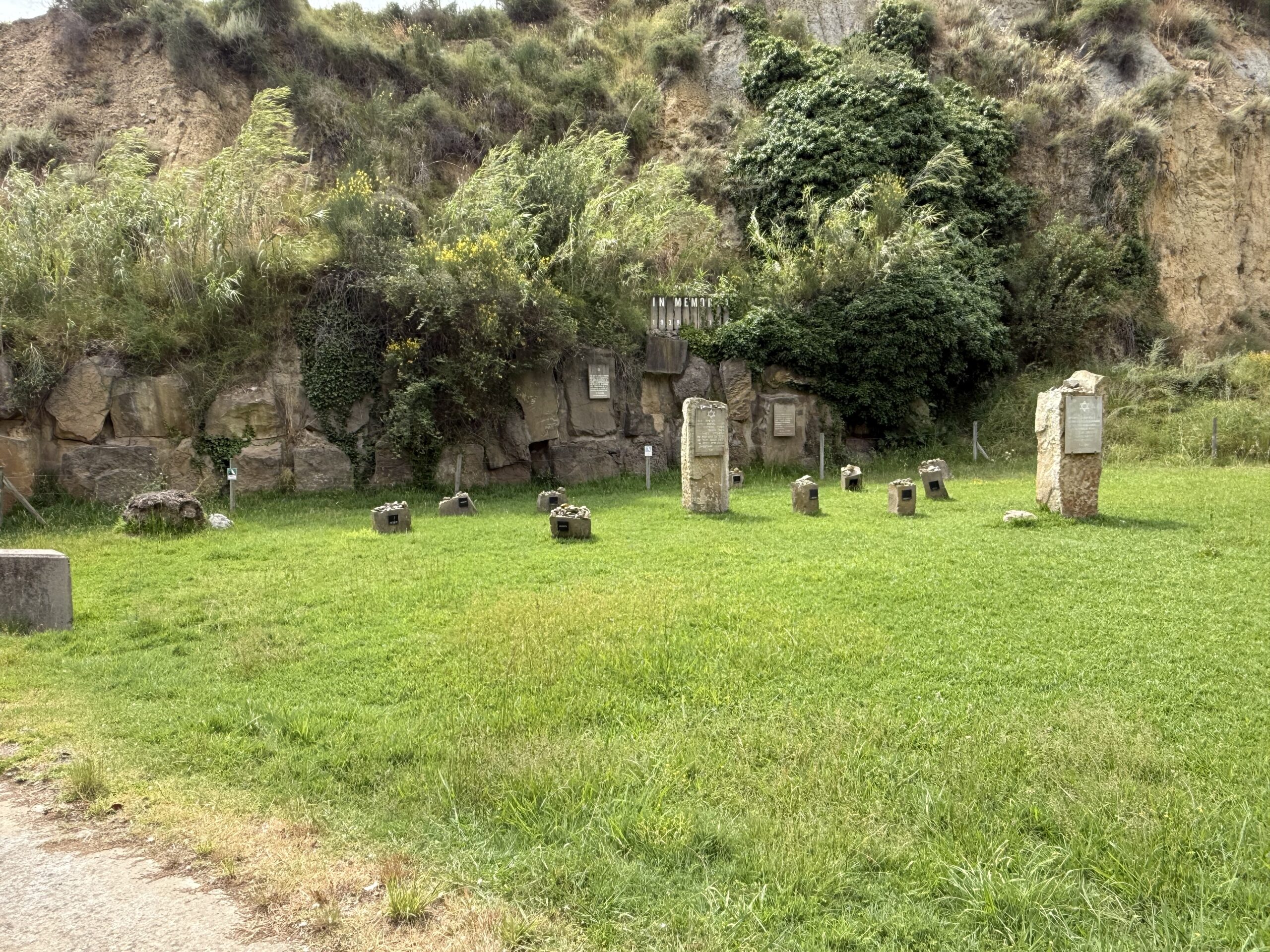
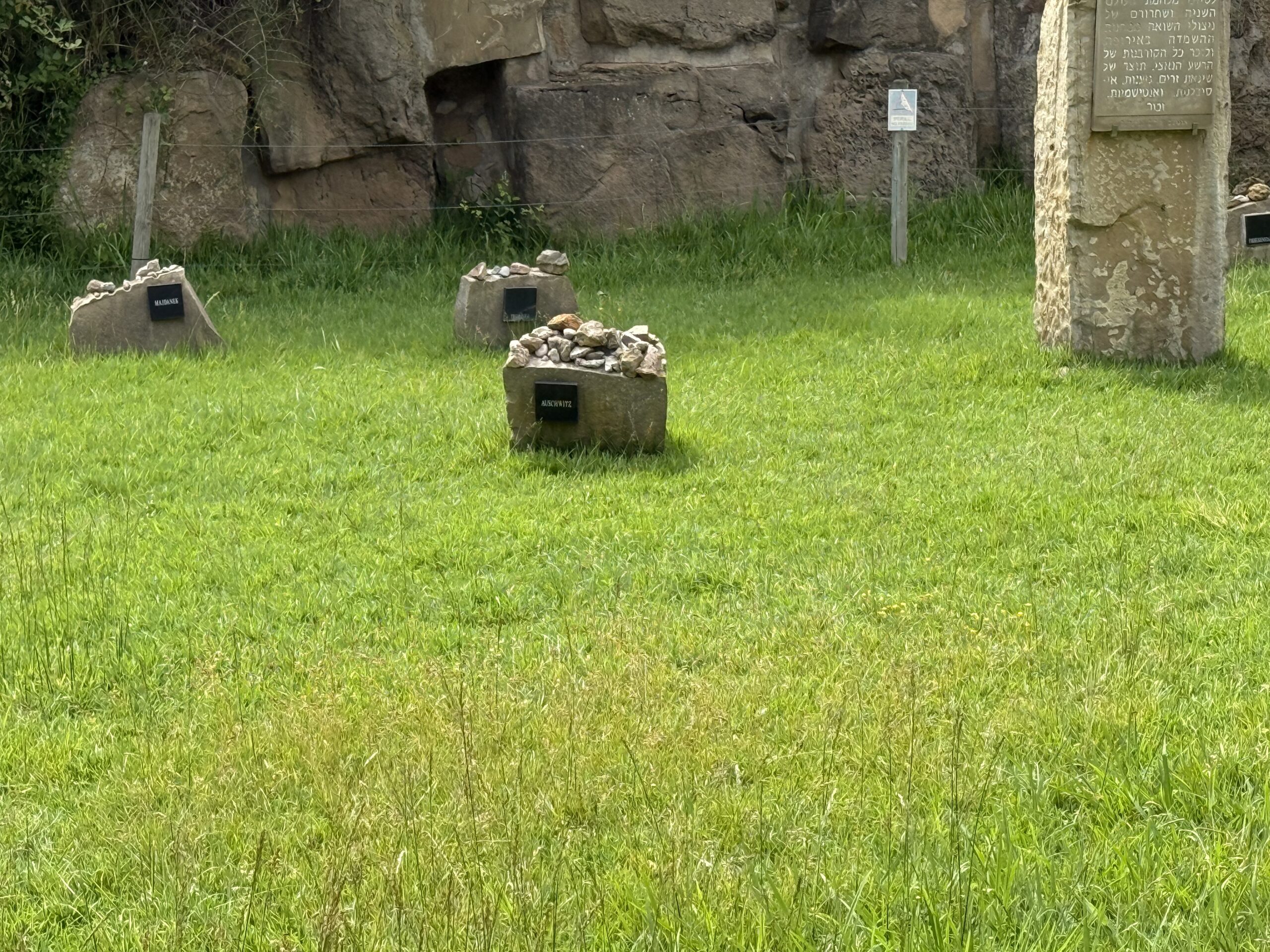
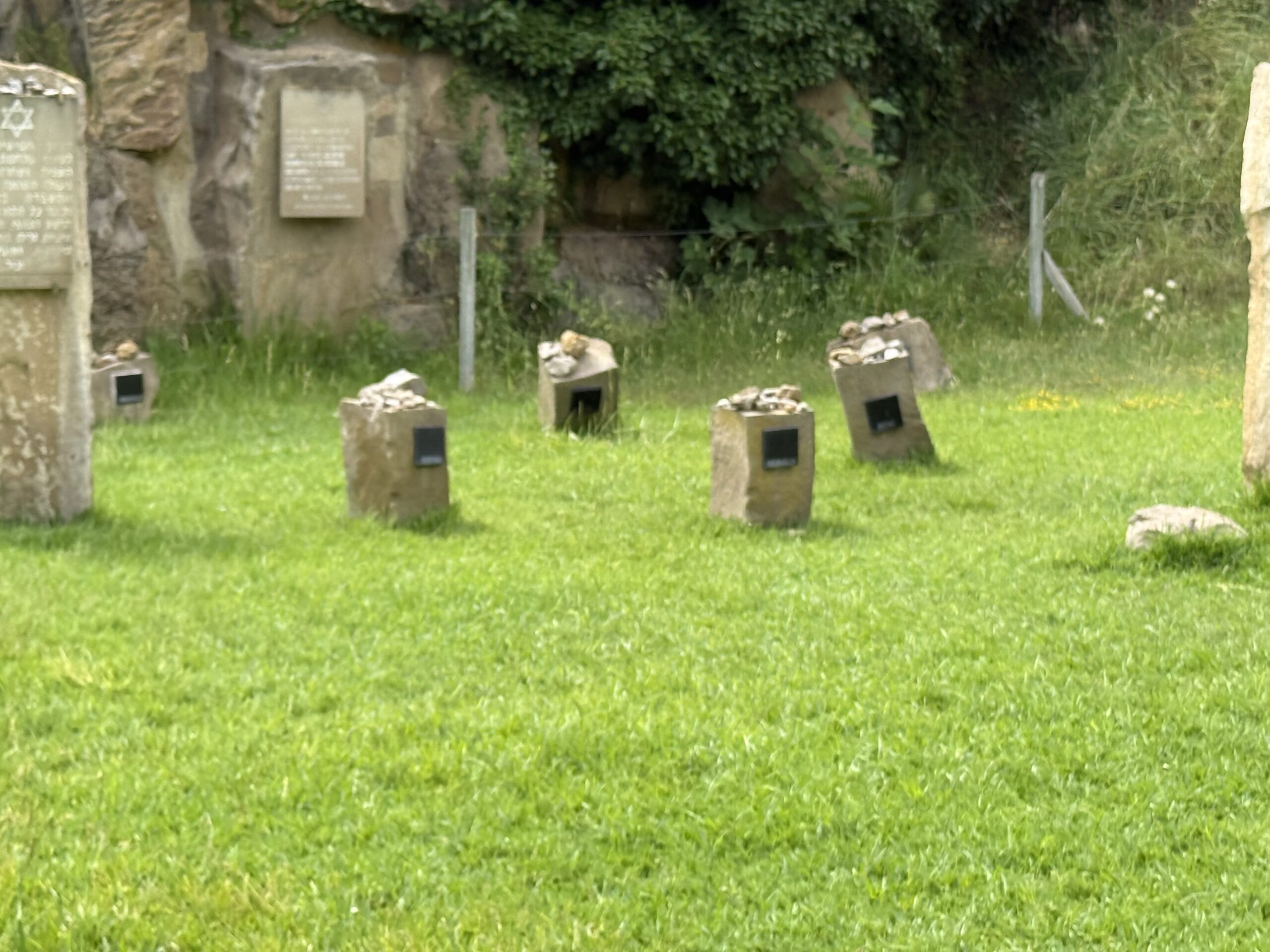
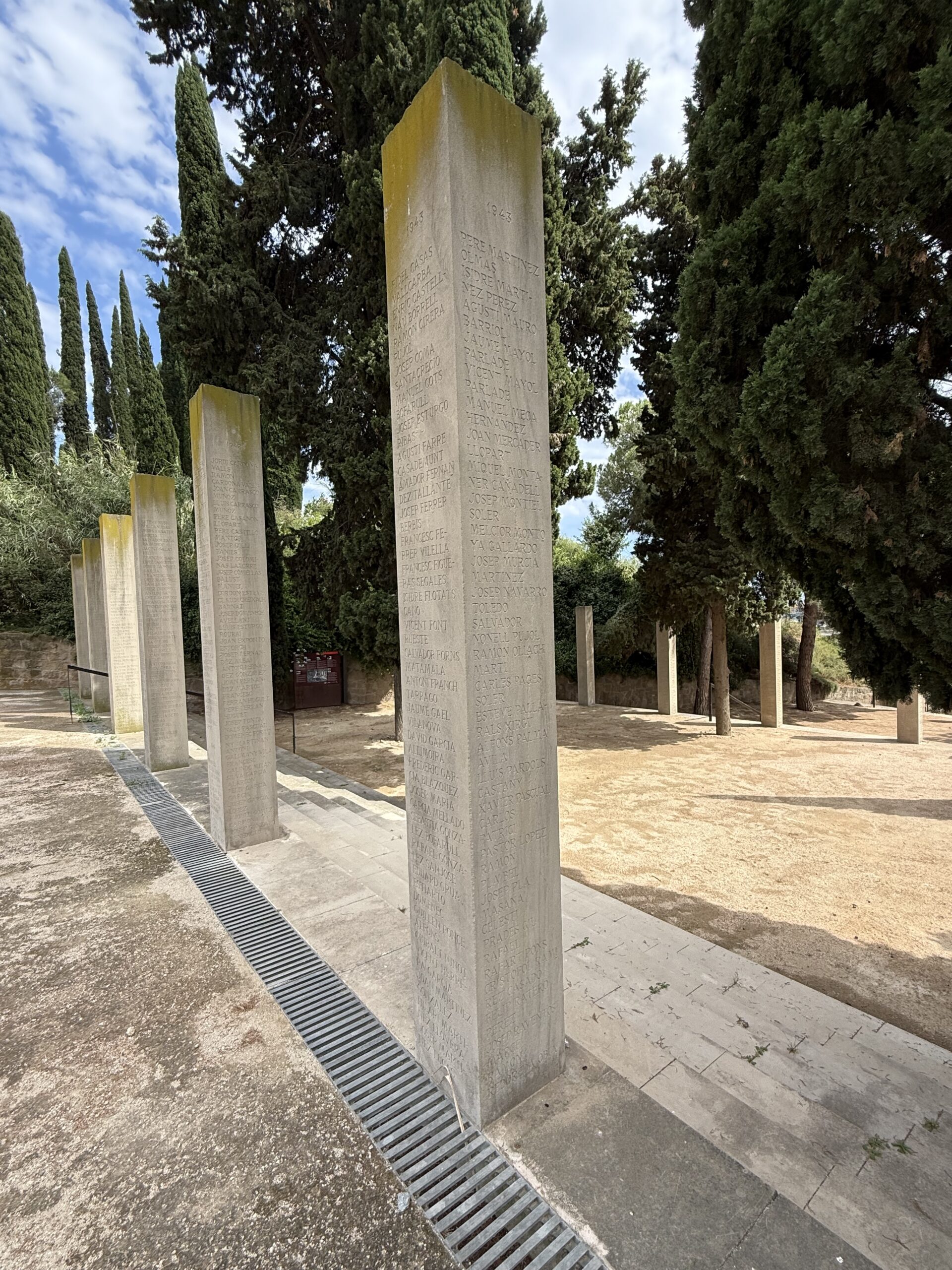
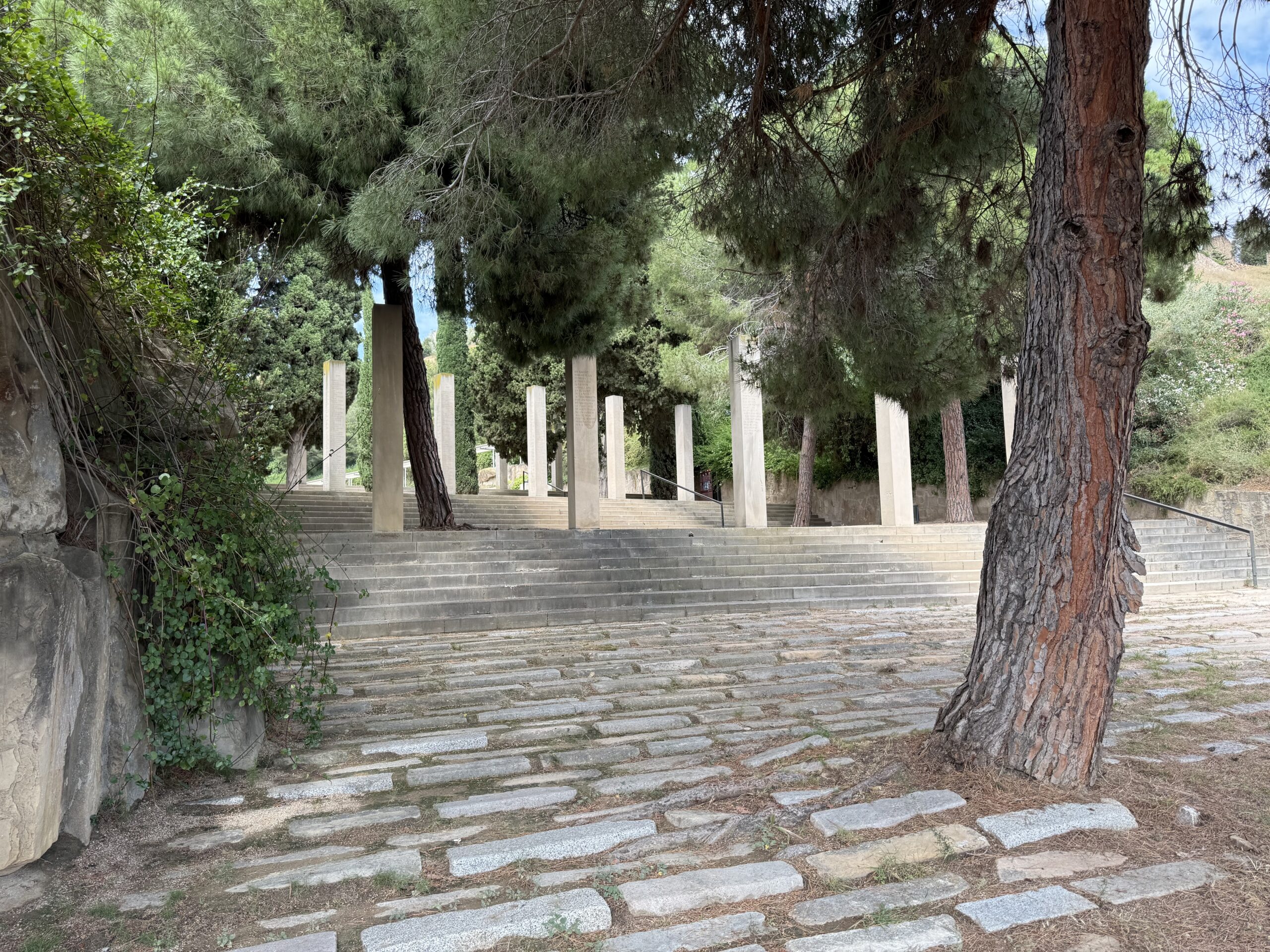
I sat on the stone benches and looked at the names, the rugged quarry walls, the silent field. It reminded me of Maya Lin’s Vietnam Memorial in Washington. It had the same refusal of the heroic register, the same insistence on names rather than narrative. I had been to the Vietnam Memorial as a younger man and felt it. I felt this one in the same place. Different scale, same gravity.
There was no one else in the Fossar. The wind moved through the quarry and carried the sound of my own breathing back to me from the rock walls. I thought about the woman at the office. I thought about the funeral procession that morning and the man who had waved at me. I thought about my own dealings with the dead, the two hundred funerals I had conducted, the bodies I had stood over before the families came in. I thought about how much of my life I had spent inside grief that belonged to other people, and how little of it I had managed to keep at arm’s length by the professional distance of ministry. I am empathic to a fault
Sitting alone at the Fossar, no protection from the hideous past was available to me. The Catalan woman in bronze was watching me from her pedestal. The four thousand names were watching from the columns. I felt the weight in a way that twenty years of conducting funerals had not prepared me for, because what I was observing was not personal grief. It was political grief, the grief of a country, the grief of people murdered by the state that called itself religious and defenders of the family.
The only word I could land on was gravitas. The Latin contained layers of meaning in a way the English did not.
When the second map fell out of my pocket, I had been at the Fossar for an hour. I had assumed I would not find Miró today. I would have to come back another time. The cemetery was too big. The shuttle bus was not running. The agrupació numbering had defeated me.
The map showed me exactly where he was. Vía Sant Francesc, Agrupació 9, núm. 33, a long walk uphill from where I was sitting, but not impossible. I had water left. The weather was still cool. I had walked fifteen thousand steps and could walk more.
I followed the second map. Miró’s family pantheon is plain: raw sienna marble, black etching, no ornamentation. The painter who taught the world how to see color chose for himself the absence of it. I walked past it twice. After the Pietà and the Fossar, the simplicity of Miró’s vault was the rest my soul needed.
I had walked over eight miles by the time I left the cemetery. The agrupació map and the second map were both folded back into my pocket. The light had begun to slant in the way late Catalan afternoons slant. I followed roads, then gave up on the roads when they switchbacked, and walked in straight lines across the grass between the graves toward what I hoped was the exit. I made it. The 21 bus, which had failed me in the morning, found me in the evening. I sat down. My legs let me know what they had done.
I journaled this the day after. I will be thinking about the Pietà for a long time, I think. The mother who held what was taken. The bronze that decided, in 1984, to do what Catholic art had not done in hundreds of years—to be honest. And I thought about the Catalan woman at the office who handed me two maps only to discover the second one when I really needed it. The four thousand names in the rock face. The wind off the harbor. The hundreds of thousands of graves. The man in the funeral hearse who waved.
That is what a cemetery is for, when it works. Not to convince you that the dead are not dead (that is the project of every other denial in the human catalog) but to let the dead stay dead and still keep speaking. The mother on the pedestal speaks. The four thousand names speak. The painter who chose plain marble speaks. The novelist whose slab I had weighted with a small stone that morning speaks. They speak because we have built places where they are allowed to. They do not need us to pretend they are not dead. They need us to come look at them, name them, and admit what was taken.
The pretense ends at the Fossar. The honesty begins.
I am glad I went.

Leave a Reply