Kiss Me, Then Leave Me Alone
What Barcelona taught a highly sensitive man about personal space
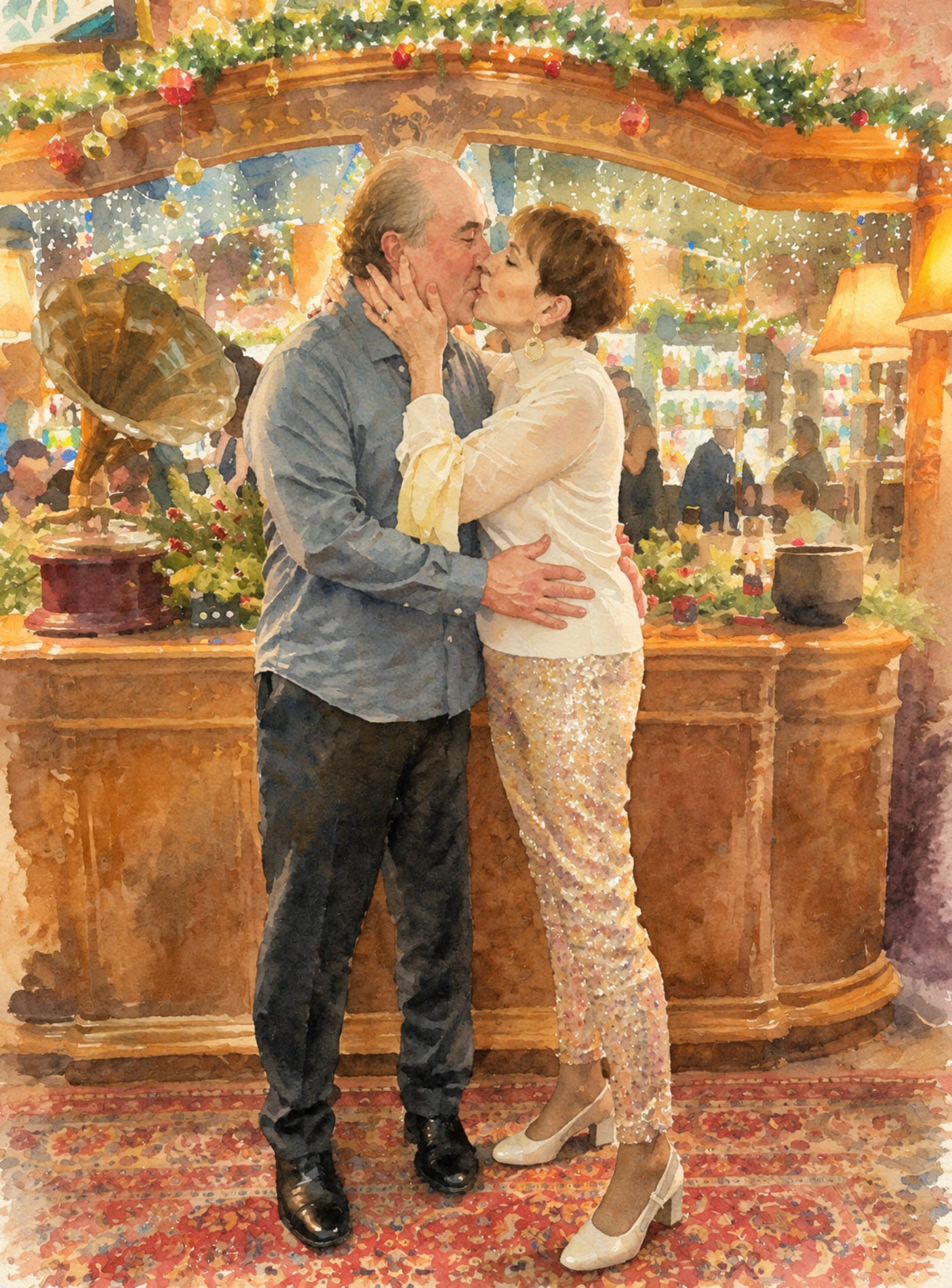
Every Sunday at Mt. Olive Church of God, a six-foot-four mountain of a man named Jubal Whitener made his rounds. He wore his finest Liberty overalls. He had no teeth, hands like dried-out leather, and one holy mission: to greet every woman in the building with a holy kiss.
You have never seen grown women move so fast. They scattered like chickens. They scooped up screaming toddlers as human shields. A few suddenly felt led to the altar for some preliminary praying. (Revival in the Appalachians had many causes. Fear of Jubal was one of them.)
That was the only kiss the church ever offered me, and everybody ran from it.
My first real kiss came a few years later, behind the outhouse of a church, on a damp mountain night. Inside, the adults were helping some sinner “pray through.” Outside, a sixteen-year-old blonde flower child named Brenda, smelling of incense, leaned close and told me I had a lovely voice. Time stood still. I will never forget the bliss of that moment. Twelve years old, fresh off a solo, and already learning the lesson that would shape the next fifty years of my life: the “holy” kiss happens in the sanctuary, and the real one happens out back.
The Bubble
Americans are proud of their personal space. We measure it in arm’s lengths. We greet with a firm handshake (and heaven help the man who offers a limp one). Evangelicals perfected the side hug: shoulder to shoulder, hips a safe foot apart, two quick pats on the back to signal that nothing more is intended. Bodies were dangerous, so we kept them apart.
There was the rare exception. One thoughtful sister at my fourth church would come back into the green room every Sunday just before the pastor and I took the stage and hug us. And I’m talking a full-on bear hug that pressed her 38DD breasts against me like a soft pillow. I truly believe it was the best blessing she knew how to give.
Yet nobody in that world ever kept their distance from my soul.
Pastors wanted to know what I watched, what I read, what I thought. Accountability partners asked every week about my eyes. Sermons told me to guard my heart, which really meant, we’ll guard it for you. My desires were church business. My doubts were church business. My bedroom was church business.
It took me sixty years to name the paradox:
America guards your body and invades your spirit. Spain touches your body and leaves your spirit alone.
Four Months In
When Gina and I arrived in Barcelona in December 2023, I considered myself ready. I am, after all, a touchy-feely man. Then came the kisses. Two cheeks, every time: from the woman at the bakery, from friends of friends, from people I had met thirty seconds earlier. Even I had to surrender a good portion of the personal space I’d guarded my whole life.
A recent BBC piece by Lucy Lovell, who has lived in Spain for six years, cites a University of Warwick study showing that Spaniards need less personal space than nearly anyone when meeting someone new, less than even the Italians, Greeks and Portuguese. Anyone who has ridden the Barcelona metro at rush hour could have saved the researchers the trouble.
On one of those rides, two young women set up a boombox and a mic and began breakdancing in our crowded car as it swerved through the tunnels. One of them brushed against me again and again, laughing, smiling, never missing a beat. In America, every alarm in my body would have gone off. Here it felt perfect.
The Kiss Was the Protest
Spain earned this closeness the hard way.
Under Franco, from 1939 to 1975, the state policed bodies. Homosexuality was criminal. Couples could be fined for kissing in public. As late as 1986, two women were arrested for kissing in Madrid’s Puerta del Sol and held for two days under the “public scandal” law. The next February, activists answered with a mass kiss-in on the same square. For years afterward, Madrid’s Pride march ended with a kiss there. The law fell in 1988.
Read that again. A kiss was a crime, then a weapon, and now it’s so ordinary nobody looks up from their café con leche.
When I walk through Galvany Market, I look at the faces of people my age and older and remember that they grew up under a regime that told them what their bodies could do in public. So did I. Their dictator wore a uniform. Mine wore a three-piece suit and carried a Bible. Both men believed a kiss could topple the whole order of things.
They were both right.
No Bad Look
The sociologist Amparo Lasén told the BBC that public affection flows easily in Spain for a simple reason: nobody gives you a dirty look, and if they do, nobody cares.
That is the whole secret. The freedom here is the absence of the judging eye.
Shortly after we moved, I wrote, “For the first time in my life I have total anonymity… Here is bliss.” In Austin, in Dunedin, in every American city we called home, I braced to run into someone from my former life, and those encounters usually ended badly. Here nobody is keeping score. Nobody is praying about me in a small group. Nobody is guarding my heart.
Strangers kiss my cheeks and let my soul be.
The Sensitive Man’s Dilemma
Here’s the confession hidden in my title. As a highly sensitive person, I need solitude the way most people need water. Crowds drain me. Noise wears me thin. And yet my hunger for touch has always been enormous.
For most of my life, I assumed those two needs cancelled each other: the hermit or the lover, the cabin or the crowd. Barcelona ended the argument. Here a stranger can kiss both my cheeks at the bakery and then leave me completely alone with my cortado and my thoughts. Closeness without claims. Touch without trespass.
Henri Nouwen saw it decades ago: loneliness makes us cling, while solitude lets us respect each other. The best intimacy I know has room in it. With Gina, I can talk without effort and sit in silence without unease. Fifteen years, and that’s still the truest picture of love I have.
Body, Soul, Spirit
Personal space turns out to be the hinge of three of my four essentials that make me who I am.
Body. The body wants nearness. It was made for touch, warmth, the press of a cheek. Every sermon that told me otherwise was teaching my nerves to flinch at the very thing they were designed to receive.
Soul. Intimacy needs both nearness and room. Communion happens when two people come close without swallowing each other, when I can be fully seen and still remain myself.
Spirit. Freedom is room for the inner self. It’s what Barcelona gave back to me: the right to think, desire, and wonder without anyone standing guard.
One woman in the BBC piece, Isabel Nieto Tous, noted that Spaniards behave the same way in public as they do in private. There’s no indoor self and outdoor self.
That’s wholeness. The same man on the park bench as in the bedroom. The same man in the pulpit as behind the outhouse. Wholeness over goodness, every time.
Tomorrow Morning
The article mentions, almost in passing, that an older couple kissing on a bench still draws more attention than young lovers do.
Fine by me.
Tomorrow morning Gina and I will walk to nearby Turó Parc. She is seventy-one, I am sixty-eight, and we will sit on a bench under the plane trees and kiss like teenagers. A tourist or two may stare. No Barcelonan will. Then Gina will head off on her errands, and I’ll go back to my atelier and my four open books, each of us alone and content.
Close enough to kiss. Far enough to breathe.
So let me ask you, friend: where in your life are you guarded when you long to be open? And where have you let others into rooms of your soul that were always meant to be yours alone?
Leave a Reply