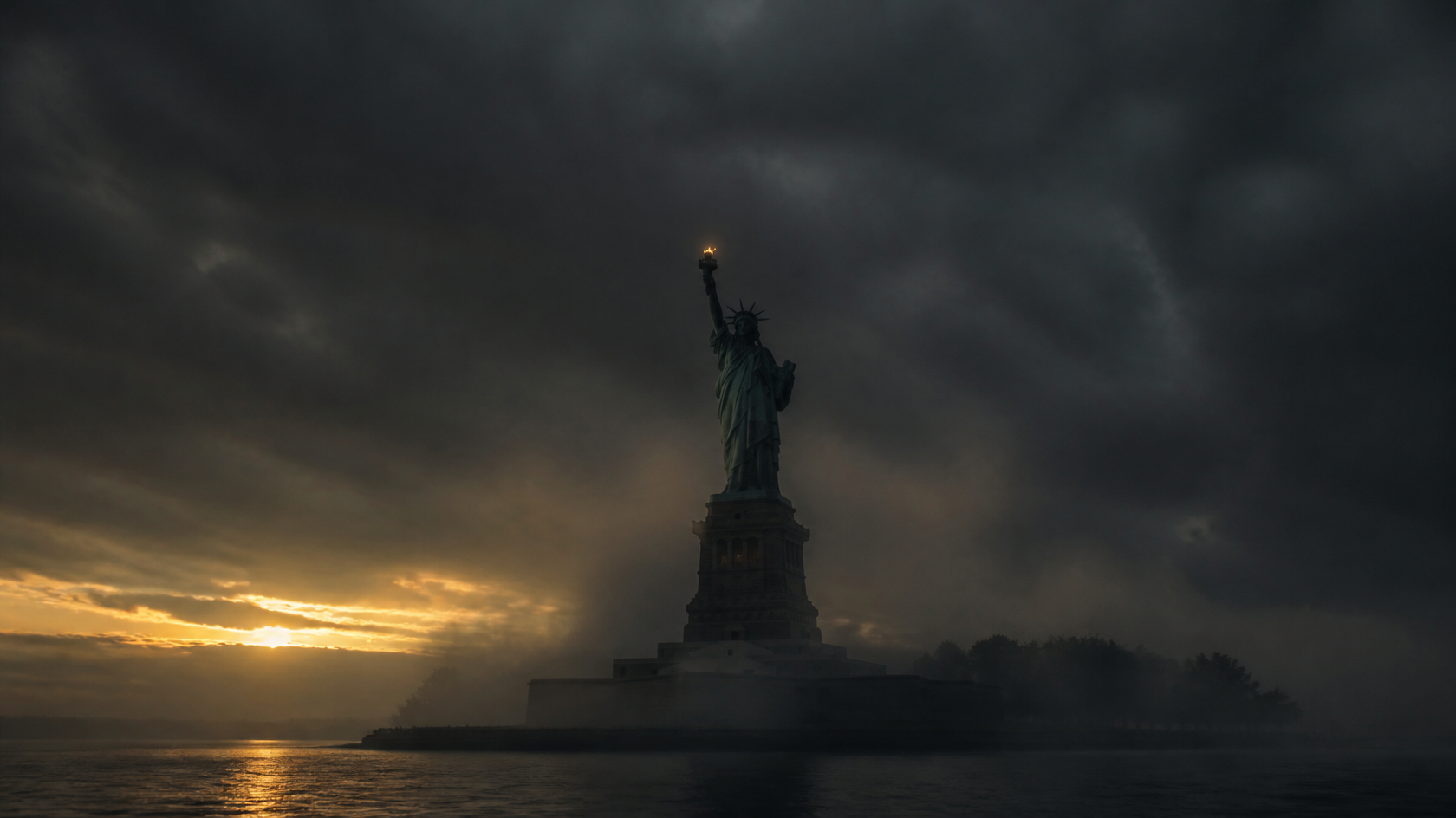
She was 250. The family asks that you hold the flowers one more week.
AMERICAN DEMOCRACY, 250, THE WORLD’S MOST IMITATED EXPERIMENT IN SELF-RULE
An advance obituary. To be published, or burned, after November 3, 2026.
BARCELONA — American democracy, the restless, contradictory, gloriously unfinished experiment that taught half the planet to say we the people, is gravely ill and may die within the week. She is 250 years old. She celebrated that birthday this past Fourth of July with a garish UFC fight, a sham ill-attended celebration of nations, and her historic reflection pool dark, yet most of the guests failed to notice the hostess could barely stand.
Every great newspaper keeps obituaries on file for the famous and the failing. Reporters write them while the subject still breathes, then update them as the decline progresses. Editors call these “advances.” They sit in a drawer and wait.
What follows is my advance on American democracy. Unlike most obituaries, this one arrives while the patient can still recover.
Should death come, the cause will be listed as complications of corruption, cowardice, and complacency. Her physicians have charted the vital signs for years. In March, scholars at the V-Dem Institute in Sweden downgraded her from a liberal democracy to a mere electoral one, and wrote that the speed of her collapse compares to a coup d’état. In September, the International Institute for Democracy and Electoral Assistance in Stockholm reported her health at its lowest point in fifty years.
The family was informed.
The family said it was inconceivable.
Early Life
She was born in Philadelphia on July 4, 1776, in a sweltering room full of men in wool coats and contradictions. Her fathers were brilliant and badly compromised. They wrote all men are created equal with the same hands that signed bills of sale for human beings, and she spent the next two and a half centuries trying to grow into the words on her own birth certificate.
John Adams, a stubborn man who borrowed shamelessly from Cicero, refused to compromise on one point: she must have checks and balances. Three branches, each jealous of the others, each holding the others’ leash. James Madison put it plainly. The accumulation of all powers in the same hands, he wrote, “may justly be pronounced the very definition of tyranny.”
She was a difficult child. She nearly killed herself at 85 in a war over slavery. She let women vote at 144. At 189, in 1965, she finally signed the Voting Rights Act and began to keep the promise she made to Black Americans a century earlier.
Remember that year. It returns at the end.
Career
Her influence was staggering. The world copied her constitution, her jazz, her blue jeans, her Bill of Rights, and her most dangerous idea of all: that a nobody could look a somebody in the eye and say no.
She was never innocent. Ask the Cherokee, my mother’s people, marched west at gunpoint. Ask anyone who stood at a lunch counter in Greensboro. Her failures were enormous, and her genius lay in this: she slowly built the tools to correct her own failures. Courts. A free press. Elections. The slow, maddening, messy pulse of self-correction.
That pulse is what’s weakening now.
An Acquaintance of Many Years
This writer knew her from birth. A preacher’s son from the Appalachian hollers, he pledged allegiance every school morning with his hand over his heart. For three decades he stood on the platforms of Southern Baptist megachurches and watched the flag and the cross slowly fuse into a single idol. He voted Republican his entire adult life until 2016.
In October of 2018, he wrote this on his blog:
“IT CAN HAPPEN HERE. It happened in Germany, it happened in Rome. It is happening in America… If we do not, I fear with all my heart Lady Liberty will soon draw her last breath. A funeral dirge will replace our national anthem.”
Friends called it hysteria. Family called it disloyalty. (He unfriended over two hundred of them that fall. Heralds are rarely popular at parties.)
A wise old psychiatrist once told him he was a herald, a symptom that appears before the disease announces itself. It’s a lonely gift. You see the smoke while everyone else admires the sunset. After January 6, he and his wife Gina began the long work of becoming immigrants. “That thug will never go away,” Gina kept saying.
She was right. He hated that she was right.
Final Illness
The decline came quickly, then all at once.
The symptoms were familiar to any student of history. Power swelled in a single office. A Congress of the same party shrugged. A Supreme Court ideologically aligned with the President granted him sweeping immunity and looked the other way. A policy blueprint called Project 2025 promised the transformation in writing before the election, and by one tracker’s count, half of its 320 objectives are now accomplished. Nobody can claim surprise. The man told us exactly what he intended. Americans simply refused to believe a man who had never once lied about wanting power.
And through it all, a song played. Its single word, inconceivable, was sung loudest by the Republican Party, with lyrics written by entitled white men who never quite forgave her for letting women and Black Americans into the choir. It’s an old hymn, the oldest one in the American South: a strong white man will sit on the throne and keep everything the way it used to be. Over eighty percent of white evangelicals sang along. They blasphemed the Sermon on the Mount and called it woke.
The Democrats, for their part, mostly wrung their hands and sent fundraising emails.
Cowardice wore both party colors.
The Old Man at the Café
Most mornings in Barcelona, this writer sees them: the elderly men and women of Les Tres Torres, taking their cortado at the sidewalk cafe, reading La Vanguardia, unhurried in the Mediterranean light. Many were children under Franco. Some lost parents to his firing squads. Some learned Catalan in whispers behind closed doors because speaking it in public could cost you everything.
Franco ruled Spain for thirty-six years. He enjoyed the blessing of the Church, the loyalty of a compromised press and military and a corrupt judiciary, and enough popular support never to need everyone. He only needed enough people to look away. He enriched his family lavishly. He made the state his personal estate. Sound familiar?
Spain’s national anthem officially has no words. After four decades of Franco, perhaps nobody trusted words anymore.
These people know what this writer’s birth country refuses to learn. Autocracy rarely kicks down the door. It walks in through the front, wearing a flag pin, holding a Bible, and smiling. And it stays as long as people let it.
Spain had to wait for a dictator to die of old age in his bed on November 20, 1975. Spaniards had no ballot to cast against him.
Americans still have one. For now.
Survived By
American democracy is survived by roughly 340 million heirs, most of whom never read the will.
She is survived by the millions who filled the streets under No Kings banners this spring. By poll workers who keep showing up despite threats. By local reporters working for wages a megachurch youth pastor would refuse. By judges who still remember their oath. By teachers, librarians, and the stubborn grandmothers of Georgia and Wisconsin and Arizona who drive their neighbors to the polls.
She is survived by a son in Barcelona, who checks her vital signs every morning before coffee and wonders whether he can still believe in her.
Preceded in Death By
The Roman Republic (509–27 BC), which also had a Senate that preferred comfort to courage. The Weimar Republic (1919–1933), whose citizens met the first assaults on freedom with complacency and approval. The Second Spanish Republic (1931–1939), murdered by Franco with help from Hitler and Mussolini, and mourned to this day in the streets where this obituary was written.
Services
Visitation is Tuesday, November 3, at polling places across the United States. Early voting is already underway in many states.
Researchers who study these things offer a sobering note. When a damaged democracy recovers, it backslides again within five years in roughly nine out of ten cases. A good election is remission. The cure takes a generation of vigilance.
Remember 1965? Scholars now measure her health at roughly the level of that year, the year she finally kept her promise at the ballot box. Sixty-one years of progress, gone in less than six.
In lieu of flowers, the family requests that you vote. Drive someone else to vote. Call the cousin in Ohio who stopped answering. Leave the denial at home. It’s become unsuitable attire.
A Personal Note from the Writer of This Obituary
Rarely do I write about politics. My work is the body, the mind, the soul, and above all, freedom. But this feels like a crack in time, and freedom is the subject.
I’m sick and weary and my optimism is nearly spent. After the last election, my mother asked when I was coming home, and I told her, “Mom, we are home.” I meant it. Barcelona restored my life. And still, this morning, on our terrace above the city, I wept for the country that raised me, the country of Appalachian hollers and Nashville studios. The same country where people who share my blood, people who taught me the Golden Rule, voted for a man who mocks it. I no longer know if I can believe in her.
An advance obituary is a strange document. Sometimes the subject rallies, and the editor quietly files it away for another decade. That’s my prayer, if a deconstructed preacher’s son still prays.
Let this sit in the drawer, America.
Make me a liar.
Spain buried a dictator and got her democracy back. You still have time to choose which obituary gets written.
Bury the autocracy.
Let her live.


Leave a Reply