From A Life in Four Movements: An Unfinished Symphony
When Physics Meets Ignorance
There’s a foolishness that strikes certain middle-aged men who’ve suddenly decided they’re construction workers despite never having owned a drill. It’s the ignorance of someone who thinks good intentions can overcome the laws of physics, that enthusiasm can substitute for experience, and that somehow, miraculously, things will just work out.
I was fifty-seven years old, a former mega-church pastor turned wilderness homesteader, and I was about to learn that gravity doesn’t give a damn about your spiritual journey.
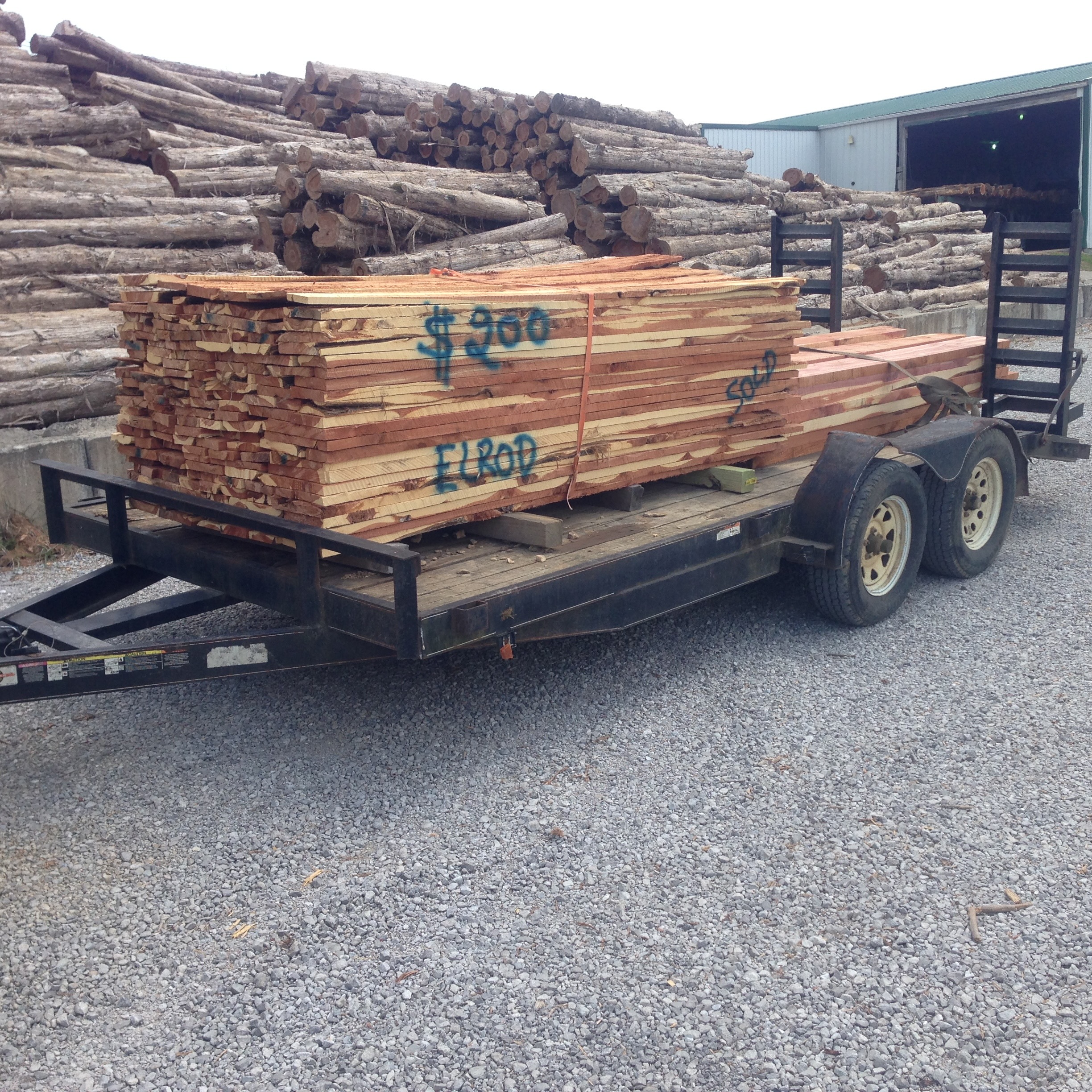
The morning started innocently enough. I had borrowed Boogus’s trailer—bless that man’s patient soul—to haul a load of freshly cut cedar planks from the sawmill. These weren’t just any planks; they were destined to become the siding on Hawks Nest, my artist cabin perched high on the ridge like some Appalachian eagle’s nest. The cedar was beautiful, aromatic, and expensive enough that losing it would hurt both my wallet and my pride.
Our property was a testament to the fact that God, apparently, has a sense of humor about ambitious dreams. Of the fifty-four acres we’d purchased, approximately two square feet were level. Everything else was hills, ridges, ravines, and slopes that would challenge a mountain goat. The driveway I’d carved out of the hillside was less a road than a suggestion—a barely passable scar in the earth that required equal parts skill, prayer, and suspension of disbelief to navigate.
Halfway up this engineering marvel, my Dodge Ram’s clutch began its death rattle. The truck started slipping like a penguin on ice, and I could feel the weight of the cedar planks—probably over a ton of timber—pulling us backward toward what would certainly be an expensive and embarrassing disaster.
I stopped. This was my first mistake.
I stopped to “assess the situation,” as if I had any qualifications to assess anything involving heavy machinery, steep inclines, and the fundamental forces of nature. What I should have done was put the truck in park, engage the emergency brake, chock the trailer wheels, sacrifice a small animal to whatever gods oversee construction projects, and then carefully consider my options.
Instead, I got out to “adjust the trailer hitch.”
Now, let me pause here to explain something about trailer hitches to those of you who, like me six months earlier, thought they were simply magical devices that made things stick together. A trailer hitch is essentially a controlled connection that can become an uncontrolled connection very quickly if you don’t understand the basic principle that weight plus gravity equals momentum, and momentum plus recklessness equals disaster.
As I fiddled with the hitch mechanism, trying to look like someone who knew what he was doing (spoiler alert: I didn’t), I failed to do the one thing that anyone with half a brain would have done: chock the trailer wheels. This oversight was about to provide me with a very expensive lesson in Newtonian physics.
Click. A chill raced across my spine.
The hitch released with a sound that, in retrospect, was remarkably similar to the sound a guillotine might make if guillotines were designed by people who enjoyed irony. The trailer, suddenly freed from the struggling truck, began its descent toward the creek at the bottom of our property. Gravity doesn’t hesitate. Neither did the trailer.
This was my second mistake: I began chasing it.
Not metaphorically chasing it, as in “pursuing a lost dream.” I literally began running down the hill after a runaway trailer loaded with a ton of cedar planks, apparently under the delusion that I could somehow catch it, reason with it, or perhaps engage it in meaningful dialogue about the importance of staying on the right path.
“Randy!” Gina’s voice cut through the morning air from up the hill, where she stood watching her husband’s descent into madness. “Stop! STOP!”
But I was committed now to this course of action that can only be described as “profoundly ill-conceived.” The trailer was picking up speed, and I was running behind it like some demented sheepdog trying to herd a mechanical animal that outweighed me by approximately two thousand pounds.
I reached for the hitch.
This was my third mistake, and nearly my last.
The moment my fingers closed around the metal coupling, I understood what it meant to hold onto something that had no intention of being held. The weight—over a ton of cedar planks plus the trailer itself—combined with the momentum of a downhill trajectory, created a force that was approximately equivalent to trying to stop a freight train with a handshake.
The hitch tore from my grasp with such violence that I’m certain my fingers briefly achieved supersonic speed–they burned with pain. I stumbled, caught myself, and for one moment of clarity, had what can only be described as an epiphany: if I tried to grab that hitch again, it would probably hit a rut, snap upward like an angry serpent, and remove my head from my shoulders with the efficiency of a medieval execution device.
The trailer continued its downward journey, picking up speed, heading directly for the creek that marked the bottom boundary of our property. In that creek lay not only environmental disaster but also the complete destruction of cedar planks that had cost me more money than I care to remember.
But suddenly, miraculously, stupidly, I had an idea.
Instead of trying to stop the unstoppable, I would redirect it. Instead of fighting physics, I would attempt to collaborate with it. If I couldn’t grab the hitch without dying, perhaps I could influence the trajectory through the ancient art of… kicking things.
I ran alongside the trailer—now moving at a speed that made this decision questionable at best—and began kicking the side with all the force my middle-aged legs could muster.
BANG. BANG. BANG.
Each kick was accompanied by a prayer to whatever saints oversee construction disasters and the preservation of foolish men. Kick by kick, I managed to alter the trailer’s path, nudging it sideways, away from the creek and toward what I hoped would be a muddy but survivable landing.
And then, miraculously, it worked.
The trailer careened sideways, hit a patch of mud soft enough to slow its momentum, and came to rest in what could generously be called a “controlled crash.” The cedar planks remained intact. The trailer remained functional. And I remained alive, which seemed like the most unlikely outcome of all.
I stood there in the sudden silence, stunned by the realization of how close I had come to achieving what would have been the most embarrassing obituary in Tennessee history: “Local man killed by cedar planks while chasing trailer he forgot to chock.”
I looked up the hill at Gina, who was standing perfectly still, face white as fresh snow. We stared at each other across the distance. Her hand still pressed to her heart. My legs shaking. Two people who had just learned that you can die from incompetence as easily as from avalanches.
“Are you okay?” she called down, her voice carrying the tone that wives use when their husbands have just demonstrated that their survival to this point in life has been more due to luck than judgment.
“I’m fine,” I called back, which was technically true if you defined “fine” as “still breathing and in possession of all limbs.”
But as I stood there next to the trailer, my fingers throbbing, surrounded by the earthy smells of mud and cedar planks and the lingering aroma of my own terror-induced sweat, I realized something profound: this wasn’t just about building a cabin or creating an artist retreat. This was about learning to live in a world where my mistakes could literally kill me, where the margin for error was measured not in embarrassment but in emergency room visits.
This was about learning that sometimes the most spiritual thing you can do is chock your damn wheels.
Boogus arrived about twenty minutes later, took one look at the scene—trailer in the mud, cedar planks scattered like giant pickup sticks, me standing there with the expression of someone who had just had a very personal conversation with mortality—and said what he always said in these situations:
“Wow.”
Then came the next challenge: the hitch and trailer arm were bent so badly that it looked like modern art sculpted by physics and panic. But this was Boogus we’re talking about—the man who could fix anything with baling wire, determination, and what I suspect was actual magic. Somehow, he managed to hook the mangled apparatus back up to my truck well enough that we could transport the cedar load to a more level staging area.
From there, I loaded the planks onto my Honda SXS—a side-by-side utility vehicle that had become my most trusted companion in the ongoing battle against Appalachian topography. We’d named her Helga, for her red, rugged beauty that reminded me of Andrew Wyeth’s muse—the woman he painted with such obsessive devotion, capturing her strength and earthy sensuality in canvas after canvas. Like Wyeth’s Helga, our Helga possessed a kind of utilitarian beauty, all curves and power, built for work but somehow graceful in her purposefulness. The Honda, unlike my trailer-handling skills, had never let me down.
Trip by trip, load by load, I ferried the cedar up the impossibly steep ridge to Hawks Nest, where it would eventually become the siding for my artist cabin. But every time I looked at those cedar planks, I would remember the day I learned that building dreams in the wilderness requires not just vision and determination, but also a healthy respect for the fact that gravity always wins, physics doesn’t care about your spiritual journey, and trailer hitches are not metaphors for anything except the importance of understanding basic mechanical principles before you try to move large objects up steep hills.
The cabin turned out beautiful, by the way. But it’s probably the only artist retreat in Tennessee whose siding carries with it the story of a man who once chased a runaway trailer down a hill because he thought enthusiasm could overcome the fundamental laws of the universe.
I was wrong about a lot of things during those Kalien years. But I was never wrong about gravity again.
Coming Friday: Post Two of The Porn Conversations (When Discovery Becomes Conversation/ The Porn Talk Most Marriages Never Have)
...The wife walks in. Her husband is masturbating to porn on his laptop. He slams it shut, face flushed with shame, his shoulders slump, and his heart drops. She stands frozen in shock in the doorway, face torn between shock, anger, and disbelief. What happens next determines whether the marriage survives...
Leave a Reply