
For over thirty years, I’ve been talking about something I call “cracks in time” —those rare moments when the fabric of human civilization splits open, and everything changes. Suddenly, irrevocably, like a fault line rupturing beneath our feet.
The discovery of fire was a crack in time. So was the invention of the wheel. The printing press. Electricity. The telephone. The steam engine. The personal computer. The Internet. Mobile phones. Each one didn’t just add to what came before—they fundamentally altered what it meant to be human, how we organized ourselves, what we could imagine.
These aren’t mere technological advances. They’re temporal fractures—moments when history literally splits into “before” and “after.” Once we pass through a crack in time, we can never go back. Try having your grandmother explain what life was like before electricity. Try explaining to your children what the world was like before the Internet. The very questions become absurd because these technologies didn’t just change what we do—they changed who we are.
I’m watching two cracks open right now, and I’m standing with one foot on each side of both.
The Search Engine → AI Assist Crack
I’ve already crossed over. Have you? I don’t bother with traditional search engines anymore—scrolling through ten blue links, evaluating sources, opening multiple tabs, synthesizing information from fragments. That feels as antiquated to me now as using a card catalog at the library. AI-assisted search doesn’t give me pointers to information; it gives me synthesized knowledge. The research is done. I start from a curated synthesis rather than raw material.
This is not only faster—it’s a fundamentally different relationship to information itself. We’re moving from “finding things” to “knowing things,” and the implications are staggering.
The Email → Messaging Apps Crack
My Chinese masseuse recently stunned me. When I asked for her email address, she looked confused. She’s 46 years old and doesn’t know her email address. She never uses it. Everything happens through messaging apps—WeChat primarily, but also WhatsApp and others.
At first, I thought this was purely generational. But it’s more than that. In Chinese culture, WeChat isn’t just messaging—it’s payments, social media, government services, and business transactions. Email didn’t get replaced; it got absorbed into an integrated ecosystem. She lives in a post-email world, just as I live in a post-telegraph world. Europe is fast adopting this method of communication. Here in Barcelona, we could not function without WhatsApp; we use it for everything. There are days on end when I do not receive a single legitimate email. It is all spam and marketing.
America is far behind in adopting these two massive changes in how we do life, but it is only a matter of time.
The Pattern
Both cracks reveal the same underlying shift: the death of segregated, specialized tools in favor of integrated, conversational interfaces.
We’re moving from tools we use to environments we inhabit.
The question isn’t whether you’ll cross through these cracks—you will, or you’ll be left behind in a world that no longer exists. The question is whether you’ll recognize them as they’re opening. Most people don’t. They experience the transition as disorientation, loss, and anxiety about “the way things used to be.”
But as a Herald, and after three decades of watching these cracks appear, the people who thrive are the ones who develop the peripheral vision to spot them early, the courage to step through while the rupture is still fresh, and the wisdom to help others across.
We’re living in a time of unprecedented temporal instability. More cracks are opening now than at any point in human history. AI. Quantum computing. Synthetic biology. Each one is a potential civilization-altering fracture.
The only question that matters: When the ground splits beneath your feet, will you have the presence of mind to jump to the other side?
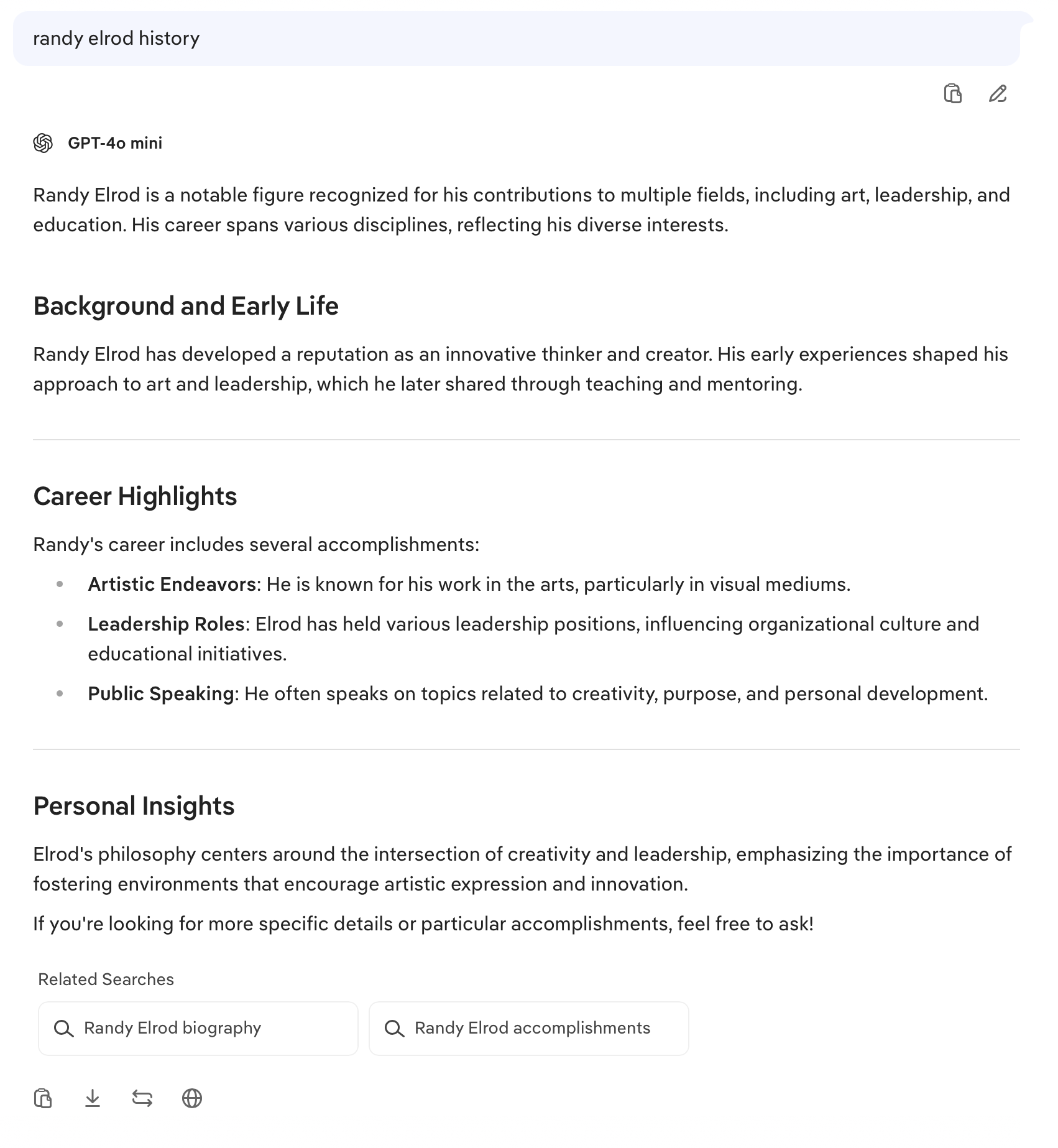
Below is what appeared when I asked DuckDuckGo AI search assist about myself: Randy Elrod. I have no idea how this was compiled; however, it is flattering, and, surprisingly, on traditional search engines, for years, one of the inevitable drop-down suggestions has been Randy Elrod divorce. Fascinating.
Leave a Reply