The Historical Novel Society reviews The Mysteries of Barcelona
The journal of the Historical Novel Society reviewed The Mysteries of Barcelona in its November issue.
If the name is new to you, HNS is the leading voice for historical fiction in the English-speaking world. Its reviewers sift through mountains of submissions, and an independent novel earns a place in those pages about as often as a Barcelona moped yields to a pedestrian.
The reviewer, Nigel Willits, reads with a discerning eye and a sharp pen. He found the final third of my novel short on dramatic thrust, and then added, in parentheses, “despite plenty of thrusting!”
I laughed out loud at my desk. Then I read it to Gina, and she laughed louder.
He also warns readers that the intimate scenes arrive described with “an unrestrained anatomical relish.”
Guilty, Mr. Willits. As charged.
I come by it honestly. When Eugène Sue serialized The Mysteries of Paris in 1842, critics scolded him for wallowing in the gutter, and Paris bought every installment anyway. (Karl Marx found the book offensive enough to attack it at length in The Holy Family. Imagine a reviewer like that.) Half a century later, the Théâtre du Grand Guignol built its whole reputation on excess, and legend says the house kept a doctor on hand for the fainting.
My erotic Gothic serial makes a promise in its subtitle. A reader who wants restraint has picked up the wrong book, and a reader who wants the gaslit, blood-red, overripe nineteenth century has found the right one.
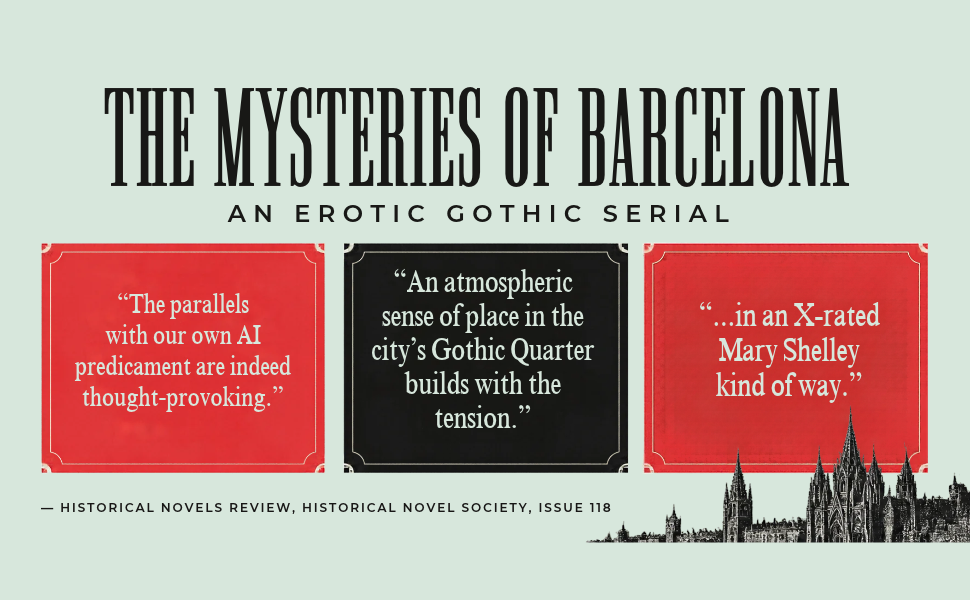
What pleased me most was where Mr. Willits lingered. He wrote that the parallels with our own AI predicament “are indeed thought-provoking,” and that the novel fulfills the Gothic brief “in an X-rated Mary Shelley kind of way.”
Mary Shelley. I’ll take it.
Baltasar’s automatons were inspired by a visit to the Museu d’Autòmats on Tibidabo, the mountain above our home, and somewhere in the writing they turned into a question I haven’t stopped asking: what happens when the made thing begins to want? Many of you have followed my essays on AI and consciousness here. The novel asks the same question by candlelight.
The reviewer praised the setting too: “An atmospheric sense of place in the city’s Gothic Quarter builds with the tension.”
That one landed close to home. The Barri Gòtic sits a short metro ride from my door. I know the chill that settles in Carrer del Bisbe after dark, the solemn hush of the ancient medieval alleyways behind Barcelona Cathedral, and the way a single footstep echoes off stone a thousand years old. Chloé haunts those streets because I haunt them.
Book Two is on the slab now, stitched together at midnight and waiting for lightning. Mr. Willits wants the final third to race, and I want that too. Chloé has unfinished business, and I promise she’ll keep seducing and avenging.
My thanks to Nigel Willits for reading so closely, and to the Historical Novel Society for opening its pages to an indie Gothic serial with blood on its hands.
Read the full review HERE.
Find The Mysteries of Barcelona HERE.
Yours, unapologetically, in an X-rated Mary Shelley kind of way.
Leave a Reply