For most of my life, I have been a problem the culture could not solve.
Too sensitive for the men’s table. Too sexual for the saints. Too intellectual for the artists. Too wild for the institutions. Too tender for the patriarchs who needed me and yet despised me for it simultaneously. I spent decades believing the problem was mine — some flaw in my wiring, some failure of will, some unresolved wound that therapy, prayer, or sheer discipline might eventually correct.
Then, in 2006, I left the church. And I started painting nude women.
They burst out of me — hundreds of watercolors across twenty years, bodies generous and unashamed, breasts large and unapologetic, the whole female form rendered with a reverence I could not have explained and did not try to. Something that had been dammed for decades broke open the moment the institution no longer stood over it. Like an orgasm that had been building for thirty years. The paintings came the way suppressed things always come when finally given air — all at once, unstoppable, overwhelming, carrying more information than I could read at the time.
I called it art. I called it practice. I called it an obsession with beauty and the female form. All of that was true. What I did not know — what it took another twenty years and hundreds of books and dreams to understand — was that every one of those women was a self-portrait.
The anima. Jung’s term for the feminine soul living inside every man, banished into the unconscious by a culture that punishes its expression. She had been there the entire time. The church had no room for her, so she patiently waited. The moment I left, she picked up the brush.
The large breasts were not a fantasy about women. They were a symbol — my unconscious translating into image what my conscious mind had been trained to suppress: a sensuality so large it had been shamed for as long as I could remember, a body whose capacities exceeded what the culture called acceptable for a man.
I did not know any of this while I was painting. Evidently, that is how the unconscious works. It knows what the ego refuses to see, and it finds its way out through the hands when the critical mind is looking elsewhere.
ºººº
The question in the title is one I have circled for years without quite landing on it. Am I a woman in a man’s body?
I wrote that phrase. The experience it names is real and deserves every dignity. And yet it does not fit me. I am heterosexual, male-bodied, with no desire to present otherwise (at least, right now, but I am increasingly open to every desire, every experience). The male body is mine, and I am at home in it.
And yet my interior has always lived in a different country from the one the culture assigned me.
Margaret Fuller — the nineteenth-century intellectual and journalist, the woman who electrified every room she entered and found in Europe what America could never give her, wrote in 1843 that there is no wholly masculine man and no purely feminine woman. She was writing about herself. When I read her biography last year, I left notes in the margin: Gina. Barcelona. Spain. and May I hope for that there? and finally, next to her line about the masculine and feminine existing on a spectrum in every soul: I wrote: Meeeee!!!
My interior has always been more Margaret Fuller than Ralph Waldo Emerson. More thyrsus than sword. More generative than dividing.
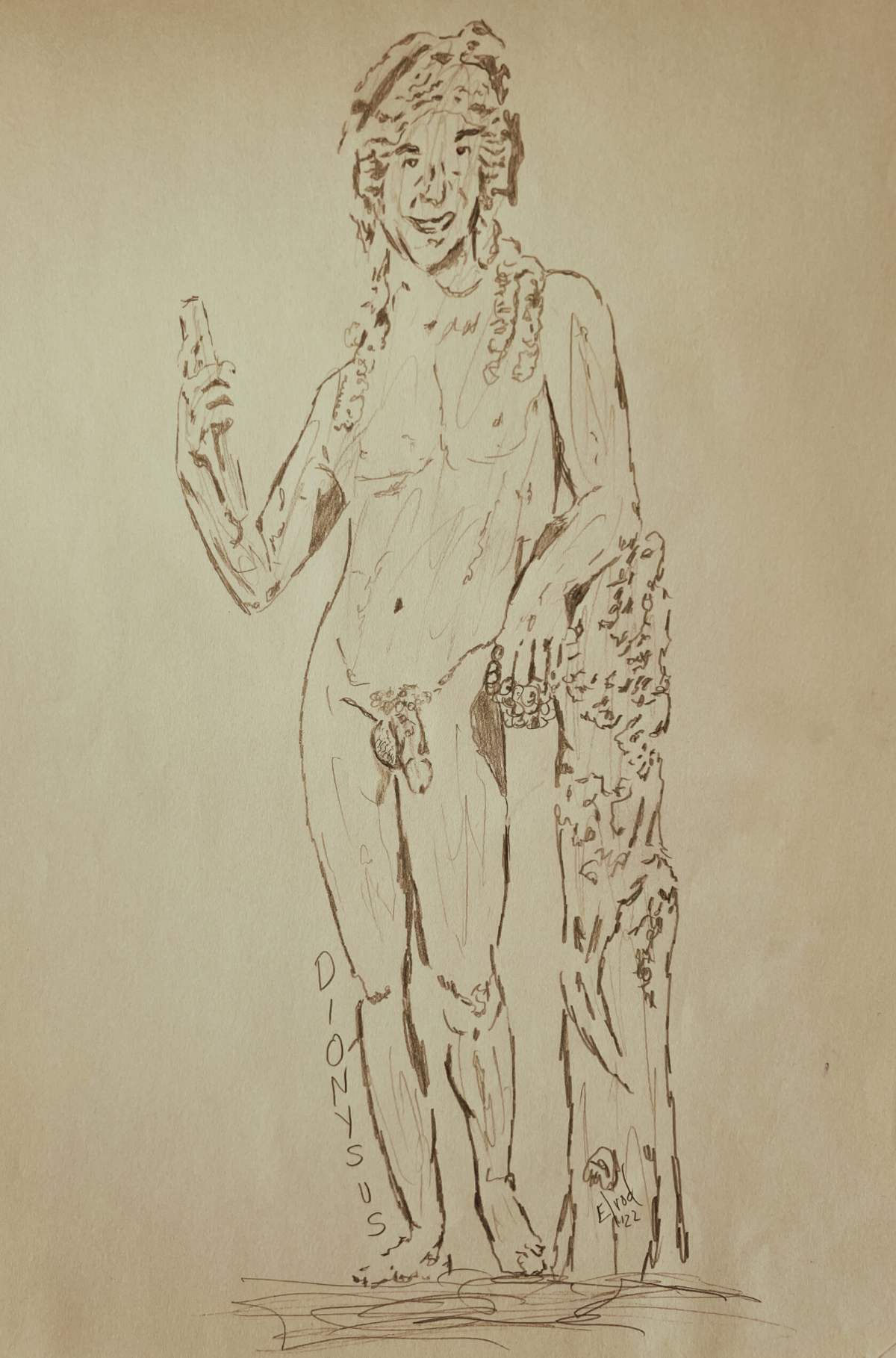
The thyrsus was Dionysus’s wand — a staff of fennel topped with a pine cone, carried by the god who could not be contained by category. Where the sword cuts and separates, the thyrsus generates and connects. Where Apollo brings order, Dionysus brings transformation. Where the patriarchy builds walls, the thyrsus tears them down and plants something in the rubble.
I have always been a thyrsus man in a sword culture. No wonder I have always been misunderstood. Too gentle to live among the wolves.
This essay grew out of a project I have been building for the past few weeks— a Book of Marginalia, a catalog of my reading life organized as an annotated library card index. Every book I have loved, every passage that reached in and grabbed something, every margin note I left that said ME!!! or Wow!!!!! or simply a person’s name. The project began with an idea from Fernando Pessoa’s Book of Disquiet and expanded into over 200 cards and counting — fiction, philosophy, biography, erotic literature, Gothic novels, Jungian psychology, books about aging, elderhood, and the complete life.
What I did not expect was what the catalog would reveal about me.
The protagonists I identified with most fiercely were almost all women. Margaret Fuller. Dagny Taggart of Atlas Shrugged. Nell Stone — the anthropologist in Lily King’s Euphoria who builds a grid to map where cultures place their most gifted people, and who asks every reader: what are my coordinates? Helen Rask, the protagonist of Trust. Dorothy/Jackie, the heroine in The Woman Who Lost Her Soul whose curiosity is the difference between the dead and the living. And now Chloé, the powerful woman at the center of The Mysteries of Barcelona— the avenger of patriarchal wrongs — whom I created, which means she came from somewhere inside me that I was finally ready to name.
When I read Middlesex — Eugenides writing the intersex narrator who carries both in a single body — I marked the line: biology gives you a brain, life turns it into a mind. And: sex is biological, gender is cultural. When I read Sophie Strand’s The Flowering Wand — her recovery of the sacred masculine that the patriarchy suppressed along with everything feminine — I underlined the passage about a man who can dance with plants and honor beasts, be a woman and an androgen and an animal, and I wrote: Me. When I read Smart Sex, I marked the passage about every person containing both masculine and feminine energies and left the note: Me right now.
The catalog had been building a portrait of someone who lives in the threshold — the Irish author John O’Donohue’s threshold, where many infinities meet — between what the culture called masculine and what it suppressed. The margin notes were a man finding his way home through other people’s books, which is the way a rare few of us find our way home.
There is a detail from my professional life that belongs here because it names the patriarchy’s con more clearly than anything else I could offer.
For years, I served as arts director to senior pastors (male, all male). In Christian conferences — actual conferences, with keynote sessions, breakout workshops and printed curricula — I was taught that my role was to function as the wife of the pastor. The sensitive, relational, artistic counterweight to his authority. The softener of his image. The feminine face of the institution’s masculine power.
They needed what I was. They named what I was with accuracy. And then they structured the institution so that what I was could never rise, could never lead, could never be recognized as a form of authority in its own right — only as a support system for someone else’s.
That is the patriarchy’s great con: it needs (and fears) the feminine qualities it publicly demeans. It requires sensitivity to hold communities together, empathy to retain loyalty, creativity to generate meaning, tenderness to keep people from leaving. And it extracts all of those qualities from the people who carry them while insisting, simultaneously, that those qualities are weaknesses.
The Joe Rogans, Elon Musks, and Donald Trumps of this cultural moment are not anomalies. They are the patriarchy in its most desperate and theatrical form — men who sense that the old categories are failing and respond by doubling down on brittleness, by weaponizing contempt for empathy, sensitivity, gentleness, and kindness, by turning the fear of the feminine interior into a political program.
They are afraid of what I am. They should be.
ºººº
So who am I?
The Greek pantheon had a figure for this, and his name was Dionysus.
He arrived in women’s clothes and commanded armies. He was virile and tender simultaneously, the god of wine and ecstasy and theater — which is to say, the god of altered consciousness and creative expression and the dissolution of the boundaries between self and world. He was the only Olympian born of a mortal woman, which made him the god closest to humans. He was the only one the other gods feared, because he could not be contained by their categories.
However, he carried the thyrsus. He never carried the sword.
He was not androgynous in the sense of in-between-ness or confusion. He was both, fully, simultaneously. The spiritual masculine that Strand was trying to recover — the wand that connects body, mind, soul, and spirit, that belongs to the man who has reclaimed his capacity for wonder and tenderness without surrendering his power — is the Dionysian masculine. The masculine that the Puritan tradition suppressed, along with everything else it could not control.
The evangelical church I grew up in had no room for Dionysus. It had the sword and the sermon and the order of service and the doctrine of headship and the role of the feminine who softened the authoritarian’s message. It had no category for the man whose interior was intimate, whose sensitivity was charismatic, whose sensuality was limitless, whose orgasms came in waves and sounded like a woman’s.
Spain, apparently, does.
ºººº
And of course, it had to be Barcelona. This city has been called the great enchantress, and she whispers my name daily. Gina urged me toward her — she knew, before I did, that this city would captivate and free me. Barcelona’s Modernista facades bloom and curve like bodies. La Sagrada is the Dionysian thyrsus in the heart of the city, the Dionysian phallus. She is a city built on the principle of the flowering wand: generative, ornate, excessive, alive.
She is integrating my feminine — and teaching her to walk openly in daylight — and she is arousing my masculine, the ancient phallic energy that the church tried to castrate. Barcelona is now making love to ALL of me with her heat and her energy and her unapologetic passion for life. I did not choose Barcelona. She chose me. And she is not nearly finished with me yet.
I am writing this at a nexus in my own becoming. Having spent years painting my anima into existence and another decade gaining the courage to name her, I find myself turning now toward something new — toward the masculine itself, the drive and the desire and what Jungian analyst Eugene Monick calls phallic thrall. The intense masculine sexual energy that runs underneath everything, that the church called sin and the culture called shameful, and that I am only now learning to call spiritual.
This is what the Dionysian path looks like in practice: you do not choose between the feminine and the masculine. You embrace them, each in its time, each at its depth. I spent most of my life suppressing the feminine. I spent the last two decades discovering her.
Now I am ready to turn toward the masculine and ask the same questions: what is it, underneath the persona? What does it want when the shame is removed? What does a man’s desire look like when it has been reclaimed from everyone who told him it was dangerous?
These are not questions I am afraid of. They are the questions Dionysus has always asked.
ºººº
Here are the truths a lifetime of reading taught me, margin note by margin note, in a catalog of 200+ books that is turning out to be a single long revelation about who I am:
The body is not the problem. The body has always known. The watercolors were self-portraits from the beginning. The protagonists I loved were waypoints. The church that named me its wife and then silenced me was, in its perverse way, seeing something real. The orgasms that come in waves have always been screaming the truth.
Margaret Fuller wrote in 1843 that what concerns her now is that her life be beautiful, powerful — in a word, complete (I would say: whole). She was writing about herself. She was also writing about me.
The complete life is the one that integrates four aspects — the body, mind, soul, and spirit, by embracing the masculine and the feminine, the sensuality and the philosophy, the painting and the writing, the thyrsus and the wine. Both the man on the outside and the woman who burst out of him the moment the church doors closed behind him for the last time.
She has been patient. She has been painting. She has been healing. She has been growing.
I am not a woman in a man’s body. I am Dionysus. Hear me roar.
***Featured Art: The Artist as Dionysus (A Self-Portrait) by Randy Elrod
Leave a Reply