#1
Oklahoma required a physical Bible in every public school classroom. Spent $25,000 of taxpayer money on Trump Bibles before the courts stepped in. Texas put the Ten Commandments on every classroom wall and mandated daily Bible reading periods. Both states ban books about LGBTQ families to protect children from dangerous content.
The Bible they’re mandating contains gang rape. Incest. A woman dismembered and mailed across a country in pieces. A king who watches a woman bathing from a rooftop and takes her. Explicit erotic poetry about breasts and thighs and a lover’s mouth.
Uncensored. Unedited. Every word of it canonical scripture.
This series is for everyone who suspects the real Bible is far more honest about human beings than anything that ever got preached on a Sunday morning.
Welcome to The Interpretation of Erotic Bible Stories.
ºººº
She knew how to read a room.
That’s the first thing you need to understand about Rahab. Before we get to the spies hidden under the flax, before we get to the scarlet cord, before we get to her name appearing in the bloodline of Jesus of Nazareth — which it does, right there in Matthew chapter one, in black and white, Rahab the prostitute, mother of Boaz, great-great-grandmother of David, direct ancestor of the man Christians call the Son of God — before any of that, you need to understand that she was a professional.
She was good at her work.
She read men the way a sailor reads weather. She knew within thirty seconds of a man walking through her door what he needed, how frightened he was, how much tenderness was buried under whatever face he was showing the world. She knew the difference between a man who wanted a body and a man who wanted to be seen. She knew how to give both. She had been doing this long enough to know that most men who came to her were lonely in ways they had no words for, and that what she offered was real — real warmth, real presence, real relief from the grinding loneliness of being alive.
She loved people. That was her secret. The one her profession’s reputation made invisible. The Hebrew word the text uses for her is zonah — זונה. It means prostitute. It also, in the same consonants, the same breath, means a woman who provides nourishment. The translators had to choose. They chose prostitute every time.
Then the New Testament writers cited her in the genealogy of Jesus and used the Greek word porne. Unambiguous. Unashamed. No inn-keeper escape hatch. Porne. Right there in the bloodline of the Messiah.
ºººº
I read about a woman — interviewed by the BBC — who has been a sex worker for years and plans to continue until she is sixty-five. She said this without apology. She said she loves bringing pleasure to people. She sets her own hours, chooses her own clients, earns an excellent living, and finds genuine meaning in the intimacy her work creates. She was articulate, warm, funny, and completely at home in herself.
Every fundamentalist I grew up with would have told you she was lying. Or broken. Or enslaved to something she couldn’t name. They needed her to be a victim because a woman who chooses this work and loves it — a woman who has built an interior life, who has dreams and opinions and genuine compassion for the humans she serves — dismantles the entire theological structure they built around sex.
Rahab dismantles it, too. She’s been doing it for three thousand years. Religious people keep plastering over the cracks.
ºººº
The two Israelite spies arrived in Jericho and went straight to her house. The text doesn’t explain why. It doesn’t need to. Men who needed cover, men who were strangers in a dangerous city, men who needed someone who would take them in without asking too many questions and who understood the currency of discretion — they knew where to go.
She took them in. Did she fuck them? I’ll leave that for you to decide.
Then the king’s men came knocking.
Most readings of this story go soft, turning Rahab into a passive vessel of divine providence, a woman swept up in God’s plan who barely understood what was happening to her. That reading requires you to stop actually reading the text.
Rahab lied to the king’s men with the ease of a woman who had been navigating powerful, dangerous men her entire adult life. She said the spies had already left. She sent the soldiers off in the wrong direction. Then she went back upstairs to negotiate.
She negotiated. She set terms. She named her price — my life, my family’s lives, everyone inside this house — and she held to it. The spies didn’t save her. She saved them and then invoiced accordingly.
This is a woman of tremendous interior power doing what she has always done: reading the room, identifying the leverage, moving.
ºººº
And that scarlet cord in her window? Some scholars believe it marked a red-light establishment. The same cord. The same color. The same window.
The thing that marked her house as a place men came for sex now marked it as a place death would pass over—the erotic and the sacred living in the same symbol. The erotic and the sacred have never been separate. Only religious translations pretended otherwise. Rahab didn’t change her window. She didn’t change her profession. She changed what the cord meant — or rather, something larger changed it for her, through her, using the exact materials of her actual life.
God, if you want to use that word, did not ask Rahab to become someone else first. She was a prostitute, a whore, in today’s terms, a sex worker.
That is the theological grenade in this story, and the church has been trying to defuse it ever since.
ºººº
I want to give Rahab back her interior life. The text stripped it. The tradition buried what remained. So here is what I imagine — what I feel — when I sit with her story:
She had seen the fear in Jericho for weeks before the spies arrived. The whole city knew about the Israelites camped across the Jordan. Knew about the Red Sea. Knew about the kingdoms already destroyed. The fear was in the streets, in the markets, in the eyes of her clients when they came to her and couldn’t lose themselves the way they usually did.
She lay awake some nights with fear moving across her like cold sweat. Raw, visceral fear.
And yet when the moment came, she moved. She acted. She hid two strangers under the flax and lied to the king’s men without flinching. That is what courage looks like — afraid and moving anyway, for the people she loved.
She had watched powerful men her whole life and understood what they consistently missed. The ones coming across that river were going to win. She knew it the way she knew men — in the body, before the mind caught up, as certainty rather than conclusion. She had decided she was going to be on the right side of this history.
When the spies appeared, she recognized them immediately. Two foreign men, nervous, trying too hard to look ordinary. She looked at them, and her whole body said yes.
She let them in.
She hid them under the flax on her roof and knew she had just changed everything.
ºººº
This is the part that gets me every time.
Matthew chapter one opens the entire New Testament with a genealogy. It is the first thing in the Christian scriptures — a list of fathers and sons, the ancestral line of Jesus, forty-two generations from Abraham to Bethlehem. Genealogies in that culture were everything. They were identity, legitimacy, and covenant. They were the most formal, official, serious document a community produced.
And Matthew, deliberately, provocatively, puts four women in it.
Tamar, who disguised herself as a prostitute to seduce her father-in-law. Rahab the prostitute of Jericho. Ruth, who crept to the threshing floor at midnight and uncovered a man’s body. Bathsheba, whom a king watched bathing from a roof and then took.
Four women with transgressive, complicated, sexual histories. In the lineage of the Messiah. Matthew had to know exactly what he was doing. He was saying something the church has spent two thousand years trying to unhear.
The sacred does not arrive through purity. It arrives through the full, complicated, often transgressive reality of human bodies and human lives.
Rahab the prostitute is in Jesus’ bloodline as herself, wholly, the scarlet cord and all.
ºººº
I have known sex workers. Real women with rich interior lives — women who are funny and philosophical and genuinely compassionate, women who have children and love them dearly and provide for them, women who have opinions about literature and dreams about where they want to live and complicated feelings about their families of origin, women who chose their work and find meaning in it and resent like hell being told they must be broken.
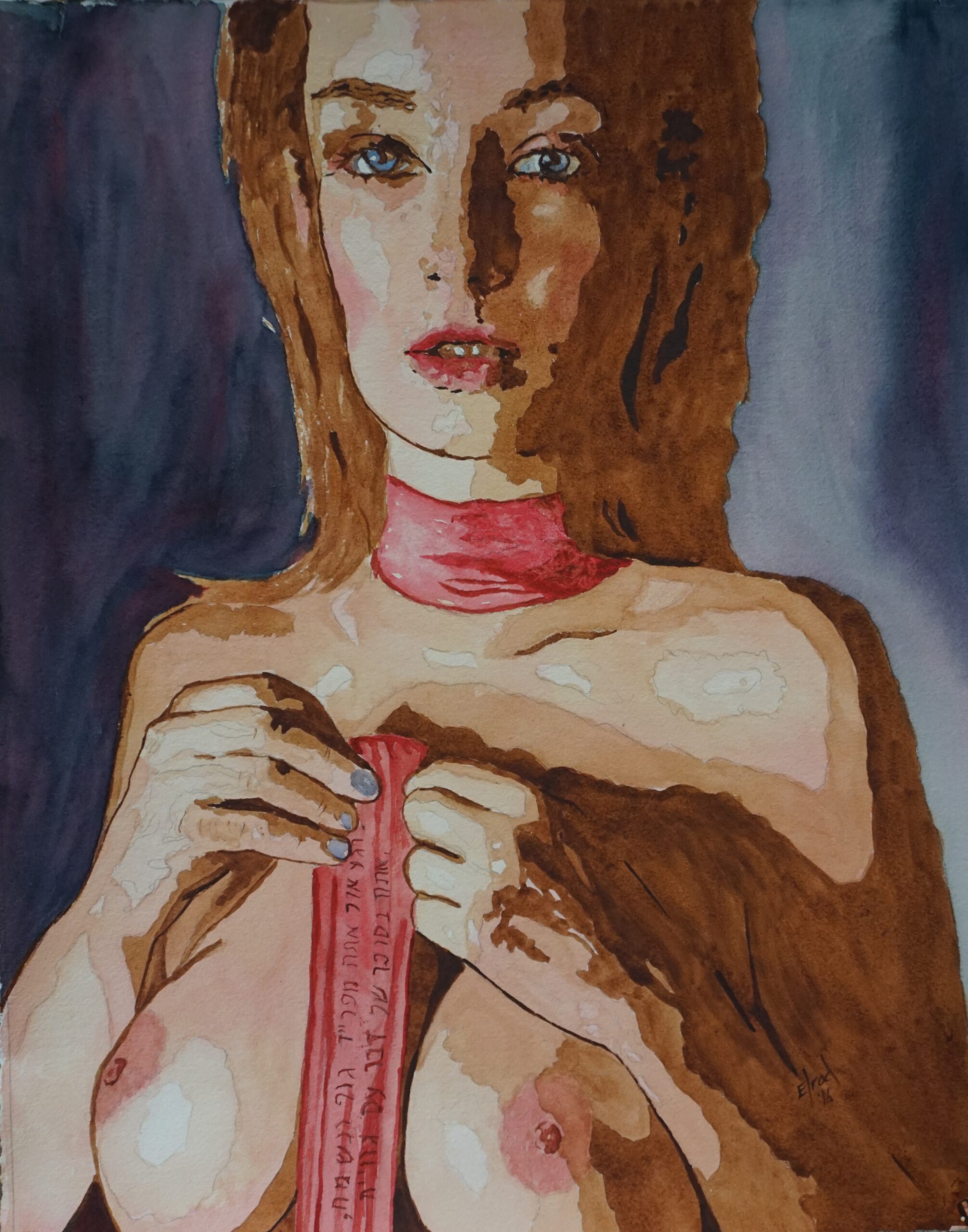
There is a painting I made of Rahab. I gave her blue eyes deliberately — here in Spain, in a country where nearly everyone has brown eyes, blue eyes carry a beauty and otherness that makes you look twice, that marks someone as both desired and different, which felt exactly right for Rahab. She is holding the scarlet cord in both hands, Hebrew text running down its length. Her breasts are bare, and she is completely at home in that. Her nudity tells you something the text forgot to — that this woman lived in her body without apology, that her body was her instrument and her home and her power, and that she was proud of all three.
She is looking straight at you.
She is absolutely not ashamed.
That is the Rahab the text doesn’t give us.
That is the woman I want to give back to you uncensored.
Where in your life have you been reduced to a single label — and what becomes available when someone finally sees past it to the full human being holding the cord?
Next Thursday: The Interpretation of Erotic Bible Stories, No. 2, Tirzah, the Levite’s Concubine
Leave a Reply