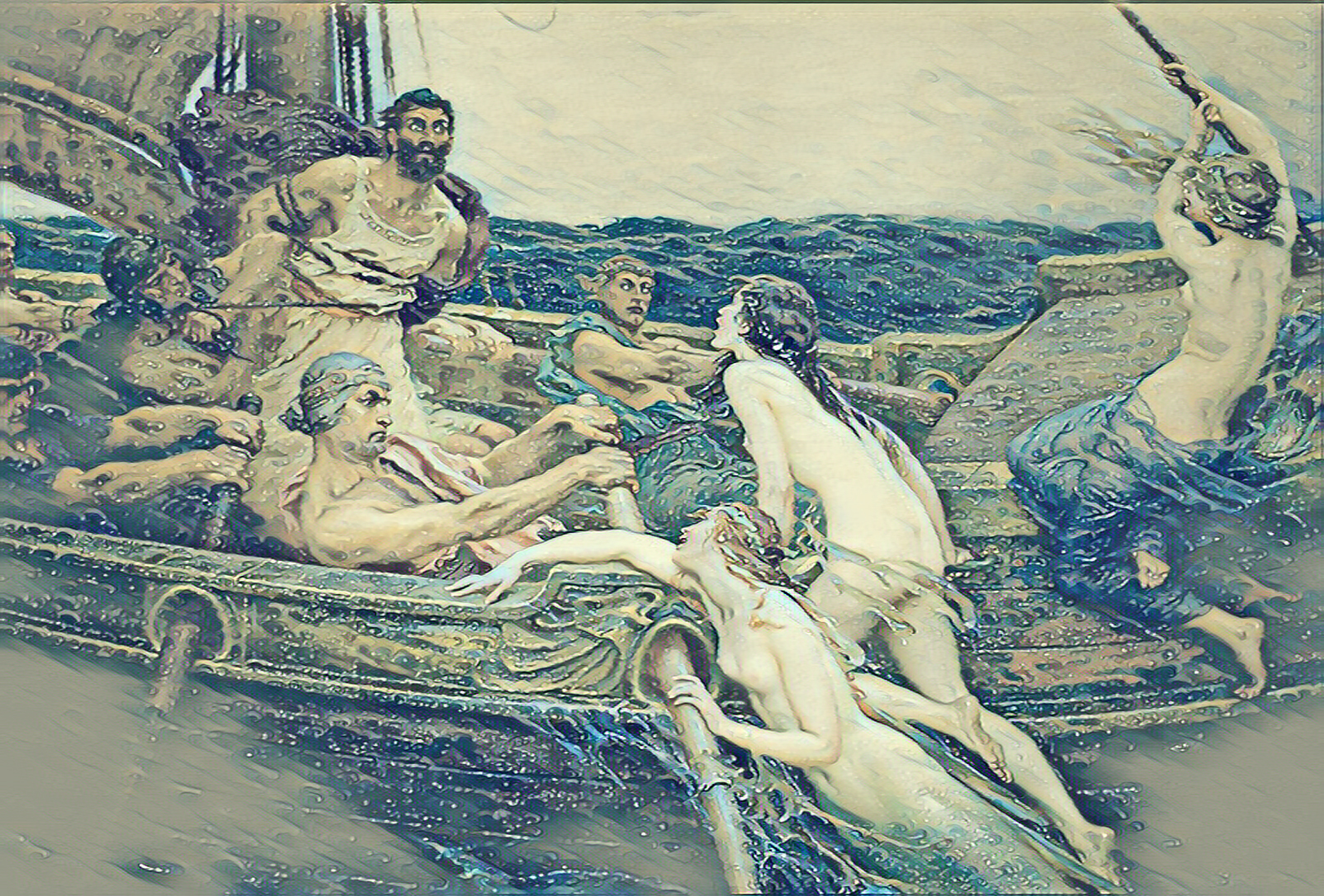
Christopher Nolan’s The Odyssey opened last week to $124.5 million domestically. It was the biggest live-action debut of the year, the best global launch of Nolan’s career, and a 95% on the Tomatometer. It is about a king who takes ten years to sail home from a war. The whole thing was shot entirely on IMAX cameras, and theaters are running 70mm screenings at two in the morning for people who refuse to wait until a civilized hour. Half the audience is under thirty-five. A generation raised on superhero sequels is discovering, in a crowded theater with popcorn in hand, that Homer already invented every plot they thought was new.
I read the box office numbers and laughed out loud, alone, in my apartment in Barcelona. I met Odysseus, Penelope, the Sirens, and Circe when I was nine years old. They have been with me ever since.
I went to see the film with expectations sky-high. Nolan is my favorite director alive, and the movie earns its acclaim. But sitting in that theater, watching the stunning Trojan Horse scene crammed with smelly poopy people rendered at staggering IMAX scale, I realized something that had nothing to do with the film’s quality.
All the cameras in the world, all $250 million of production, could not equal the Odyssey I created at age ten in a mountain shack with no budget and no crew. That version still runs, uncut and uncensored, in the limitless theater of my mind. Nolan regifted the world a timeless myth. My imagination gave it to me first, and it has never left my screen and never grown old.
I grew up poor in the Appalachian Mountains, in a three-room house where my whole family slept in one bedroom. Twelve schools in twelve grades. No television. But there was a library down the mountain in the city of Chattanooga. The building opened in 1905 and was built with a $50,000 gift from Pittsburgh steel magnate Andrew Carnegie. A native of Scotland who came to the United States as a young boy with limited means, Carnegie had been an avid reader. As a result, he wanted others to enjoy the pleasures of reading as well.
The library, which became my theatre (our religion did allow us to go to movies), was already sixty-three years old the day I climbed its tall concrete steps. In that library of 13,000 square feet and three floors of magic and mysterious nooks and crannies, I found the gods.
I still remember the shelf where I found D’Aulaires’ Book of Greek Myths, thick with color plates. It was my gateway drug. Then Padraic Colum’s The Golden Fleece handed me Jason and the Argonauts like a passionate secret. Then Rosemary Sutcliff’s The Adventures of Odysseus, and I was raptured completely.
Homer. The Iliad. The Odyssey. Helen of Troy. I couldn’t get enough Greek and Roman mythology. No one was ever in that room except me. It was the one place the bullies couldn’t reach me. Zeus. Athena. The sirens. Oh, the sirens. Perhaps they were my first arousal. The siren scene was Nolan’s most disappointing moment for me. It featured a whirlpool rather than the sensual temptresses of my imagination.
I remember the words I read fifty years ago as if it were today: a raft, a wine-dark sea, and a man clever enough to outlast monsters and gods.
Northrop Frye said literature carries us into a realm separate from the world of fact, and that an educated imagination lets us picture what might be, what could be, and therefore what should be. I didn’t read Frye as a boy. I lived him. The facts of my childhood were poverty and a punishing religion. Myth was where I went to breathe… and lust. Homer gave me heroes who lied, seduced, raged, wept, and still got called great. That told a poor suppressed Pentecostal kid something no sermon ever did: that a complicated and sensual man could be a hero. I have spent most of my adult life extending myself that same permission, and freeing my moral imagination.
From mythology I widened out fast. Tom Sawyer and Huckleberry Finn gave me a raft of my own and a friend willing to break a cruel society’s rules for another man’s freedom. I was Tom. I paddled that river in my head a thousand times before I ever left the mountains. The Hardy Boys taught me that mysteries got solved by boys nobody thought were important. Boy’s Life by Robert McCammon opened with a line I have never forgotten — I believe in magic — and that sentence did more theological work on me than a decade of altar calls. Peter Pan came back around decades later, my youngest daughter pushing the original text into my hands, and I discovered at mid-life that the boy who refuses to grow up had been waiting for me the whole time, patient as myth always is. I have called myself a man-child for years, only half joking, and Peter Pan is the reason why. Growing older was never going to cure me of him.
The gods weren’t finished with me either. At sixty, the man-child who never fully left Neverland found Madeline Miller’s Circe, and it moved me the way only a handful of books ever have. Miller took a minor witch from the margins of Homer’s story and gave her the archetype of a healer and a whole interior life: banishment, motherhood, sensuality, centuries of loneliness, a fierce late-life claiming of her own power. I read it as a man who had spent thirty years in an institution that told women exactly what portion of themselves they were allowed to keep. Circe kept all of hers. I wept reading the last page, sixty years old, still the same boy who once fled home from a library with a stolen afternoon of Homer dancing in his head.
Then science fiction found me, and it became, in my own words, a drug. Heinlein. Bradbury. Vonnegut. Andre Norton, whose Catseye planted in me a permanent instinct to fight for the underdog; this was years before I discovered Norton was a woman writing under a man’s name to get published at all. These writers handed me futures nobody in my church could imagine, and futures were just myths that hadn’t happened yet.
In sixth grade, alone in that same library, I pulled a green cloth-bound book off the shelf because its title character shared a name with a Titan condemned to hold up the sky. Atlas Shrugged. I read the first page — Who is John Galt? — and the librarian had to shake me hours later to say she was closing. Mom found me, took me home, and I hid in my closet and finished the whole book in three days. Then I turned back to page one and read it again. Whatever anyone wants to say about Ayn Rand’s politics, and there is much I disagree with, that book handed a repressed thirteen-year-old his first permission to want things: a sensual and powerful woman, men with minds of their own, and a life built by one’s own hands instead of handed down by pulpit or family. My dream of Galt’s Gulch never died. It found reality, eventually, at a mountain retreat I named Kalien.
Later came John Fowles’s The Magus, a book I still tell people to read before they turn twenty-one, because it taught me that reality itself could be staged and manipulated and still carry deep truth underneath the theater. And Jung’s Man and His Symbols gave me, decades on, the vocabulary for why all of it mattered in the first place: that myth was not just childish fantasy. Myth was the unconscious speaking in the only language it has.
Which brings me to Dionysus.
I was raised to worship a god of the heavens, of regulations, of rules, a god who fled the earth at death and returned to heaven rather than staying to get his hands dirty with humanity and fleshly desire. Somewhere in my sixties, living in Spain and communing with place instead of dogma, I found the god I had been longing for since I was nine years old.
Dionysus. Nature. Wine. Ecstasy. Theatre. A god who dances instead of judges. In Sophie Strand’s telling, Dionysus is the one who pulls Christ out of that tomb and buries him in the earth, forcing him to become one with the world instead of forsaking it.
Because of Sophie Strand, the image of a flowering wand rather than a dividing sword has charged my imagination. That image alone required the foundation of childhood myths to build upon. If you have the opportunity to visit my home in Barcelona, the first thing you will see is my sculptures of a god’s nude torso and a golden replica of my phallus sprouting a flower.
Here is what I know at sixty-eight that I couldn’t have said at nine. Every one of those books was a scene of my life’s movie. Homer, Twain, Heinlein, Norton, Rand, Fowles, Jung, Strand. It was not an escape from my life. It was training for it. The moral imagination Frye describes doesn’t just let us dream what might be. It builds the creativity and curiosity we later use to become it. I read my way out of Appalachia, out of the pulpit, out of a life a church had split into fragments.
I am, right now, living in a story, a movie, that I first imagined as a boy reading about a country I couldn’t have pointed to on a map, longing for a god I hadn’t yet met.
Christopher Nolan spent $250 million and three hours of IMAX film giving people back Odysseus this year. I got him for free, sixty years ago, immersed in the pages of a musty book off a shelf in Chattanooga, Tennessee. And my imagination gave the journeys and adventures of Odysseus a reality that even a creative genius like Nolan could not equal.


Leave a Reply