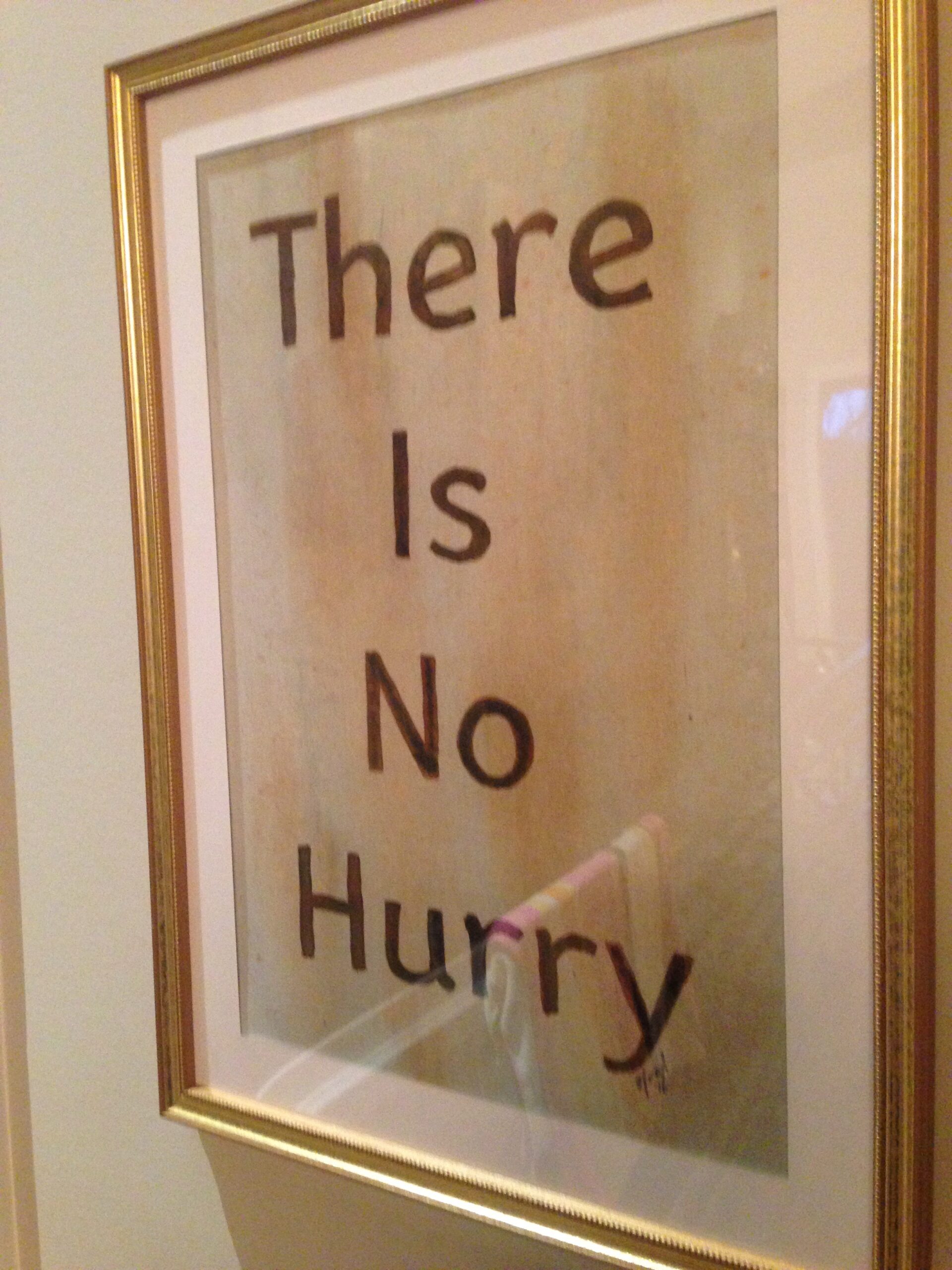
I painted those words myself.
Tall skinny letters on handmade paper, watercolor — hung in the great room at our wilderness retreat, Kalien, so I’d see it every morning walking out of the bedroom. A daily reminder. A manifesto of sorts. Five words I desperately wanted to believe.
And then I spent the next five years proving I didn’t.
I’d hurtle up the ridge in the SXS at breakneck speed to fix another broken fence. Another blown pump. Another stretch of dirt road, the rain had eaten overnight. I’d catch myself in a full sprint toward whatever crisis the land had cooked up for the day and mutter aloud, “Randy, there is no hurry.” And then immediately speed up. Cut the fallen tree. Grade the driveway. Feed the horses. Maintain the trails. Repair the fence again.
The wilderness is beautiful and it is ruthless and it does not give a damn about your watercolor philosophy.
That frenzied time was healing in ways I still don’t fully understand. But tranquil it was not. Here is the irony I could not have seen then: we had to sell the farm — exponential profit during COVID, of all the improbable windfalls — in order to finally live the life that painting was pointing toward. The wilderness had to make us enough money to leave it. Sometimes healing costs you the very place that healed you.
So we moved to Barcelona.
And for the first time in my sixty-seven years on this earth, I began to slow down. Actually, slow down. In my body. In my bones.
The Spanish have a word for it. Tranquilo. You hear it everywhere here — from shopkeepers, waiters, strangers on the metro. Calm. Peaceful. Relaxed. But the fuller meaning is something closer to a worldview: it is better to be than to do. Americans live to work. Spaniards work to live. That is not a small difference. That is a completely different cultural philosophy.
And then there is jubilado. Read that word slowly. Savor it the way you’d savor a glass of good Spanish wine. Jubilado. It comes from jubilar — jubilation. This is what they call retirement here. Jubilation. In America, we treated retirement like an ending, something to dread or deny. Here it is announced as joy. As the long-awaited beginning of something.
I am jubilado. How glorious is that?
I heard plenty of people in Florida insist that retirement is the busiest stage of their lives — that they could never slow down and wouldn’t know what to do with themselves. Those people have confused doing with living. But a culture that has been around for 2,000 years knows the difference.
ºººº
There is a whole lexicon of slowness I’m only now becoming fluent in.
Slow food — now a full movement, born when a group of indignant Italians watched a McDonald’s open near the Spanish Steps and decided enough was enough. Their manifesto declares that a firm defense of quiet material pleasure is the only way to oppose the universal folly of fast life. Their logo is a snail. Perfect.
Slow reading — what the brilliant Francine Prose calls close reading: you give a sentence the weight it deserves, and then you stay there a while. You let the words work on you rather than racing to find out what happens next.
Slow walking — Thoreau called it a ramble, which is exactly the right word, because a ramble has no agenda. You set out and see what finds you.
Sobremesa — that gorgeous, untranslatable Spanish word for the unhurried conversation that continues long after the meal is done, when the wine has been drunk, and there is nowhere on earth you need to be. The table is yours. The afternoon is yours. Stay as long as you like. This is not an accident of Spanish temperament; it is a feature, carefully protected, deeply meant.
Slow sex — tantra, which my therapist teaches me with a knowing smile and the same single word: tranquilo. Relax. Enjoy the journey. The destination, the orgasm, is not the point. What a lesson for a control freak who has spent sixty-five years trying to get things done.
Slow coffee — Which deserves a few paragraphs. Every restaurant in Barcelona — every single one, from the hole-in-the-wall tapas bar to the white-tablecloth temple — has a full-on espresso machine. With a frother. There are no sad carafes of burnt coffee sitting on a warmer since seven a.m. There are no Keurigs, God forbid. Even the old gym where Gina and I watch basketball has a proper espresso setup at the snack bar. A snack bar. With a frother.
We have a Starbucks one block from our apartment. We have never been inside.
We splurged on a DeLonghi La Specialista with a built-in grinder when we arrived, and we order fresh-roasted beans from a local roaster. Our morning coffee hour — which Gina and I have protected like sacred ground for years, no planning, no to-do lists, no devices, face to face — has become slower. More deliberate. Frankly, more sensual.
A Spaniard will spend twenty minutes with a two-ounce espresso. An American will slurp a Venti-Trenta-Whatever-the-Hell-They-Call-the-Largest-One in four minutes while driving. We have confused volume with pleasure. Velocity with satisfaction. Coffee here is not a caffeine delivery system. It is an event. It belongs to the sobremesatradition — a small espresso appearing after the meal as punctuation, not as the point. Slow coffee. Who knew that was a thing? I had to move 5,000 miles to learn it.
Slow Afternoon — Also known as the siesta. The word comes from the Latin hora sexta— the sixth hour from dawn, meaning midday. The Romans knew. The Spanish remembered. The Americans forgot entirely, somewhere between Benjamin Franklin and the sixty-hour work week.
Our first week here, Gina and I made the rookie mistake of trying to find dinner around four in the afternoon. Every restaurant was closed. The streets were vacant. A Tuesday. In a city of two million people. Shuttered, silent, gloriously unashamed. We stood on the sidewalk blinking at each other like the confused tourists we were.
Most of Spain closes from two to five. Every day. To rest.
I grew up in a tradition that treated rest as moral weakness. The Protestant work ethic dressed idleness up as sin, stamped it with scripture, and sent generations of exhausted, guilt-ridden Americans back to their desks. Napping was what the lazy did. The shiftless. In my first life — thirty years of ministry, then entrepreneurship, then building Kalien acre by acre with my own two hands — I don’t think I took a single guilt-free afternoon nap.
Now I take one almost every day.
I pull the metal shades down over our wall of windows — the ones that turn two in the afternoon into what feels like midnight — lie down, and disappear for forty-five minutes into what Tom Hodgkinson rightly calls a twilight nether world where ideas surface, and the body remembers it is not a machine. I wake up a different man than the one who lay down. Softer. Quieter. More willing to let the afternoon be whatever it wants to be.
The siesta is not laziness. The siesta is the opposite of hurry.
ºººº
Which brings me to Hodgkinson’s How to Be Idle: A Loafer’s Manifesto — the quintessential text for all of this, and one I want to press into the hands of every exhausted, overcommitted American I know (which is most of them.)
His central provocation: the idea of the job as the answer to all woes is one of the most pernicious myths of modern society, sold to us by politicians, parents, and productivity gurus from cradle to cubicle. Institutions fear idle people, he argues, because idle people think — and thinking people ask questions — and questions are dangerous. The relentlessly busy American is not a moral achievement. The relentlessly busy American is a managed one.
Hodgkinson is also rapturous on the nap, counting it among life’s perfect pleasures — one that splits the day into two halves, each more livable and more human than one unbroken slog. Barcelona figured this out centuries ago.
And this observation, which landed hard: the less conventional work he has done, the more genuinely productive he has become. All that time doing nothing — staring out windows, wandering without destination, lying in the afternoon quiet — turns out to be where the real ideas live. Where the real self lives.
I think about my watercolor. Those five words I painted and then ignored for five frenzied years in the Tennessee hills.
And yet.
Even here. Even in this city that has been teaching me tranquilo for two years now, I catch myself eating too fast, walking too fast, reading too fast — and yes, fucking too fast. Blowing past the bite, the step, the sentence, the sensation. Racing toward the finish line of an experience I haven’t even fully tasted yet.
Old habits don’t die. They just get quieter. They wait.
So I practice. Some days badly. I put the fork down between bites. I stop on the sidewalk for no reason. I read the same paragraph twice because the first time I was only moving my eyes. I let the moment breathe before I reach for the next one.
Tranquilo, I tell myself.
The painting was right all along. I was just in the wrong place to hear it. And occasionally — more often than before, less often than I’d like — I actually listen.
Leave a Reply