My friend Ray has known me for over thirty years. We’ve made music together, carried each other through some hard seasons, and can talk about anything. Yesterday he sent me a note about my writing here:
“I continue to be amazed at the vulnerability in your writing. I haven’t reached the point where I can share my innermost fantasies. I imagine it must be so freeing for you. You are willing to put pen to paper and say things that we all think about but are afraid to put into words.”
It IS freeing. But it took me forty-eight years to get here.
So let me try to answer the questions underneath, the ones I keep asking myself. If we all think these things, why are we so afraid to say them? Why do we lie about our desires, our lovers, our deepest feelings, even to the people who love us most? Even to ourselves?
My Own Decades
For thirty years I stood on church platforms and led thousands of people in worship. For the first twenty, I believed every word I sang. My faith was sincere. I served as a faithful and pure minister in five churches, despite many opportunities to do otherwise.
But I have always had questions. The first arrived in 1980, when I was a twenty-two-year-old minister of music, and my pastor preached a Sunday evening sermon titled “Why Doubting God Is Sin.” Over the next two decades, as I read, traveled, and listened, the questions multiplied, and I asked them. I searched openly, in the only world I knew, and met ridicule, threats, and censure. I learned quickly what honest questions cost there.
So the lies in my story were mostly the ones I was taught. The body is sinful and not to be trusted. Desire is lust. Doubt is sin. Years ago I wrote a book called Sex, Lies & Religion, and even though I no longer believe much of what I wrote, I still believe those three words belong together. Religion handed me its lies as truth, and I received them in good faith.
The answer that helped seal my decision was when I asked my pastor whether he ever doubted that heaven and hell were literal places, the eternal destinations the Bible describes. “No, Randy,” he said. “I’ve never doubted it, even for a second.”
The most famous preacher in nineteenth-century America, Henry Ward Beecher, packed his Brooklyn church every Sunday preaching a gospel of love. In 1874, a close friend accused him of an affair with the friend’s wife. The trial was the scandal of the century and ended in a hung jury. Beecher kept his pulpit until he died.
Beecher used his pulpit to hide. I left mine to keep searching. In 2006 I resigned and left the ministry forever. Some years later my marriage ended too, for many of the same reasons. Neither the church nor my family had room for my questions, and I had to leave both if I was ever going to be true to myself.
The Lie Box
Right now I’m reading the love letters between Henry Miller and Anaïs Nin. Nin is the patron saint of erotic honesty. Her diaries put female desire on the page more frankly than any woman of her century dared.
For the last two decades of her life, Nin was married to two men at the same time. One in New York, one in Los Angeles. Neither knew about the other.
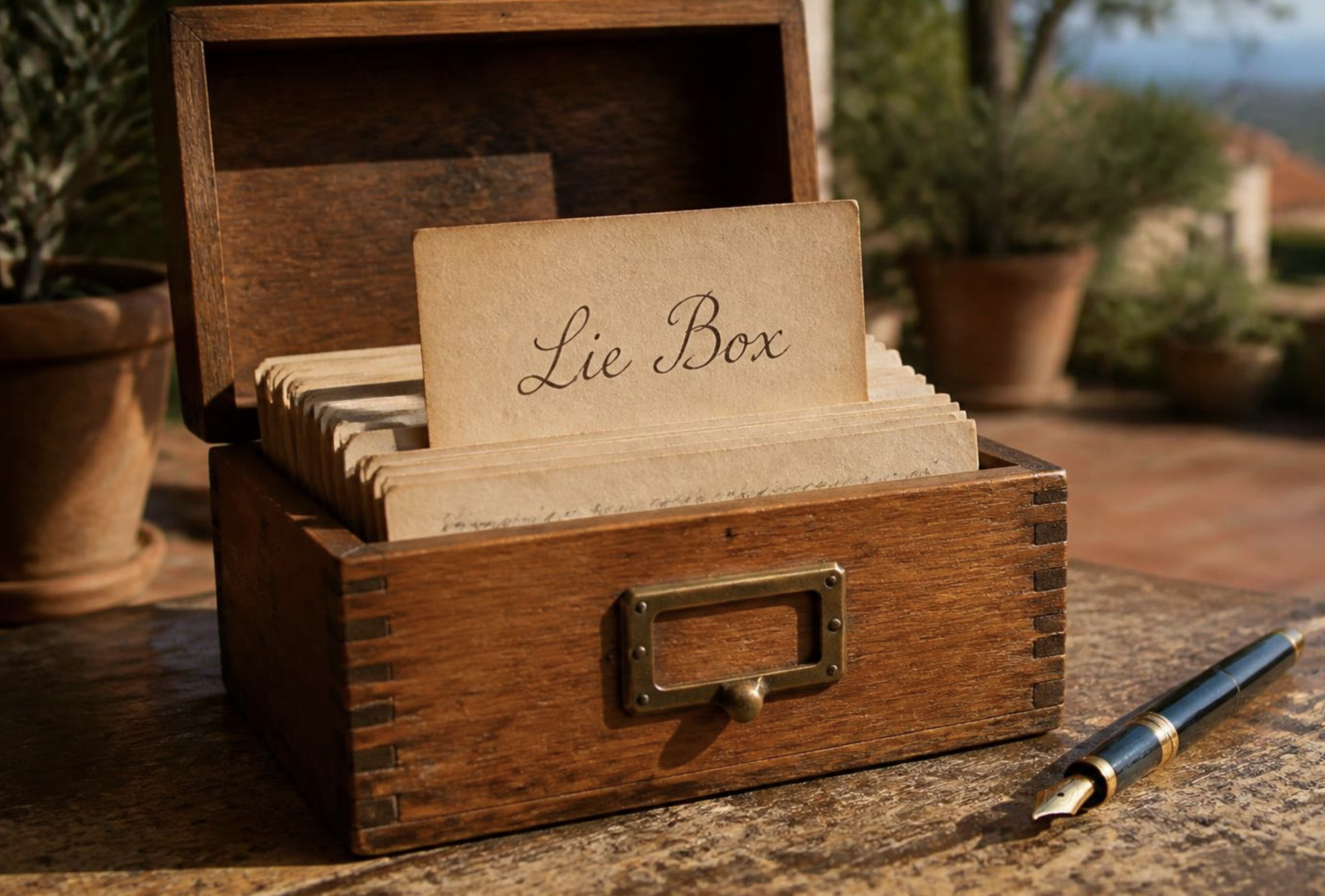
Her biographer Deirdre Bair tells us Nin kept what she called a “lie box,” a set of index cards recording which story she had told to which husband. On her flights across the country, she studied them.
The most honest writer of desire in the twentieth century needed a filing system for her deceptions.
That image haunts me, for a different reason. I never kept a lie box. I was handed one at birth, already full, and spent decades believing every card in it.
Why We Lie
So why can’t we just be honest? I think there are at least four reasons, and each deserves respect.
Shame, installed early. Most of us learned that desire was dirty before we could spell the word. You can’t admit what you’ve been trained to believe makes you filthy.
The cost is real. People lie because the punishment for honesty is real. Jobs, marriages, churches, families. Pretending otherwise is naïve.
Some silence is love. There are people in our lives whose privacy deserves protection, and some stories belong partly to them.
The deepest fear. If I show you all of me and you leave, there’s nowhere left to hide. Every lie is a small insurance policy against that.
What Europe Is Teaching Me
Barcelona didn’t hand me a new set of morals. It handed me room.
Here, people sunbathe topless, or nude, on the city’s beaches, and nobody looks twice. Couples kiss on park benches like the world is theirs. Nude bodies fill the museums, and nobody hangs a fig leaf on them. At dinner, a friend asks whether my fantasy has come true, waits for the answer, and then tells me his. Nobody lowers their voice. Nobody leaves the table.
In America, I always felt judged. It turns out that’s measurable. When the Pew Research Center asked adults in 25 countries about the morals of their fellow citizens, the United States was the only one where more people called their neighbors’ morality bad than good.
That’s the difference I feel every day. Europeans aren’t necessarily more truthful than Americans. They’re less busy judging each other. And when the judgment shrinks, so does the need to lie.
And yet the old training runs deep. In my last post I told you about a terrace conversation on circumcision with friends from Lebanon, Croatia, and China, and how I’ve always wanted to ask my mother why I wasn’t circumcised, and my brother Terry was.
I still haven’t asked her. That’s no lie. Call it modesty, or love, or the shame of an ultra-conservative boyhood. The man who can discuss masturbation with friends from three countries still blushes at the thought of asking his own mother a question about his birth.
So yes, it’s freeing. It isn’t finished.
Honesty and Full Disclosure
Let me be honest about my own honesty, since a sharp reader will wonder.
I keep some things private. There are people I love and protect, and stories in my life that aren’t mine alone to tell. Is that hypocrisy?
I don’t think so, and here’s the distinction that matters most to me: honesty and full disclosure are different things.
Honesty means refusing to deceive. Yourself first, and then the people inside your relationships. Disclosure is a separate choice about who else needs to know.
You can tell the world nothing and still live a fully honest life. You can also tell the world everything, the way Nin did in her diaries, and lie to the people at home.
Beecher preached love to thousands and deceived his friend. Nin confessed everything on the page and kept a box of lies. They had it backwards. The people closest to you deserve the whole truth. The public deserves only what you choose to give it.
What I put on this page is a choice. What I owe the people I love is the truth.
Your Turn
Ray, you said I write the things we all think about but are afraid to say. Maybe the first step is smaller than writing. Maybe it’s one honest sentence, spoken to one person.
So here’s my question for you, and for everyone reading: Who is the one person you’ve never been fully honest with? And what do you fear would happen if you were?
Here’s the truth: I’m still gathering the courage to go call my mother and ask about my foreskin.
Leave a Reply