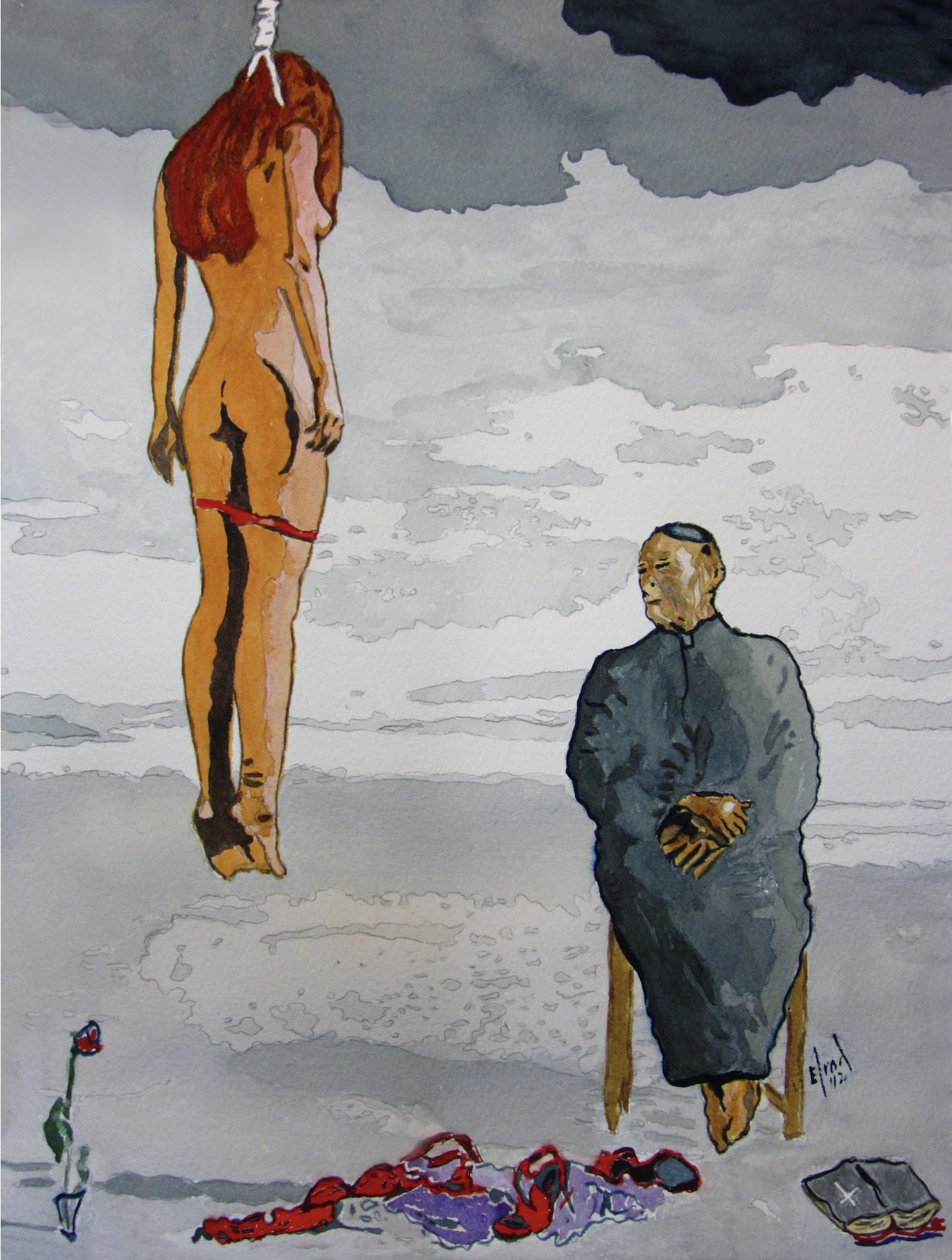
The news reached my Barcelona terrace on Wednesday, the way bad news always finds you when the coffee is good, and the humidity is low, and you have, for one blissful morning, forgotten the country you came from.
The Southern Baptist Convention met in Orlando this past week. More than ten thousand (led and dominated by men) messengers packed into a cavernous hall. On June 9, they elected a Florida pastor named Willy Rice, a man their own hard right recruited to drag the denomination further from daylight. On June 10, they advanced what Albert Mohler christened the “Truth and Unity Amendment”—a measure to bar women from the office of pastor and, going further than any version before, from preaching to a gathered congregation at all. The vote was 6,028 to 2,026. Three to one.
These are the same men—more than eighty percent of white evangelicals, across three straight elections—who handed the American presidency to a man a civil jury found liable for sexually abusing a woman.
Read that sequence twice. A woman with a Bible and something true to say: forbidden. A man found liable in open court for forcing himself on a woman: anointed.
I gave this institution thirty years of my life. I know exactly what I’m looking at.
It is fear. Strip away the proof-texts and the parliamentary procedure and the syrupy Southern baritones, and what remains is a frightened animal guarding a door.
This week, in The Atlantic, Peter Wehner, an evangelical who has spent his whole life inside this world, named the same thing I felt on my terrace. For half a century, he argued, evangelical engagement with the world has been driven by fear: fear of losing cultural and political power, and with it a whole way of life. That fear hardens into a siege. It breeds suspicion of outsiders, empowers theological enforcers, and draws the doctrinal lines ever narrower and meaner. I lived inside that siege for three decades. I can tell you he is right. Anything other than a heterosexual white male is dangerous.
I Was Inside the Machine
I earned the right to say all this.
I was a golden boy of the conservative resurgence before I knew enough to be ashamed of it. In 1982, I sang in a four-hundred-voice choir at First Baptist Dallas, in W. A. Criswell’s “School of the Prophets,” where the right-wing men of the movement gathered to plan their war on the moderates. That pulpit belongs now to Robert Jeffress, Donald Trump’s most fawning defender, the man who said he wanted “the meanest, toughest SOB I can find to protect this nation.” I stood in that choir loft as an awestruck country boy. I did not yet understand what I was looking at.
I was bear-hugged in front of thousands by Bailey Smith, president of fourteen million Southern Baptists, the man who once told a political rally that God Almighty does not hear the prayer of a Jew. I sat at country-club tables with the men who ran the denomination like a small business.
And the pastor I served as worship leader did more than admire the resurgence. Rick White, of The People’s Church in Franklin, Tennessee, sat on the search committee in early 1993 that unanimously handed the presidency of Southern Seminary to a thirty-three-year-old Baptist journalist named Albert Mohler. White became the first chairman of Mohler’s board of trustees, and the only chairman to serve three terms. He was proud of it. His thrill at making the resurgence happen was something you could taste in the room.
Here is the irony I have carried for two decades.
The same denomination that celebrated Rick White’s seminary work turned on his pulpit. He began to embrace contemporary worship—a new sound, a new style—and I was the one helping usher it into the SBC. The national Baptist newspaper blasted our “worship wars.” They wrote me up. They castigated me. Over a thousand people left, the LifeWay (an educational and publishing arm of the Southern Baptists) power brokers prayed for our transition to fail, and my pastor, the golden boy once groomed for denominational president, watched his standing collapse. He fell into a clinical depression so deep that on some Sundays we showed a video of his first sermon because he could not preach a second time.
The machine eats its own. And this week, the young theologian Rick White’s board installed in 1993 stood at a microphone in Orlando and built the walls a little higher—this time around the women.
I watched it from across an ocean and felt the old nausea and trauma return.
The Ego of the Male Conservative
I realize it is impolite to say what I am about to say. I have never been good at impolite restraint.
These men are compensating.
Watch the iconography. The monster truck jacked so high you need a stepladder to reach the cab. The long rifle held across the chest in the Christmas card. The flag the size of a parking lot. The voice that gets louder, never wiser. Every prop is a billboard advertising a fear its owner would die before naming.
Compensation: the inferiority we cannot admit gets buried under a big performance of superiority. Men who feel diminished, who feel the ground shifting under their status, reach for control. It is the famous “Napoleon complex.” Little men (in body, body parts, and soul) hunt for a bully pulpit.
Vast stretches of the current evangelical world abandoned the carpenter of Nazareth and his Beatitudes for a rugged warrior-protector. They rebranded male dominance as “biblical headship,” the man as warrior and the woman as helpmeet, and sneered at any “feminized” faith that asked a man to be gentle or, god forbid, equal. John Eldredge sold millions of copies of a book telling men that God wired them for a battle to fight and a beauty to rescue. A beauty to rescue. The woman is window dressing, a trophy in the man’s adventure. She does not get to be the hero. She does not get to preach.
Here is what unhinges them. A woman who does not need them.
A woman who can run a company. A woman who can preach a better sermon. A woman who can think past them, see through them, out-argue them at the dinner table. And—God help us all—a woman who can bring herself to sexual pleasure without their permission, their participation, or their applause.
That last one is the wound underneath all the others. Her vote and her pulpit frighten them. Her completeness terrifies them. A whole woman does not require them. A whole woman is a mirror, and they cannot stand the neutered man they see in it.
I wrote about this years ago, in Sex, Lies & Religion, and I’ll stand by every word:
Religious objectification is a consequence of the need for alpha male leadership to demonize and marginalize women to solidify the controlling power of the religious hierarchy. The preachers and other religious heads got together and said, “Let’s eliminate the competition—read: women—by convincing everyone that women are inferior, subservient, and useful only for beauty, labor, and reproduction.”
Southern Baptist men did not amend the Baptist Faith and Message to honor God. They wrote it to eliminate the competition.
The Androcentric Model of Sexuality
There is a name for the engine that drives all of this, and it predates the SBC by centuries. Rachel Maines named it in The Technology of Orgasm: the androcentric model of sexuality.
The idea is brutal in its simplicity. For most of Western history, sex has been defined entirely around the male body and the male climax. Penetration is the event. Male orgasm is the point. Everything else—the clitoris, the slow build, a woman’s own private map of her own private pleasure—gets filed under unnecessary or, worse, disorder.
Maines tracked what happened to women whose bodies refused that script. They were diagnosed with “hysteria,” a word built from the Greek for womb, a catch-all pathology for any woman whose desires would not resolve neatly through a man. (Her book is thin on footnotes, and later historians have argued with her specifics—but the core idea, the androcentric standard itself, is bulletproof and worth the read.)
The Road to Wellville—T. C. Boyle’s novel and the film it spawned—dramatized exactly this era: John Harvey Kellogg’s sanitarium, the medical management of the body, the doctor as the gatekeeper of every sensation a female body might dare to feel.
And when management was not enough, there was the knife.
In 1860s London, the surgeon Isaac Baker Brown performed clitoridectomies—he cut the clitoris out of women—to “cure” them of masturbation and the restlessness it supposedly caused. The procedure crossed the Atlantic and lingered in American medicine into the twentieth century. And a broader practice of mutilating women persists across parts of Africa and the Middle East to this day. Let the meaning land. Men were so threatened by the existence of a pleasure they did not control that they mutilated it. Female pleasure had to arrive by way of the sexual weapon of choice, the male penis, or it would not be permitted to exist at all.
That is the androcentric model with its mask off. The same logic that cut women in 1866 writes amendments in 2026. The instrument changes. The fear is identical.
The Oldest Version of the Fear
I want to name the darkest chapter of this, because it belongs here, and because the men who fear women have always feared other things in the same breath.
In the Jim Crow South, white men lynched Black men for the crime of merely looking at a white woman. The mythology beneath the murder was sexual—the lie that Black men were monstrously endowed, a standing threat to the females the white man believed he owned. The lynchings so often ended in castration. They cut away the manhood that made them feel inferior and small.
Sit with that. The terror was never really about the woman; she was property in the equation. The terror was about a man’s own inadequacy, his own fragile sense of size and worth and standing, vomited outward and washed in blood.
The same insecurity that mutilated a body in Mississippi writes the bylaws in Orlando. It is a continuum. It always was. The fear of a woman’s autonomy and the fear of another man’s body are the same fear wearing different clothes: the terror of not being enough, of not being boss, dressed up as the defense of God and country.
What They Are Actually Afraid Of
So let me address my own title.
Conservative men fear powerful and sensual women because they are strong, and whole, and unowned, and increasingly unwilling to pretend otherwise.
They fear her intellect, which embarrasses theirs.
They fear her beauty, which they can neither purchase nor command.
They fear her pleasure, which proves she was never as dependent on them as their entire theology required her to be.
And so they legislate. They make laws about what she may do with her own body, her own voice, her own pulpit. They call it biblical authority. I served their God for thirty years, and I can tell you plainly: it is not biblical authority. It is small men who are afraid, reaching for a gavel.
I wrote this once, watching the shaming pour across my feed after two Latina women dared to enjoy their own bodies on a Super Bowl stage, and it is the truest sentence I know on the subject:
Religion has taught us to hate our bodies. So we angrily shame ourselves and others when we happen to revel in our sexuality.
The men in Orlando hate their own bodies and body parts. That is the secret underneath the spectacle. They were taught to hate and shame, same as I was. The difference is that some of us climbed out of the pit, and some, like Al Mohler and his ilk, stayed down there and started handing out shovels, and knives, and guns.
A Different Kind of Man
I am sixty-eight years old. I write this from a terrace where Gina and I take our coffee slow and our conversation slower, where her female mind is the most exciting and intelligent thing in the room, where her pleasure, with me or without me, is a gift and never a threat, where no one has reached for a tool of destruction in years.
The body was never the emergency. The walls were. Sound familiar?
The men of the Southern Baptist Convention spent this week setting another course of brick on their wall, and they will tell you it was about truth and about unity and about the unchanging Word of God. I knew those men. I sang in their choirs and sat at their tables and helped install their “kings.” And I will tell you what it is really about.
It is about a frightened white male animal guarding a door, a bed, a pulpit, terrified of the women on the other side, the ones who long ago stopped knocking, and faking, and acquiescing, and simply began to live and orgasm and preach in freedom.


Leave a Reply