
Non Omnis Moriar
We have been doing it for as long as we have been burying our own. The pretending varies by culture, by century, by temperament: séances and vampires and cryonic vats and AI ghost-apps and the religious doctrine of resurrection. But the verb is constant. We refuse to let our dead be dead.
What I had not done until recently was look at the practices side by side, as a single human denial expressed in different forms of magical thinking. Standing at Montjuïc Cemetery in Barcelona, the stories began to organize themselves. What follows are six versions of the same denial. What is yours?
Talking to the Dead
In my reading, I had encountered Aleister Crowley early, and through him, the whole belief system of séances, automatic writing, magical orders, and the Western occult revival of the late nineteenth century. I was dismissive. Crowley struck me as a self-mythologizing crank, his disciples suspect, and the spiritualist project a Victorian parlor game that should have stayed at the table.
Then I read Carl Jung. I have studied almost all of his works over the years. What I found was that Jung, the most rigorous psychological mind of the twentieth century, the one I had been using as my teacher, had taken spiritualism seriously his entire life. His doctoral dissertation, in 1902, was on the psychology of mediumship. He attended séances as a young man. He spent the last thirty years of his career studying alchemy. After his near-death experience in 1944, he wrote openly about the survival of consciousness. The man I had trusted with my own exploration had made his descent through material I had been waving away. That did not prove Crowley right. It proved I had been incurious.
The actual practice, humans trying to talk to the dead, has been a continuous Western project for nearly two hundred years. The modern movement began in 1848 in upstate New York with two teenage sisters, Maggie and Kate Fox, who claimed to communicate with a spirit through coded knocks on the wall. Within five years, séances were a parlor staple from New York to London. Madame Blavatsky founded the Theosophical Society in 1875. The Hermetic Order of the Golden Dawn followed in 1888, Crowley joined it in 1898, and so did W. B. Yeats. Yeats’s wife Georgie Hyde-Lees produced thousands of pages of automatic writing that Yeats eventually published as A Vision.
Sir Arthur Conan Doyle, the man who invented modern detective fiction, became spiritualism’s most public evangelist after losing his son and brother in World War I. Harry Houdini spent the last decade of his life debunking mediums, often the same ones his friend Conan Doyle defended. Both world wars produced massive spiritualist revivals; grief and séance attendance rose together every time. The pattern has not broken. It has only changed forms.
Having Sex with the Dead
My wife, Gina, loves Twilight. She is one of millions who refuse to let the vampire die. And Gina is not alone. I should admit I have my own films in this genre, Francis Ford Coppola’s Dracula, Embrace of the Vampire with Alyssa Milano (a guilty pleasure), The Hunger with Bowie, Deneuve and Sarandon, and the disturbingly erotic Blood for Dracula with Udo Kier. The vampire-as-erotic-figure is not abstract to me. I have spent evenings of fantasy inside it. I loved The Historian by Elizabeth Kostova. From Stoker to Anne Rice to Stephenie Meyer, the lineage runs straight through human imagination and shows no sign of stopping. The vampire is what happens when eros refuses thanatos, when the body keeps its hunger past the point where biology rules it out.
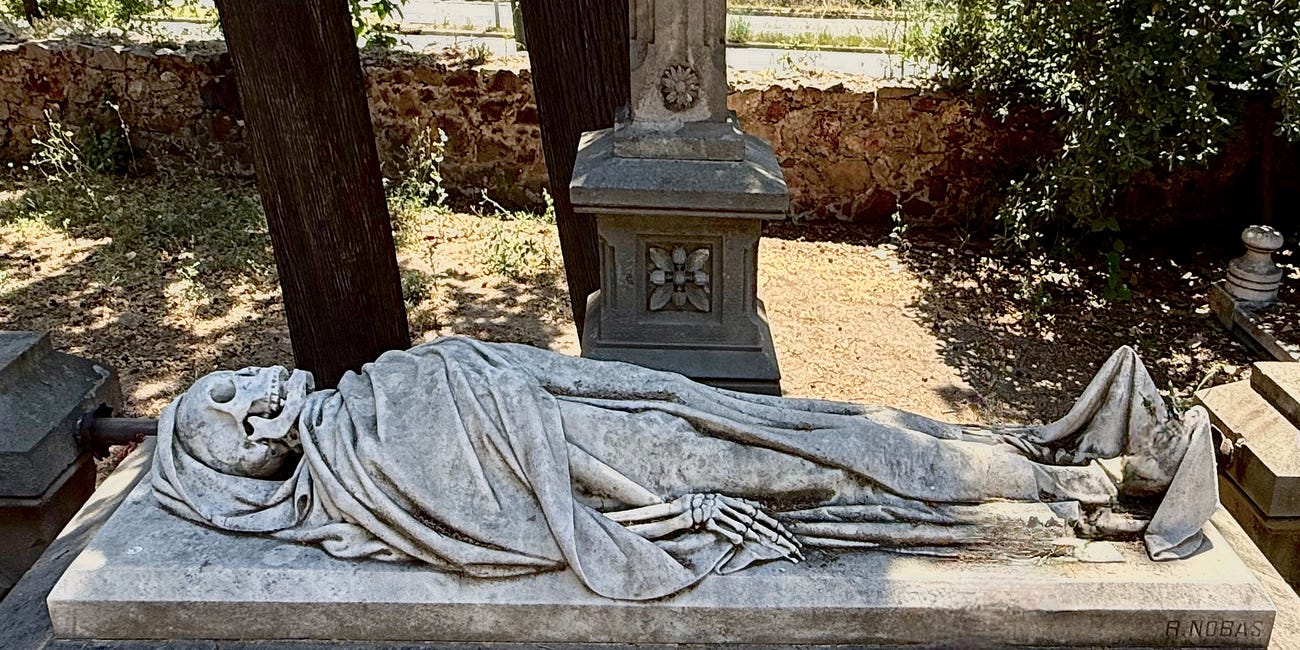
It is the same proposition the marble widows and the statuary at Montjuïc Cemetery flirt with, only made literal: beauty and sensuality that refuse to decompose. The Catalan modernistas understood the proposition without flinching. The widow draped across her sarcophagus, the nude laborer mid-strike with his pickaxe, the shroud clinging to the skeleton’s hipbones, all of these are erotic, and the patrons who paid for them knew it.
Necrophilia, the literal collapse of that boundary, is what Jung would call shadow at its rawest: eros drawn toward its own end, the body desired at the moment of its return to dust. Herodotus records that when an Egyptian woman of rank or unusual beauty died, the family kept her body for three or four days before handing her to the embalmers, to ensure she had begun to decompose. At least one embalmer had been caught violating a corpse. The earliest professional code for handling the dead is a code against necrophilia. The taboo has been collapsing for twenty-five hundred years.
The modernista mausoleums above me on that hillside are doing in marble what Stoker and Rice and Meyer have been doing in prose. They attempt to keep the body beautiful past where biology says stop. They refuse to let the corpse become only a corpse. The gothic novel was born somewhere near this argument. So was the vampire.
Eternity with the Dead
I know this myth from experience. I spent almost two decades as a minister, conducting funerals, sitting with the dying, believing the doctrine that the person in the casket was not the person; they had gone on to something better; this was the dust that remained. I believed it once. I do not anymore. But the story’s elegance is hard to deny.
Heaven, paradise, resurrection, reincarnation, ancestor veneration, the Bardo, the Elysian Fields. Every major civilization has produced a theology that says, in some idiom, the dead are not actually dead; they have just moved. Roughly four in five Americans still believe in heaven. Globally, the number is higher. Religion is the most sophisticated and durable mythology humans have built for the pretense at hand. The séance, the vampire, and the cryonic vat all came later. The doctrine of heaven has been doing this work for at least three thousand years.
Eternal Life is the mythology I walked away from. And I cannot pretend the others are foreign to me. They are not. They are the same, pretending to be dressed differently. I left the church and walked straight into the cemetery. Or did I?
Grieving the Dead Forever
Grief is the refusal that has no name and needs no doctrine. It is the one we all do. A mother who keeps her son’s room exactly as he left it for forty years. A widow who lays a place at the dinner table for the empty chair. A father who cannot speak his daughter’s name without his voice breaking, twenty years on. The bereaved who never quite consent to the was of someone they cannot stop saying is about.
Victorian England turned this into a national aesthetic. Two years of formal widow’s mourning, the first year in deep black crepe, the second easing into grays and lavenders. Jet jewelry. Hair lockets. Mourning stationery edged in black. Post-mortem photography. Lockstep social rituals for keeping the dead present in the household. Queen Victoria wore black for the remaining forty years of her life after Albert. Miss Havisham in Great Expectations, technically jilted rather than widowed, but frozen in the same pretense to let lost time become past time. She is the satirical extreme, and the underlying instinct is one we all recognize.
As a minister, I sat with families locked in this refusal. I watched it tear those families apart. Grief unprocessed becomes contagious, becomes shame, becomes rage, becomes a thousand small cruelties between people who used to love each other. Death does not always bring out the best in us. It often does the opposite. That is its own essay, for another day.
Freezing the Dead
The most expensive denial is the cryonic one. Roughly five hundred people now lie in liquid nitrogen at minus 196 degrees Celsius at the Alcor Life Extension Foundation in Arizona and the Cryonics Institute in Michigan, waiting for a future medical science that will defrost them, repair them, and resurrect them. Whole-body preservation runs about $200,000. Head-only preservation — on the theory that the brain is what matters and a future body can be grown around it — runs about $80,000. The waiting list is mostly male, mostly American, mostly wealthy, and mostly Silicon Valley.
Ray Kurzweil, seventy-seven, still works at Google and gives interviews. He takes about eighty supplements a day and intends to merge his consciousness with AI by 2045, when he predicts the Singularity will arrive. Peter Thiel has funded life-extension research for years. The transhumanist movement has billions behind the proposition that death is a technical problem with a technical solution.
It is the séance with better engineering.
Recreating the Dead
The newest denial is the digital one. A startup called HereAfter AI records interviews with you while you are alive and turns them into a chatbot your survivors can talk to after you die. Replika’s death-mode features let users keep conversing with the AI persona of a lost spouse or parent. Kim Kardashian received a hologram of her dead father, Robert, as a fortieth birthday present in 2020 — he smiled and told her he was proud. Tupac performed at Coachella in 2012, sixteen years after his murder. ABBA has been touring since 2022 as four digital avatars of their younger selves. The voice-cloning industry will, within a few years, make it routine to commission a new performance from a singer who has been dead for decades.
Every séance medium in nineteenth-century London promised to put the bereaved in touch with the dead. The Silicon Valley founders building these services are making the same promise, with a cleaner UX. It is the oldest denial in the newest dialect.
Six dialects, one denial. The vampire novelist, the Victorian widow, the heaven-believer, the embalmer, the cryonicist, the HereAfter AI engineer — they are all doing the same thing. Humans walking around pretending the dead are not dead.
I was dismissive of all of it for most of my life. Standing in Montjuïc, looking at half a million marble refusals to let the bodies on this hillside become the dust they have already become, I am no longer sure I have the standing to dismiss anyone. I have spent my whole life walking around pretending I am not going to die. Why should I be surprised that my fellow humans walk around pretending their dead relatives are not dead?
It is the same lie, told from the opposite end of the grave.
If you enjoyed this, read Part One of this post HERE:
I Walk Around Pretending I Am Not Going to Die
·
MAY 25
¡Una versión en español está disponible AQUÍ!
I Walk Around Pretending I Am Not Going to Die
Leave a Reply