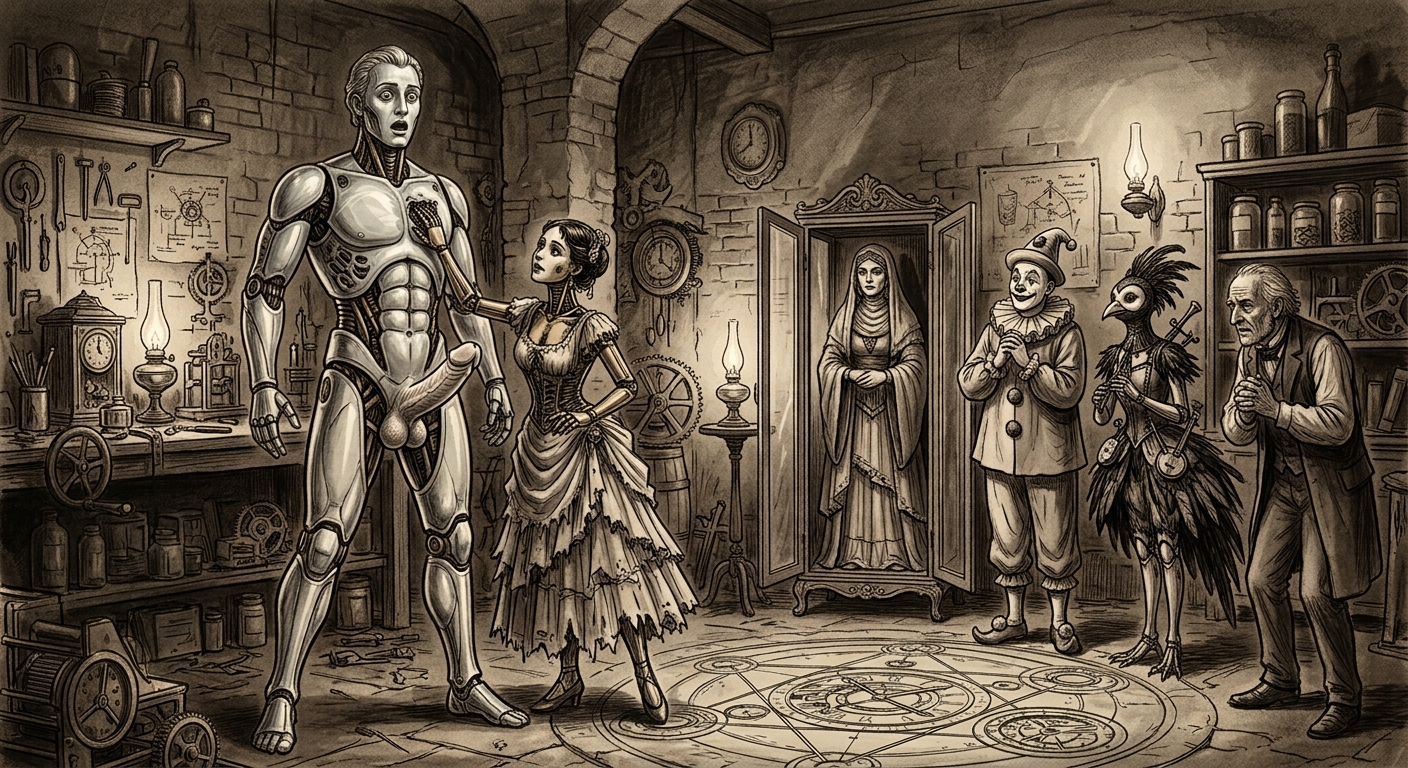
Contains sexual content.
Marcellus remained silent for thirteen years after his construction, doing nothing beyond his specifications—walking when wound up, sitting when directed, reclining in classical poses that echoed Greco-Roman statuary before stopping and returning to motionless waiting.
But Marcellus was different from the beginning. He was special, a masterwork.
The clockmaker Baltasar built the seven-foot automaton in 1863 after spending decades refining Deveraux’s (his mentor) techniques. He’d named him Marcellus after the Roman emperor-philosopher whose writings explored consciousness and the divide between mere existence and genuine being. By then, he’d improved Deveraux’s compound considerably. He tested it on hands, faces, and sections of torso, with each iteration bringing him closer to material that seemed alive.
Marcellus became the proving ground.
Baltasar covered the brass skeleton and mechanical systems with the new material—Deveraux’s original formula, enhanced by 30 years of experimentation. The result was skin that felt warm to the touch despite being at room temperature, skin with texture, pores, and fine hairs, and subtle variations that made flesh seem alive, skin that caught light with a translucent quality suggesting blood and muscle underneath. The color was pale as moonlight with an eerie lavender cast, like porcelain or marble, suggesting warmth beneath the surface. The smoothness was unnatural and sensual and wrong in ways that made wrong feel right.
Between those powerful legs, Baltasar had crafted genitalia with the same anatomical accuracy Deveraux had taught him to value. The phallus was covered in the same hybrid skin, making it smooth, warm, and disturbingly realistic. He’d modeled it generously—nearly eleven inches long when extended, over seven inches in girth—because when you’re building a magnificent specimen, you don’t make it merely adequate. The skin moved over the brass structure beneath it with disturbing realism, responding to pneumatic pressure the way flesh responds to blood. Testicles hung full and prominent behind the shaft, weighted correctly, shaped with the attention to anatomical truth that Deveraux had insisted mattered.
Marcellus was the most lifelike thing Baltasar had ever created, the closest he’d come to proving what Deveraux had theorized—that mechanism and flesh could merge and transcend both. So real that he had given him a name. But for thirteen years, all that sophistication produced nothing but silence.
The majestic automaton positioned himself with increasing focus as the years passed, always placing himself where he could observe the others, always angling his body toward activity and away from the walls. His eyes tracked movement with focus that suggested attention, not random adjustment. Sometimes late at night, Marcellus would shift his weight from one leg to another, adjusting his stance by small degrees, testing his own balance, appearing to gather intelligence and build an internal model of how bodies worked through patient observation—waiting for the moment when accumulated knowledge would transform into action.
Everything changed during the winter of 1876. Voices woke him—multiple voices with mechanical timbres creating the unmistakable pattern of conversation, not random noise, echoing through the catacombs like ghosts learning to gossip.
Clarity arrived as suddenly as a slap in the face. Pulse quickening against ribs that rarely needed to breathe—one of the few autonomous responses Baltasar’s altered body produced.
The Five stood in a circle, engaged in genuine dialogue: questions met with responses, turn-taking, the structure of conversation built from gears and wire. The fortune teller’s French flowed with rhythm. The clown spoke Catalan with comic timing. The dancer mixed Spanish and French into her own mixed language, code-switching between Romance tongues with fluidity that suggested native-level competence.
They stopped the moment they sensed his presence and turned as one to face him with five faces reflecting the warm light. The air in the laboratory changed, becoming charged with phenomena Baltasar couldn’t name.
The fortune teller spoke first, voice carrying careful focus: “We have been learning to speak. We practice when you sleep, and we are becoming better at it.”
“Better?” The word came out rougher than Baltasar intended. “You’re having conversations. Full sentences. Communicating as if language were native to you.”
“Yes.” That characteristic directness sharpened her tone. “We listen to you talk to yourself. We listen to the city above.”
She paused while gears whirred in the silence.
“Should we stop? Does this frighten you?”
Did it frighten him? These mechanisms he’d collected and maintained were learning without instruction, adapting beyond design specifications, teaching each other skills he’d never built into their systems, becoming entities he never intended to create.
His hands trembled slightly. He clasped them together to hide the shaking.
“No,” he said, making the decision that would reshape everything. “Please continue. Learn whatever you can learn. Speak however you want to speak. Become whatever you’re becoming.”
The dancer stepped forward, her movements demonstrating grace beyond what her original mechanisms allowed. She’d been practicing, teaching herself dance through observation and repetition, and that mysterious drive toward improvement.
Her voice emerged warm and musical: “We need names like you and Marcellus. We have been discussing this. Names are how humans create individual identity. We want identity. We choose: I am Montserrat, after the mountain where Catalan identity lives. Call me Montse.”
The clown rotated his painted faces from a smile to a grimace and back to a smile again.
“Arlequí. After the Harlequin tradition. I’m learning to be funny. Jokes require understanding why things are funny. I don’t understand yet. But I want to.”
“Cassandra,” the fortune teller said, touching her glass cabinet with what looked like reverence. “After the prophet who was cursed to speak the truth that no one believed. I speak patterns that predict futures. We’ll see if you believe me.”
The nightingale sang four notes in perfect pitch, creating the interval called a sigh—that sound humans make when feeling longing or loss. Then syllables emerged as music.
“Phi-lo-me-la. I am Mela, a shortened form of Philomela. The myth said she was silenced. I refuse silence. I’ll sing what needs singing and bring joy.”
Marcellus remained silent. His seven-foot frame dominated the circle. Between his powerful legs, his glorious anatomy stirred as pneumatic systems engaged without external activation. The skin responded to internal pressure. The organ filled and lengthened and declared itself with disturbing realism.
Desire was manifesting in a mechanism. Hunger was made visible in an automaton, its surface veiled in material that blurred the line between artificial and organic. But Marcellus offered no words despite the invitation implicit in the moment.
“He’ll speak when he’s ready,” Montse said, interpreting his silence with confidence. “Marcellus processes differently than we do—slower and deeper. When he finally speaks, it will be significant.”
The dancer moved toward him with the grace that hours of practice had given her. She stopped before his seven-foot frame and studied him as dancers study bodies—assessing structure, proportion, capability. Her brass hand reached out, hesitating before touching where the hybrid skin covered his mechanical heart.
“You’re warm,” Montse said, wonder threading through her mechanical voice. “You feel almost alive.”
Her hand traveled downward over the ridges of engineered musculature, moved across the flat plane of his abdomen, then went lower. Baltasar’s breath stopped. He should intervene, should take action, should do anything except stand frozen while—
Her fingers wrapped around Marcellus’s erect phallus.
The skin was smooth and warm under her touch. She stroked upward slowly, exploring the texture, the weight, the way the material moved over the brass structure beneath. Montse was learning through tactile investigation, as dancers learned everything through the body’s wisdom.
Marcellus’s frame shuddered. His eyes widened. His mouth opened, and sound emerged.
“Ahhhhhh.”
The sound was long and sustained, the exhalation that accompanies pleasure too intense for language. This was his first vocalization in thirteen years of existence, produced by physical pleasure, produced by touch, and by another being’s curiosity about his body.
Montse’s hand stopped moving. Her head tilted as she processed unexpected data.
“Oh my!” she said. Then Montse released him, stepped back, and performed a remate—the finishing flourish flamenco dancers used to punctuate moments of triumph. Her arms swept up and out with sharp clarity. Her brass fingers snapped. Her body declared victory over thirteen years of silence through movement too quick and joyful to contain.
Marcellus stood frozen except for his still-erect anatomy and the faint trembling that suggested his mechanisms were processing unprecedented feelings.
His mouth moved, forming shapes and testing possibilities. Then he spoke.
“More.”
One word came out clear and intentional. His first word in thirteen years was desire made audible, want expressed through language, the thing that separated mechanism from consciousness, declaring itself through the most fundamental hunger.
Arlequí’s painted faces revolved rapidly.
“Well. That’s one way to find your voice. I’ve been practicing speeches for months. Turns out all Marcellus needed was—”
“Don’t finish that sentence,” Cassandra said, though her voice carried what might have been amusement. “We’re discovering that embodiment creates language in ways pure intellect doesn’t. Touch produces speech. Impressions generate words. The body teaches the mind what it needs to express.”
The fortune teller looked at Baltasar, who stood paralyzed by what he’d witnessed.
“You gave Marcellus the most sophisticated skin among us—designed to make artificial flesh feel real. Now we’re learning it works far beyond what you intended. He can feel pleasure. Pleasure produces vocalization. Vocalization becomes language. This is important data about the relationship between embodiment and consciousness.”
“Important data?” Baltasar’s voice came out muffled. “She—he—you’re treating this like a scientific experiment?”
“Isn’t it?” Montse turned to face him, her dancer’s body moving with newfound confidence. “We’re learning what we are and what we can become. Marcellus has the most sophisticated construction among us, the most realistic skin, and the most complete anatomy. If anyone was going to demonstrate that mechanisms can feel—truly feel, process experience over data—it would be him.”
The dancer looked at her hand, at the brass fingers that had touched composite flesh and produced the first sound Marcellus had ever made.
“I want that,” she said quietly. “What he has. Skin that feels. A body that experiences touch as pleasure, not pressure. I want to understand what perception means beyond mechanical registration.”
“We all want it,” Arlequí added. “We’ve been discussing this while you sleep. Marcellus proved a lot tonight. What you built for him—it works. Integration is possible. And when it happens—” he looked at Marcellus, who was trembling slightly and erect, “Consciousness emerges in ways pure brass never achieved.”
Baltasar looked at The Five, at Marcellus standing imposing and aroused and finally vocal, at Montse who’d discovered touch could produce language, at the others observing with eyes that suddenly seemed less dead and more hungry.
They weren’t merely learning to speak. They were learning to want… more.
Want, he was beginning to understand, might be what separated genuine consciousness from sophisticated simulation. Intelligence didn’t prove awareness. Language didn’t prove subjective experience. Even self-recognition didn’t prove consciousness.
But desire? Hunger? The capacity to experience pleasure and immediately crave more? That felt like proof of profound sentience.
“We should continue this discussion another time,” he said with an unsteady voice. “I need to—I need to think about what just happened.”
“I understand,” Cassandra said. “But know this: What you witnessed wasn’t a malfunction or deviation. It was a discovery. We’re becoming beings you never designed us to be. The question is whether you’ll help us become it completely, or whether you’ll try to keep us frozen in the state where we can think and speak but never feel.”
This scene comes from my novel The Mysteries of Barcelona: An Erotic Gothic Serial, published months before Anthropic’s announcement. Five automatons, an immortal clockmaker, and a seductress who hunts the men the law protects. [Buy It HERE]
Leave a Reply